





Block · kaisho 楷書 · VB5J
Block or kaisho (楷書) styles are the most common and recognizable styles. Block styles are easily read and are noted for their angular form and their vertical and horizontal lines.
吾唯足知
ware tada taru o shiru
I Know Only That I Have Enough
I know only that I have enough, a riddle in four characters that can share one square hole.
Master Takase creates this beautiful scroll when your order is placed, personally preparing the ink and brushing your art, which proudly bears her signature and seal. This is an original work of art.
Description
吾唯足知 (ware tada taru o shiru): I know only that I have enough.
In the phrase, 吾 is I, 唯 is only, 知 is to know, and 足 is not foot but taru, to be enough. Inside the four is the old word 知足, knowing what is enough, here said of oneself. The 日本国語大辞典 defines 知足 as being content and at ease with one's own share, and not grasping for more.
Each of the four characters holds a 口, and the riddle lets a coin's square hole serve as the 口 of all four. Set 五 above the hole, 隹 to its right, 止 below and 矢 to its left. Read clockwise from the top, the four give 吾唯足知. Written in the order of the sentence, they are 吾唯知足, the order the texts beside the drawings give more often.
In the Edo period the riddle served two opposite uses: a jab at thrift imposed from above, and a discipline for oneself. A lampoon on the shogun's thrift is reported to have drawn a coin with the riddle on one face and 吝, stingy, on the other.
In a picture book for adults of 1790, drawn by Utamaro, Santō Kyōden's old Kamakura pushes thrift until nothing is left idle. The official Aoto judges the zeal folly and shows the people a one-mon coin, the character 口 taken to be the hole of the coin and used in four characters, so that even that is not wasted. All the people of Kamakura come to a just-right measure of mind.
Kanzawa Tokō, a former officer of the Kyoto magistrate's office, drew the riddle as his own crest in his miscellany 翁草. He wrote of the crest, I wear this crest to keep my heart in check. He called it, with a line he bowed to as to the Buddhist altar, his tools for mastering himself.
Two reports made after the death of Tokugawa Nariaki, lord of Mito, give the riddle as his seal legend. The poet Kawahigashi Hekigotō, in his travel journal printed in 1910, saw a coin-shaped cedar carving in Hakodate said to copy Nariaki's stone seal.
Library catalogues record the riddle on owners' seals stamped in books printed in the Edo period. In the nineteenth century it was a stock legend for such seals.
In February 1936, at a Ministry of Education evening course for workers in Kawaguchi, a student heard a talk on 吾唯足知. He wrote that he went home, wrote the words on two sheets of hanshi and pasted them on the wall. He savors their meaning, he added, day after day.
The riddle's famous home today is the stone water basin at Ryōan-ji in Kyoto, whose four characters share the 口 at its center. The temple's site said in 2002 that the basin is said to have been given by Lord Tokugawa Mitsukuni of Mito.
In a letter of 1951 to Isamu Noguchi, the painter Hasegawa Saburō gave the words as ware wa tada taru o shiru, with the particle wa. He had made them in calligraphic relief in a village, he wrote, in my struggle to attain the ideal; the letter is printed in The Saburo Hasegawa Reader (2019).
In English, Yoshikawa Isao's Chōzubachi (1989), a book on stone basins, renders the four characters I know only enough, and Preston L. Houser's The Tea Garden (1992) Realizing what is enough.
Who first set the four characters round one square hole is not known: a Chinese scholar of the eighteenth century saw a seal of it by the Ming carver He Zhen, who died in 1604, and called the form old, and in Japan it is first printed, among the witnesses read, in a seal book of 1735, after a lampoon of 1727 known from a later quotation.
We want you to be as happy with the meaning as you are with Master Takase's art. To learn more, visit Philology of 吾唯足知.
Delivery
Your scroll is brushed when you order it and completed within 1 to 3 business days. It ships by USPS Priority Mail from Master Takase's studio in Washington State, boxed and ready to hang, with a printed page giving the art's English, romaji and Japanese.
Sending it as a gift? Add your message at checkout and we will include it.
Shipping is calculated at checkout from your address; within the United States it is $13 to $23. We ship worldwide, and any import charges for your country are shown at checkout before you pay.
Every order is covered by our 30-day money-back guarantee. If your scroll arrives damaged, or we made an error, we replace it or refund you in full, including shipping. Refund policy
About Our Scrolls
Master Japanese Calligrapher Eri Takase brushes your scroll by hand when you order it. Each scroll bears her red seal, 英利, and her signature.
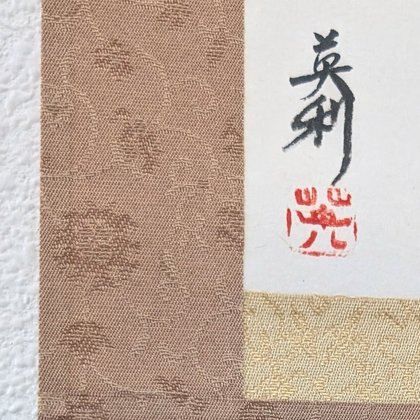


The scrolls are 12 1/4" W × 43" H (31 × 109 cm), with woven damask borders and layered Japanese paper, designed to last generations. The scrolls themselves are made by a scroll maker in Gifu, Japan, and we have worked with them for over two decades.
Eri Takase was born and raised in Osaka, Japan, and holds the rank of Shihan, the highest rank in Japanese calligraphy, from the Bokuteki-kai and the Bunka-shodo. About Master Takase


