





Semi-Cursive · gyōsho 行書 · VS5J
Semi-Cursive or gyōsho (行書) styles are a simplified and softer form of the kaisho styles. Gyōsho styles can be read by most Japanese.
天は自ら助くる者を助く
ten wa mizukara tasukuru mono o tasuku
Heaven Helps Those Who Help Themselves
Heaven helps those who make the effort themselves, without relying on others.
Master Takase creates this beautiful scroll when your order is placed, personally preparing the ink and brushing your art, which proudly bears her signature and seal. This is an original work of art.
Description
天は自ら助くる者を助く (ten wa mizukara tasukuru mono o tasuku): Heaven helps those who make the effort themselves, without relying on others.
Word for word, the Japanese closely follows the English line Heaven helps those who help themselves, Heaven included: ten is Heaven, mizukara is oneself, by one's own hand, and mono is those who. It says Heaven where much English says God. Tasukuru is a classical form of the verb tasuku, to help, so the line is in the literary language.
English print carries the line, in one shape or another, from the sixteenth century on. Richard Taverner's Erasmus in English, in its printing of 1569, has The Goddes do helpe the doers. George Herbert's Outlandish Proverbs of 1640 has Helpe thy selfe, and God will helpe thee. Algernon Sidney's Discourses Concerning Government of 1698 has God helps those who help themselves. Benjamin Franklin printed God helps them that help themselves as a saying of Poor Richard.
By the 1890s, Japanese books credited the maxim to five sources: a Western proverb, Poor Richard, Samuel Smiles, the English, and a translated book. In a play printed in Osaka in 1896, a merchant giving capital to a man who had resolved to die calls it a precious holy word that a man could not use up in a lifetime.
In the 1920s, Japan's national ethics textbook for sixth-graders set the maxim under a lesson on Benjamin Franklin's life, called standing on one's own. A teacher's manual of 1923 explained it as help that Heaven gives to none but those who apply themselves to their own work.
In a survey reported in 1912, 24% of 193 pupils at one Kyoto elementary school named this maxim, third among thirty-four ethics-textbook maxims. Among the older pupils alone, 70% named it. A line like this, the report adds, does not go into a young child's head.
In the cursive design, Eri writes 自ら as 自から, a spelling also printed in a self-help book of 1892.
An old Western maxim, which Samuel Smiles quoted, never as his own, in the first line of the first chapter of Self-Help (1859); Nakamura Masanao's Japanese of it opens his translation, the Saigoku risshi hen 西國立志編 of 1870–71, and the spelling with 者 is that of the maxim books from 1874 and of the national ethics textbook of the 1920s.
We want you to be as happy with the meaning as you are with Master Takase's art. To learn more, visit Philology of 天は自ら助くる者を助く.
Delivery
Your scroll is brushed when you order it and completed within 1 to 3 business days. It ships by USPS Priority Mail from Master Takase's studio in Washington State, boxed and ready to hang, with a printed page giving the art's English, romaji and Japanese.
Sending it as a gift? Add your message at checkout and we will include it.
Shipping is calculated at checkout from your address; within the United States it is $13 to $23. We ship worldwide, and any import charges for your country are shown at checkout before you pay.
Every order is covered by our 30-day money-back guarantee. If your scroll arrives damaged, or we made an error, we replace it or refund you in full, including shipping. Refund policy
About Our Scrolls
Master Japanese Calligrapher Eri Takase brushes your scroll by hand when you order it. Each scroll bears her red seal, 英利, and her signature.
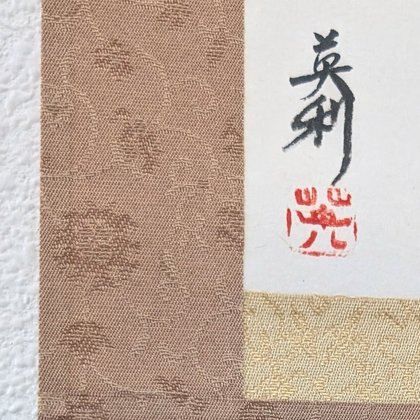


The scrolls are 12 1/4" W × 43" H (31 × 109 cm), with woven damask borders and layered Japanese paper, designed to last generations. The scrolls themselves are made by a scroll maker in Gifu, Japan, and we have worked with them for over two decades.
Eri Takase was born and raised in Osaka, Japan, and holds the rank of Shihan, the highest rank in Japanese calligraphy, from the Bokuteki-kai and the Bunka-shodo. About Master Takase


