


Eri's Choice · VD5J
Eri's Choice is a design that does not keep strictly to one style; it is Master Takase's own artistic choice.
鶴亀 tsurukame Crane and Tortoise
The crane and the tortoise, a lucky pair used at celebrations and as a symbol of long life.
Master Takase creates this beautiful scroll when your order is placed, personally preparing the ink and brushing your art, which proudly bears her signature and seal. This is an original work of art.
Description
鶴亀 (tsurukame): the crane and the tortoise, a lucky pair used at celebrations and as a symbol of long life.
Japanese dictionaries give 鶴亀 as the crane and the tortoise, both held to live long. The pair is used at celebrations for good luck and as a symbol of long life. The two characters say crane and tortoise, in that order. Said twice, tsurukame tsurukame, the word is also a charm spoken to undo an unlucky word.
A Japanese proverb gives the crane a thousand years and the tortoise ten thousand. The proverb is in the tale of Urashima Tarō, in a print of the early eighteenth century. Urashima lets a tortoise go back to the sea and gives the proverb as his reason. At the end he becomes a crane and the tortoise becomes a god. That, the tale says, is why people say crane and tortoise among the happy examples.
The crane and the tortoise stand for long life at Japanese weddings, birthdays and the New Year. The Noh play 鶴亀 was on the stage by 1544. In the play a crane and a tortoise dance for an emperor at the New Year and offer him their years. A dictionary printed in 1867 describes a wedding stand set with figures of the crane and the tortoise.
The crane's thousand years and the tortoise's long life are Chinese, written together as 龜鶴, tortoise first, by the fourth century; the Japanese word puts the crane first, and the 日本国語大辞典's earliest citation for it is the preface to the Kokinshū, the first imperial anthology of Japanese poetry, compiled from 905.
We want you to be as happy with the meaning as you are with Master Takase's art. To learn more, visit Philology of 鶴亀.
Delivery
Your scroll is brushed when you order it and completed within 1 to 3 business days. It ships by USPS Priority Mail from Master Takase's studio in Washington State, boxed and ready to hang, with a printed page giving the art's English, romaji and Japanese.
Sending it as a gift? Add your message at checkout and we will include it.
Shipping is calculated at checkout from your address; within the United States it is $13 to $23. We ship worldwide, and any import charges for your country are shown at checkout before you pay.
Every order is covered by our 30-day money-back guarantee. If your scroll arrives damaged, or we made an error, we replace it or refund you in full, including shipping. Refund policy
About Our Scrolls
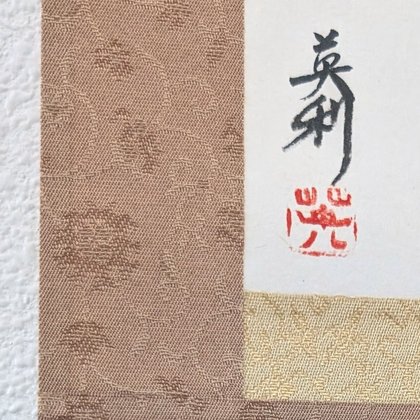
Master Japanese Calligrapher Eri Takase brushes your scroll by hand when you order it. Each scroll bears her red seal, 英利, and her signature.
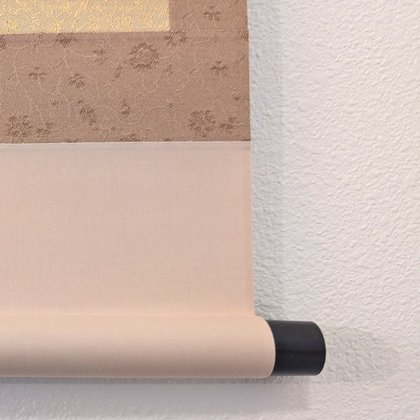
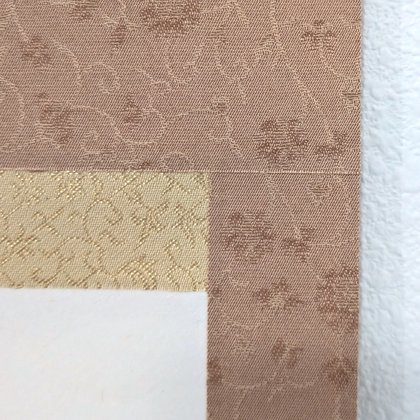
The scrolls are 12 1/4" W × 43" H (31 × 109 cm), with woven damask borders and layered Japanese paper, designed to last generations. The scrolls themselves are made by a scroll maker in Gifu, Japan, and we have worked with them for over two decades.
Eri Takase was born and raised in Osaka, Japan, and holds the rank of Shihan, the highest rank in Japanese calligraphy, from the Bokuteki-kai and the Bunka-shodo. About Master Takase


