





Cursive · sōsho 草書 · VC5J
Cursive or sōsho (草書) styles are the most simplified styles and Master Takase's favorite. While very beautiful, these styles are often difficult to read even by specialists.
実るほど頭の下がる稲穂かな
minoru hodo atama no sagaru inaho kana
The Riper the Rice, the Lower It Bows Its Head
The more the rice ripens, the lower it hangs its head: the deeper a person's learning and virtue, the humbler they grow toward others.
Master Takase creates this beautiful scroll when your order is placed, personally preparing the ink and brushing your art, which proudly bears her signature and seal. This is an original work of art.
Description
実るほど頭の下がる稲穂かな (minoru hodo atama no sagaru inaho kana): the more the rice ripens, the lower it hangs its head, and the deeper a person's learning and virtue, the humbler they grow toward others.
稲穂 is the ear of rice, which grows heavy and hangs down as its grain fills. 頭 is the head, read atama here, and かな is the exclamation that closes a hokku. 頭が下がる on its own means to be moved to respect, so a reader may hear both the hanging ear and a bowed head.
Lesson plans of 1901 and 1908 set the verse in lessons on humility. The educator Tanimoto Tomeri, lecturing in 1900, recalled it from an ethics book. The rice, he added, does not bow from any purpose of its own: it ripens, and so its tip comes down.
A magazine of 1899 called the verse the motto of the copper magnate Furukawa Ichibei. A book of 1902 says he always showed it to his men and, it is said, never ceased to preach the worth of humility. In a passage by Endō Shūsaku from 1974, a woman says it of a gentle doctor.
Takenobu's Japanese-English dictionary of 1918 gave the verse an English proverb as its equivalent: The boughs that bear most hang lowest. The proverb says of boughs what the verse says of rice. Daniel Buchanan's book of Japanese proverbs in English rendered the image in 1965 as Ripening rice plants hang down their heads.
No author is known: the rice that bows as it fills, set against the man who leans back, is a saying found in a chronicle of the 1620s and in the proverb lists of the seventeenth century, and the seventeen-syllable verse is first known in print, on the National Diet Library's full text, in 1894, without a name, with one late attribution, of 1932, to the haikai poet Kokubu Taneyuki.
We want you to be as happy with the meaning as you are with Master Takase's art. To learn more, visit Philology of 実るほど頭の下がる稲穂かな.
Delivery
Your scroll is brushed when you order it and completed within 1 to 3 business days. It ships by USPS Priority Mail from Master Takase's studio in Washington State, boxed and ready to hang, with a printed page giving the art's English, romaji and Japanese.
Sending it as a gift? Add your message at checkout and we will include it.
Shipping is calculated at checkout from your address; within the United States it is $13 to $23. We ship worldwide, and any import charges for your country are shown at checkout before you pay.
Every order is covered by our 30-day money-back guarantee. If your scroll arrives damaged, or we made an error, we replace it or refund you in full, including shipping. Refund policy
About Our Scrolls
Master Japanese Calligrapher Eri Takase brushes your scroll by hand when you order it. Each scroll bears her red seal, 英利, and her signature.
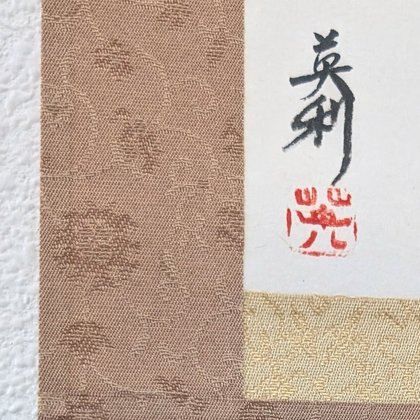


The scrolls are 12 1/4" W × 43" H (31 × 109 cm), with woven damask borders and layered Japanese paper, designed to last generations. The scrolls themselves are made by a scroll maker in Gifu, Japan, and we have worked with them for over two decades.
Eri Takase was born and raised in Osaka, Japan, and holds the rank of Shihan, the highest rank in Japanese calligraphy, from the Bokuteki-kai and the Bunka-shodo. About Master Takase


