



Font Design · VD5J
Font Designs are Master Takase's unique designs. Often she will use her own style or a combination of fonts and, without a classification limit, create exactly the look she wants.
目には青葉
山ほととぎす
初鰹
me ni wa aoba
yama hototogisu
hatsugatsuo
sodō 素堂
Green leaves for the eye,
the mountain cuckoo,
the first bonito
Green leaves for the eye, the mountain cuckoo, the first bonito.
Master Takase creates this beautiful scroll when your order is placed. Personally preparing the ink and brushing your art that proudly bears her signature and seal. This is an original work of art.
Description
目には青葉山ほととぎす初鰹 (me ni wa aoba yama hototogisu hatsugatsuo): green leaves for the eye, the mountain cuckoo, the first bonito.
Word for word: for the eye, green leaves; a mountain cuckoo; the first bonito. Three things of early summer, and no verb. A Japanese dictionary says that in Edo especially, people took pride in eating the first bonito.
The verse names the eye and leaves the ear and the mouth unnamed: the cuckoo is heard, and the bonito is eaten. A treatise of 1764 printed it as 眼に青葉, without は (wa), and said those five syllables hold all three senses. With は, the opening part runs one syllable past the measure of five.
In a verse contest of Sodō's own, printed after his death, the verse sits under the headnote when I went to see Kamakura. The judgment there asks whether, once green leaves for the eye is said, the ear and the mouth come through of themselves. It closes: all the scenery of Kamakura goes no further than this.
In the Edo period, Haruo Shirane writes, bonito were caught at Kamakura or Odawara and reached Edo by night. Makoto Ueda says an Edo comic verse alludes to Sodō's verse, and gives the comic verse in English as it costs nothing / for the eye and ear, but a lot / for the mouth.
Sodō knew Bashō, and published a collection with him in 1676. Harold G. Henderson called the verse Sodō's trinity of early summer in 1934. R. H. Blyth wrote in 1963 that he disliked it for its greediness.
Yamaguchi Sodō (1642–1716), a haikai poet of Kai who lived in Edo; printed in 1678 in 『江戸新道』, an anthology compiled by Ikenishi Gonsui, under 來雪, another of Sodō's names, Raisetsu, as 目にハ青葉山郭公初鰹.
We want you to be as happy with the meaning as you are with Master Takase's art. To learn more, visit Philology of 目には青葉山ほととぎす初鰹.
Delivery
Your scroll is brushed when you order it and completed within 1 to 3 business days. It ships by USPS Priority Mail from Master Takase's studio in Washington State, boxed and ready to hang, with a printed page giving the art's English, romaji and Japanese.
Sending it as a gift? Add your message at checkout and we will include it.
Shipping is calculated at checkout from your address; within the United States it is $13 to $23. We ship worldwide, and any import charges for your country are shown at checkout before you pay.
Every order is covered by our 30-day money-back guarantee. If your scroll arrives damaged, or we made an error, we replace it or refund you in full, including shipping. Refund policy
About Our Scrolls
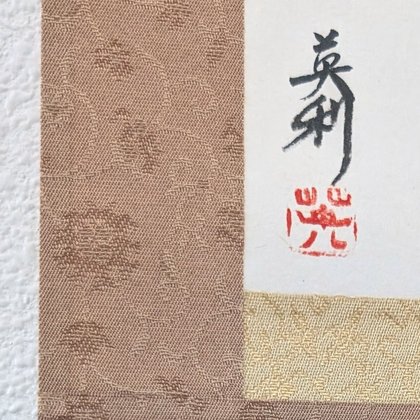
Master Japanese Calligrapher Eri Takase brushes your scroll by hand when you order it. Each scroll bears her red seal, 英利, and her signature.
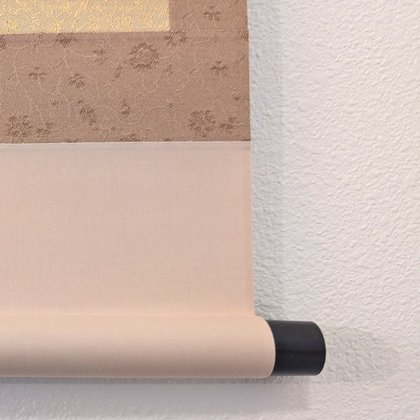
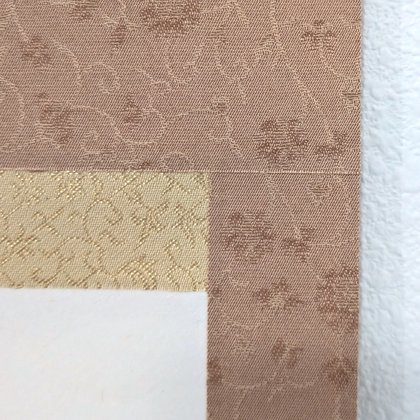
The scrolls are 12 1/4" W × 43" H (31 × 109 cm) with woven damask borders and Japanese paper that are layered so the scroll hangs straight and will not warp over time. The scrolls themselves are made by a scroll maker in Gifu, Japan, and we have worked with them for over two decades.
Eri Takase was born and raised in Osaka, Japan, and holds the rank of Shihan, the highest rank in Japanese calligraphy, from the Bokuteki-kai and the Bunka-shodo. About Master Takase
Related products

Bashō - A rough sea: lying toward Sado, the Milky Way荒海や佐渡によこたふ天河araumi ya sado ni yokotau amanogawa

Bashō - As the temple bell fades, The ringing lingers in the blossom scent, Evening鐘消えて花の香は撞く夕べ哉kane kiete hana no ka wa tsuku yūbe kana

Bashō - Gathering the early-summer rains, swift: the Mogami River五月雨をあつめて早し最上川samidare o atsumete hayashi mogamigawa
