


Font Design · VD5J
Font Designs are Master Takase's unique designs. Often she will use her own style or a combination of fonts and, without a classification limit, create exactly the look she wants.
柿食えば
鐘が鳴るなり
法隆寺
kaki kueba
kane ga naru nari
hōryūji
shiki 子規
As I eat a persimmon,
a bell rings:
Hōryūji
As I eat a persimmon, a bell rings: Hōryūji.
Master Takase creates this beautiful scroll when your order is placed. Personally preparing the ink and brushing your art that proudly bears her signature and seal. This is an original work of art.
Description
柿食えば鐘が鳴るなり法隆寺 (kaki kueba kane ga naru nari hōryūji): as I eat a persimmon, a bell rings: Hōryūji.
柿 is the persimmon, and the デジタル大辞泉 gives its fruit as a season word for autumn. 鐘 is a bell. The same dictionary says 法隆寺 is the temple in Nara said to have been built by Prince Shōtoku in 607.
Eri's four scrolls write 柿食えば, the modern spelling of 柿食へば. くへば and 食へば are one word, kueba, written in kana or with its kanji.
In the preface to the selection of his verse printed in 1902, Shiki looked back on 1895. Going round Nara at the end of autumn, turning out bad verses by the heap, was a great joy, he wrote. He chose the verses himself, he wrote, as though his own ghost were choosing them.
The persimmon has no example in the 万葉集, the 日本国語大辞典 notes, and became much sung in the haikai of the Edo period. In 1901 Shiki wrote that poets had passed the persimmon by, and that pairing it with Nara was a thing no one had thought of. He was very glad, he wrote, to have found this new pairing.
The critic Kawahigashi Hekigotō, reviewing the selection of 1902, wrote that the verse was not in Shiki's usual manner. He asked why Shiki had not written while I am eating a persimmon, the bell rings at Hōryūji. Shiki answered in his newspaper column 『病牀六尺』, a sickbed six feet long: a fair point, he granted, but put that way, he thought, the syntax grows somewhat weak. The book of the column dates the entry 30 August 1902; Shiki died on 19 September.
The Japanese commentaries before 1949 that we have read, where they say whose bell it was, hear the bell at Hōryūji. In 1939 a teachers' guide placed the teahouse where a stone carved with the verse stood. A study of 2009 says a stone carved with the verse went up at the site of the teahouse in September 1916. Takahama Kyoshi, in a piece collected in 1943, read the verse as saying only that as he was eating a persimmon at the teahouse at Hōryūji, the bell rang, gong. He added that one can picture the traveler resting on the teahouse bench. In the verse, he said, is the feeling of fondness for the sound of Hōryūji's bell, and the quiet of the place.
In an essay of 1901 on fruit, Shiki tells of an inn in Nara where a maid peeled persimmons for him and a bell sounded. It was, she said, the great bell of Tōdaiji striking the first watch. The essay does not quote the verse or name Hōryūji. Shiki gave Tōdaiji's bell a verse of its own in his manuscript: the long night: striking the first watch, Tōdaiji.
In 1938 a teachers' commentary guessed that an earlier draft of the verse named Tōdaiji, reasoning from the essay on fruit. A life of Shiki of 1967 made the guess an itinerary, the inn and then Hōryūji the next day, as a 2009 study quotes it. In English, Janine Beichman stated it as fact in 1982, naming no source in the passage we read. Donald Keene, in 2013, held it probable.
R. H. Blyth put the verse into English in 1952: Eating persimmons; / The bell sounds, / Of Hôryûji Temple. Harold Henderson, in 1958, called it deservedly one of Shiki's most famous poems. The renderings we have read since differ chiefly over the temple: the bell's source, the place, or a name standing alone.
Masaoka Shiki, at a teahouse at Hōryūji in Nara, in the autumn of 1895, on his way back to Tokyo from Matsuyama, as the preface in his own manuscript says; he wrote it 柹くへば there and in the selection of his verse printed in 1902, and his newspaper column of that year printed 柿食へば.
We want you to be as happy with the meaning as you are with Master Takase's art. To learn more, visit Philology of 柿食えば鐘が鳴るなり法隆寺.
Delivery
Your scroll is brushed when you order it and completed within 1 to 3 business days. It ships by USPS Priority Mail from Master Takase's studio in Washington State, boxed and ready to hang, with a printed page giving the art's English, romaji and Japanese.
Sending it as a gift? Add your message at checkout and we will include it.
Shipping is calculated at checkout from your address; within the United States it is $13 to $23. We ship worldwide, and any import charges for your country are shown at checkout before you pay.
Every order is covered by our 30-day money-back guarantee. If your scroll arrives damaged, or we made an error, we replace it or refund you in full, including shipping. Refund policy
About Our Scrolls
Master Japanese Calligrapher Eri Takase brushes your scroll by hand when you order it. Each scroll bears her red seal, 英利, and her signature.
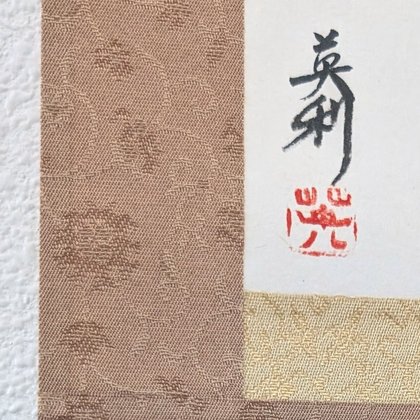
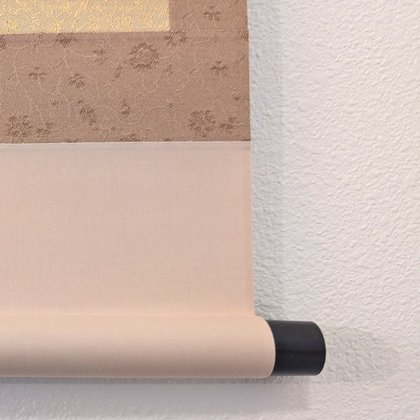
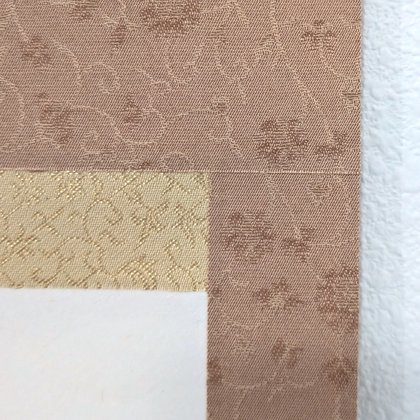
The scrolls are 12 1/4" W × 43" H (31 × 109 cm) with woven damask borders and Japanese paper that are layered so the scroll hangs straight and will not warp over time. The scrolls themselves are made by a scroll maker in Gifu, Japan, and we have worked with them for over two decades.
Eri Takase was born and raised in Osaka, Japan, and holds the rank of Shihan, the highest rank in Japanese calligraphy, from the Bokuteki-kai and the Bunka-shodo. About Master Takase
Related products

Bashō - A rough sea: lying toward Sado, the Milky Way荒海や佐渡によこたふ天河araumi ya sado ni yokotau amanogawa

Bashō - As the temple bell fades, The ringing lingers in the blossom scent, Evening鐘消えて花の香は撞く夕べ哉kane kiete hana no ka wa tsuku yūbe kana

Bashō - Gathering the early-summer rains, swift: the Mogami River五月雨をあつめて早し最上川samidare o atsumete hayashi mogamigawa
