



Cursive · sousho 草書 · VC5J
Cursive or sousho (草書) Fonts are the most simplified fonts and Master Takase's favorite. While very beautiful, these fonts are often difficult to read even by specialists.
雪とけて
村一ぱいの
子どもかな
yuki tokete
mura ippai no
kodomo kana
issa 一茶
The snow melts,
and the village
is full of children
The snow melts, and the village is full of children.
Master Takase creates this beautiful scroll when your order is placed. Personally preparing the ink and brushing your art that proudly bears her signature and seal. This is an original work of art.
Description
雪とけて村一ぱいの子どもかな (yuki tokete mura ippai no kodomo kana): the snow melts, and the village is full of children.
The dictionaries define snow melt, 雪解け, as the melting of snow that has fallen and lain, a seasonal word of spring. After a place, いっぱい means the place is entirely filled, so the whole village is full of children.
Issa's later fair copy keeps the town, 町. The form known today is the village, 村, as prints of 1926 set it and a primary-school reader prints it now. That reader's form is the one this page gives, character for character, closing on かな, the same exclamation the diary writes 哉.
The 1976 editors of Issa's complete works call the verse printed under 柯尺's name Issa's own. They describe 柯尺 as a haikai poet of the town of Zenkōji. No source read for the history says why the verse went out under the name 柯尺.
Kawashima Tsuyu, in his commentary read in its 1936 edition, hears noise in the words the whole village. He allows that the village may be in Issa's home region, and says no more than that.
R. H. Blyth put the verse into English in 1942: The snow having melted, / The village / Is full of children. Harold G. Henderson's version of 1958 makes the village overflowing, with the remark This certainly starts one on a picture of disaster. Later translators wrote flooded and floodwaters; no Japanese source read for the history reads a flood.
Kobayashi Issa, in his diary, the 七番日記, in the first month of 文化11 (1814), as 雪とけて村一ぱいの子ども哉; in its third month the diary has 町, town, for 村, and Issa printed the 町 form that year in his anthology 『三韓人』 under the name of the poet 柯尺.
We want you to be as happy with the meaning as you are with Master Takase's art. To learn more, visit Philology of 雪とけて村一ぱいの子どもかな.
Delivery
Your scroll is brushed when you order it and completed within 1 to 3 business days. It ships by USPS Priority Mail from Master Takase's studio in Washington State, boxed and ready to hang, with a printed page giving the art's English, romaji and Japanese.
Sending it as a gift? Add your message at checkout and we will include it.
Shipping is calculated at checkout from your address; within the United States it is $13 to $23. We ship worldwide, and any import charges for your country are shown at checkout before you pay.
Every order is covered by our 30-day money-back guarantee. If your scroll arrives damaged, or we made an error, we replace it or refund you in full, including shipping. Refund policy
About Our Scrolls
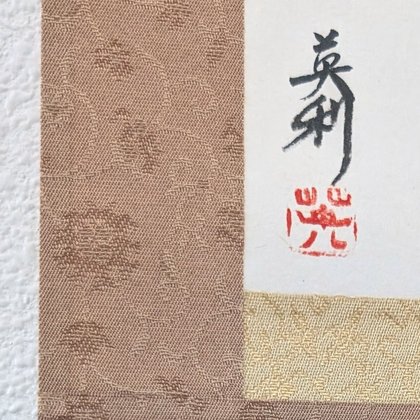
Master Japanese Calligrapher Eri Takase brushes your scroll by hand when you order it. Each scroll bears her red seal, 英利, and her signature.
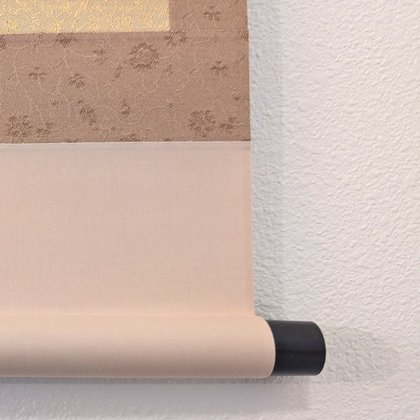
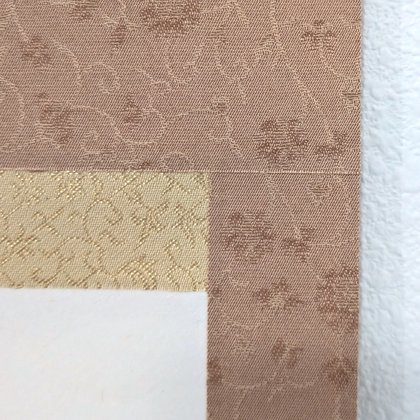
The scrolls are 12 1/4" W × 43" H (31 × 109 cm) with woven damask borders and Japanese paper that are layered so the scroll hangs straight and will not warp over time. The scrolls themselves are made by a scroll maker in Gifu, Japan, and we have worked with them for over two decades.
Eri Takase was born and raised in Osaka, Japan, and holds the rank of Shihan, the highest rank in Japanese calligraphy, from the Bokuteki-kai and the Bunka-shodo. About Master Takase
Related products

Bashō - As the temple bell fades, The ringing lingers in the blossom scent, Evening鐘消えて花の香は撞く夕べ哉kane kiete hana no ka wa tsuku yūbe kana

Bashō - How admirable, to see lightning, and not think life is fleeting稲妻にさとらぬ人の貴さよinazuma ni satoranu hito no tattosa yo

Bashō - In the plum blossom scent, the sun pops out, a mountain path梅が香にのつと日の出る山路かなmume ga ka ni notto hi no deru yamaji kana
