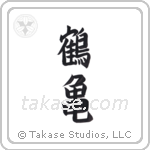
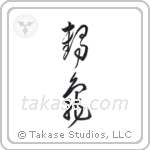
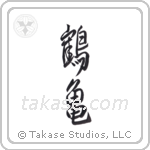
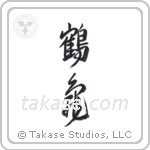
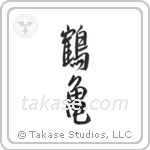
Japanese dictionaries give 鶴亀 as the crane and the tortoise, both held to live long. The pair is used at celebrations for good luck and as a symbol of long life. The two characters say crane and tortoise, in that order. Said twice, tsurukame tsurukame, the word is also a charm spoken to undo an unlucky word.
A Japanese proverb gives the crane a thousand years and the tortoise ten thousand. The proverb is in the tale of Urashima Tarō, in a print of the early eighteenth century. Urashima lets a tortoise go back to the sea and gives the proverb as his reason. At the end he becomes a crane and the tortoise becomes a god. That, the tale says, is why people say crane and tortoise among the happy examples.
The crane and the tortoise stand for long life at Japanese weddings, birthdays and the New Year. The Noh play 鶴亀 was on the stage by 1544. In the play a crane and a tortoise dance for an emperor at the New Year and offer him their years. A dictionary printed in 1867 describes a wedding stand set with figures of the crane and the tortoise.
The crane's thousand years and the tortoise's long life are Chinese, written together as 龜鶴, tortoise first, by the fourth century; the Japanese word puts the crane first, and the 日本国語大辞典's earliest citation for it is the preface to the Kokinshū, the first imperial anthology of Japanese poetry, compiled from 905.
We want you to be as happy with the meaning as you are with Master Takase's art. To learn more, visit Philology of 鶴亀.