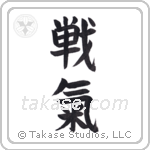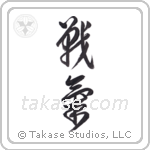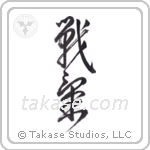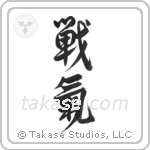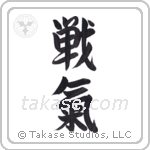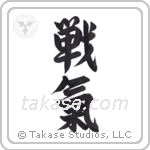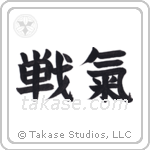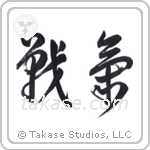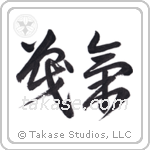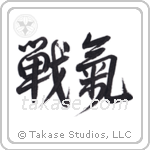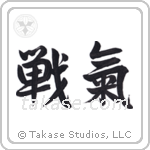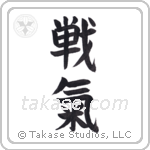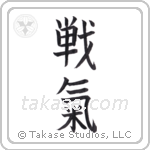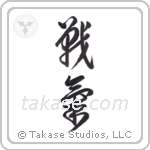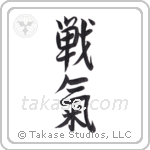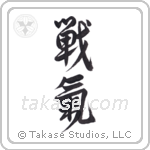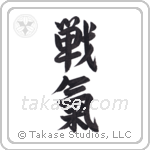

The will and momentum of battle, and something older: the air over a fight as a thing seen. A trained eye once read it for what it foretold. English hears Spirit of Battle as ardor, and the word reaches that, a fighter's will and an army's morale. The scroll it comes from shows the opposite: stillness that reflects, a cold stream carrying the moon. A person who chooses these two characters should know both halves: what the word says, and what Musashi wrote beneath it. Which they take is theirs.
Master Takase writes 氣 in its traditional form, as Musashi did. She offers the word in block, semi-cursive and cursive script and in her own font designs.
It is a literary word, and in Japan it is known from the hanging scroll Miyamoto Musashi brushed. The two characters stand large at its head. Beneath them is a line of verse about a cold river carrying the moon, clear as a mirror. The verse is taken to express the state he reached with the sword. The scroll is kept in Yatsushiro, Kumamoto, and is a cultural property of the city.
戦氣 is composed of the kanji 戦 (read sen) meaning "war, battle" and 氣 (read ki) meaning "air, breath, spirit".
Miyamoto Musashi brushed the word in the early seventeenth century at the head of a hanging scroll, above a line by the Chinese poet Bai Juyi that Japan knew from the Wakan rōeishū.
We want you to be as happy with the meaning as you are with Master Takase's art. To learn more, visit Philology of 戦氣.