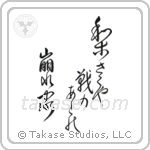
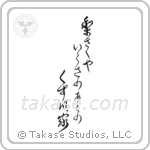
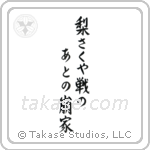
梨さくや戦のあとの崩れ家 (nashi saku ya ikusa no ato no kuzure ie)
| A pear tree is blooming, By a collapsed house, on an old battlefield | nashi saku ya ikusa no ato no kuzure ie | 梨さくや 戦のあとの 崩れ家 |
| Shiki | shiki | 子規 |
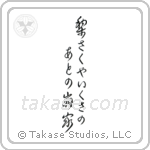
梨さくや戦のあとの崩れ家 (nashi saku ya ikusa no ato no kuzure ie): pear trees in bloom, and a house fallen in, after the battle. 梨 is the pear, whose white blossom is a spring season word; さくや, *blooms, and*, is the cut; いくさ is *battle*, and the second の binds *after the battle* to 崩れ家, a house fallen in, a compound the poet made for it. Nothing in the Japanese says *old*: あと is *after*, and the after was five months. Shiki wrote it in the spring of 1895 at Jinzhou (金州) on the Liaodong peninsula, where he had gone as a war correspondent in the month the Sino-Japanese War ended, standing where the battle of the previous November had been fought. It is in his own hand in his manuscript collection Kanzan Rakuboku, under the headnote *two verses at Jinzhou*, beside its pair, an old pear tree sparse in flower by a leek field. Hekigotō, his first critic, read the Jinzhou verses in 1907 as calm and without bluster: scenes after a war, with nothing pressed. On two of the designs Master Takase brushes いくさ in kana, as Shiki's manuscript does; the words are the same. The English is Timothy L. Jackowski's, made for Takase Studios.
Couldn't add to cart. Please try again.