

Good health: being well and free from illness.
Couldn't add to cart. Please try again.
Good health: being well and free from illness.
Couldn't add to cart. Please try again.
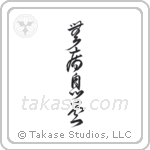
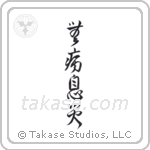
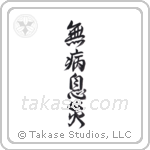
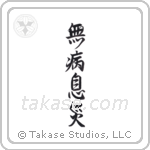
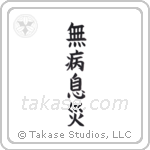
Japanese dictionaries define 無病息災 as being healthy, without falling ill. The dictionaries define a state, and people use the phrase as a wish. It is prayed for at shrines and at the New Year. The four characters say without illness, calamity stopped.
無病息災 joins without illness to 息災. 息災 is a Buddhist word for stopping calamity, and by the eleventh century it also meant being well. The Hakone shrine's account of itself is dated 1191 by its colophon and known from copies of the fifteenth century. In the account, the vase of the Medicine Buddha is tilted to give good medicine to those who seek 無病息災. A tale of Jizō printed in 1653 says the Medicine Buddha pours medicine over the world each day. Those who believe, the tale says, will be 無病息災.
By 1676 無病息災 was the sixth line of a New Year counting song. The song belonged to the Daikoku dancers, described by one translator as New Year street performers in the masks of the god of luck. The seventh line reads nothing amiss. In 1901 Lafcadio Hearn printed the same sixth line in a children's ball-song.
A Japanese phrase, which CBETA's full text of the Chinese Buddhist canon does not carry in the Taishō canon or the 卍續藏: 無病, without illness, joined to 息災, the name of the esoteric Buddhist rite for stopping calamity, which had come to mean being well. Its oldest dated witness in the Diet Library's full text is the Hakone shrine's account of itself, dated 1191 by its colophon and known from copies of the fifteenth century, in which the precious vase of the King of Healing, the Medicine Buddha, is tilted for those who seek to be 無病息災.
We want you to be as happy with the meaning as you are with Master Takase's art. To learn more, visit Philology of 無病息災.
Each design is Master Japanese Calligrapher Eri Takase's hand-brushed calligraphy of the word or phrase on this page, delivered as a PDF you can print. Every PDF includes the line art, so a tattoo artist or a craftsperson can work from the outline as well as the brushed image.
Your purchase includes a personal-use license: use the design as a tattoo reference, frame it, engrave it, print it for yourself, or make it into a gift. For more information see Licensing, which also covers commercial-use options that may be purchased separately.
Your PDF is available for download the moment your order completes, and a copy is attached to your emailed receipt.
If you need your design again later, ask us for it and we will send it.
Master Takase personally brushes your scroll when you order, and it bears her red seal and her signature. The scroll has real silk borders and layered Japanese paper, so it hangs straight, and it arrives ready to display.