
Fine Japanese Calligraphy

The Art of Master Japanese Calligrapher Eri Takase

0

琴瑟相和 kinshitsu sōwa Two Zithers in Harmony

A husband and wife on the best of terms.
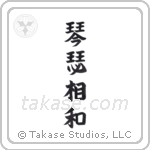
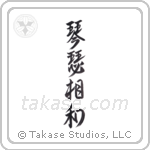
Two Zithers in Harmony (琴瑟相和) in Block style Japanese calligraphy by Eri Takase
Two Zithers in Harmony 琴瑟相和 kinshitsu sōwa Vertical Block VB5J
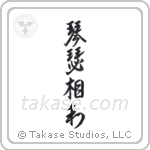
Two Zithers in Harmony (琴瑟相和) in Cursive style Japanese calligraphy by Eri Takase
Two Zithers in Harmony 琴瑟相和 kinshitsu sōwa Vertical Cursive VC5J
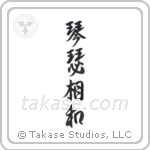
Two Zithers in Harmony (琴瑟相和) in Design style Japanese calligraphy by Eri Takase
Two Zithers in Harmony 琴瑟相和 kinshitsu sōwa Vertical Design VD5J
Two Zithers in Harmony (琴瑟相和) in Design style Japanese calligraphy by Eri Takase
Two Zithers in Harmony 琴瑟相和 kinshitsu sōwa Vertical Design VD5K
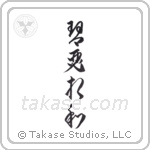
Two Zithers in Harmony (琴瑟相和) in Semi-Cursive style Japanese calligraphy by Eri Takase
Two Zithers in Harmony 琴瑟相和 kinshitsu sōwa Vertical Semi-Cursive VS5J
More about 琴瑟相和

In today's dictionaries the phrase is said of a husband and wife who are on the best of terms. The four characters say the qin and the se in harmony. The qin (琴) is a zither with no bridges, and the se (瑟) is a long zither of about twenty-five strings on movable bridges.

The wish in 琴瑟相和 is that two different instruments sound together. In the 左傳, Yanzi tells his lord that harmony is not sameness. If the qin and the se played a single note, he asks, who could listen?

In Japan the phrase is in print of a married couple in accord by 1805. Meiji letter manuals give the variant 琴瑟調和 among the phrases for a wedding letter.

The picture of a married couple as the qin and the se, two zithers played together, comes from the Book of Songs, and the earliest instances of the four characters in the Chinese texts the history searched are a Tang commentator's and a ninth-century storyteller's; in Japan they are in print as a wish for a marriage by 1805, in a preface that sets the couple in tune against the couple who glare at each other.

We want you to be as happy with the meaning as you are with Master Takase's art. To learn more, visit Philology of 琴瑟相和.

About the Designs

Each design is Master Japanese Calligrapher Eri Takase's hand-brushed calligraphy of the word or phrase on this page, delivered as a PDF you can print. Every PDF includes the line art, so a tattoo artist or a craftsperson can work from the outline as well as the brushed image.

Licensing

Your purchase includes a personal-use license: use the design as a tattoo reference, frame it, engrave it, print it for yourself, or make it into a gift. For more information see Licensing, which also covers commercial-use options that may be purchased separately.

Delivery

Your PDF is available for download the moment your order completes, and a copy is attached to your emailed receipt.

If you need your design again later, ask us for it and we will send it.

Two Zithers in Harmony as a hand-brushed scroll

Master Takase personally brushes your scroll when you order, and it bears her red seal and her signature. The scroll has real silk borders and layered Japanese paper, so it hangs straight, and it arrives ready to display.