

隻手の音声 · sekishu no onjō · The sound of one hand
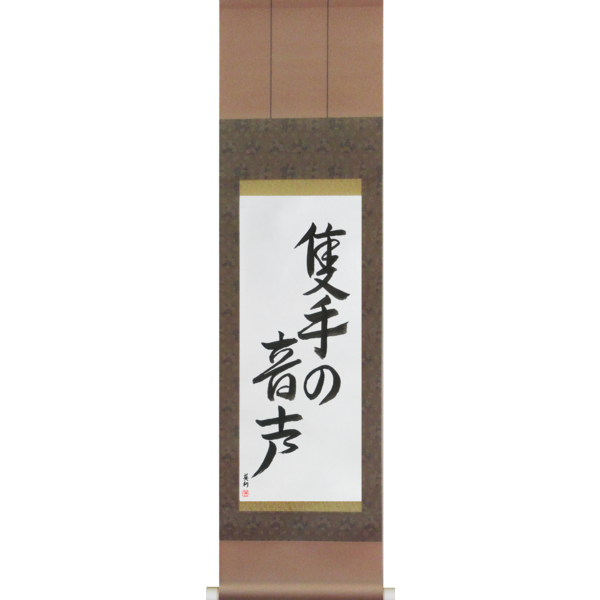
Sold as The Sound of One Hand Clapping · Read sekishu no onjō · Oldest witness Hakuin's own tract 藪柑子 of 1753, where he defines the koan and says he began setting it five or six years before · Sense the question Hakuin gave his students in place of every older koan: two hands struck together make a sound; what is the sound of the one hand raised?
The words
隻手, sekishu, is one hand: 隻 counts one of a pair, as in 隻眼, one eye, and the oldest Japanese use the dictionaries find is Dōgen's, 共出一隻手, both put out one hand, in the 正法眼蔵 (1231–53, 身心学道). In Chan writing before Hakuin the one hand is the teacher's, reached down to a student: 垂一隻手, lower a single hand, in the 空谷集; 各出一隻手、扶竪宗乘, each puts out one hand to hold up the teaching, in the 無門關. None of these is about sound. [kotobank.jp/word/隻手, text; cbdata.dila.edu.tw stable/juans, work T2005 juan 1 and work X1303 juan 5, text]
音声, onjō, is the Buddhist reading of the word that is onsei, voice, in ordinary speech; the go-on reading marks it as a term of the sutras, and Hakuin himself pairs it with the plain word for sound: 隻手の聲を聞き得、音聲を止め得, to hear the sound of the one hand, to still all sound. The catalogue's onjō is right, and onsei would be wrong. [kotobank.jp/word/隻手の音声, text; dl.ndl.go.jp/pid/823257 koma 480, by eye]
The whole phrase is Hakuin's own definition turned into a name. In 藪柑子 he writes: 卽今兩手打合せて打つ時は丁々として聲あり。唯隻手を擧る時は音もなく香もなし, now, when the two hands are struck together there is a sharp sound; only when the one hand is raised there is neither sound nor scent. The verb for the one hand is 擧る, raise, and for the two hands 打つ, strike. The one hand does not clap and fail to sound. It is held up. The word clapping in the English title belongs to the English tradition, not to Hakuin, and the page's own explanation, the sound of one hand, is his. [dl.ndl.go.jp/pid/1148985 koma 6, by eye]
Three forms of the phrase live side by side in Hakuin's texts: 隻手の聲, the sound of the one hand, in his prose; 隻手音聲, the four-character name, in his song and his last verse; and the question form the 1911 editor gives as the gloss, 隻手に音聲ありや, has the one hand a sound? The design's 隻手の音声 is the headword of the デジタル大辞泉 and joins the first two. The reading is sekishu no onjō.
A history, from the earliest witness
1753. Hakuin Ekaku, 藪柑子, a tract for a retainer of the lord of Okayama, written for his mother's fiftieth memorial in his sixty-ninth year. This is the koan's own text, and the only witness in this whole family of texts whose author says in writing when he made the line and why. Hakuin recalls his awakening on hearing a distant bell at Eigan-ji in Echigo, forty-five years before, and the forty-five years since of setting students the 無字 and other devices, with some dozens coming through. Then: 此五六ヶ年以來は、思ひ付きたる事侍りて、隻手の聲を聞屆け玉ひてよと人每に指南し侍るに、從前の指南と拔群の相違ありて、誰にも疑團起り易く、工夫進み易き事、雲泥の隔有之樣に覺へ侍り。是に依りて唯今專一に隻手の工夫を勸め侍り, these five or six years I have had a thought, and have told everyone: hear the sound of the one hand. It differs from the old instruction beyond measure; the great doubt rises easily in anyone, the work moves easily, as far apart as cloud and mud. So now I urge the one hand alone. He defines it in the two sentences quoted above, ties it to Confucius' Heaven that says nothing and to the mountain crone of the Noh who hears the unborn sound in an empty valley's echo, and promises that when the one hand just enters the ear, 佛聲、神聲、菩薩聲 … 世間所有の一切の音聲毫釐も聞殘す事なし (the OCR reads 毫蓋)。是を淸淨の天耳通といふ (the OCR garbles 淸), the voices of the Buddhas, the gods, the bodhisattvas … not a hair of any sound in the world is left unheard; this is called the pure divine ear. Forty-five years from the bell of 1708 gives 1753, and five or six years back gives about 1747 or 1748: the koan is datable to Hakuin's early sixties, from the one witness who could know. The 1935 typeset is printed from his own woodblock edition. [dl.ndl.go.jp/pid/1148985 koma 6, by eye, and koma 3 for the editor's note, OCR; lab.ndl.go.jp/dl/api/page/1148985_6, text]
1760. Hakuin, さし藻草, the first citation the dictionaries give. 隻手の聲を聞き得、音聲を止め得、見性の眼を開き得玉はざらん限りは、成佛は存じも寄らず、淨土の片端も亦見付け玉ふ事能はじ, unless you hear the sound of the one hand, still all sound, and open the eye that sees your nature, Buddhahood is out of the question and you will not glimpse the edge of the Pure Land. The 精選版日本国語大辞典 files 隻手の声 with this line as its first attestation, and the leaf was opened. [dl.ndl.go.jp/pid/823257 koma 480, 1896 typeset, by eye; kotobank.jp/word/隻手の声, text]
1760. Hakuin, 粉引歌, the mill-song. 隻手音聲求め得て置て、此で休すりや斷見外道, having found the sound of the one hand, if you rest there, that is the nihilist's heresy. The four-character name, in a song written for people who could not read the sutras, and a warning that the koan is not a place to stop. [dl.ndl.go.jp/pid/823165 koma 69, 1911 typeset, OCR]
Undated. Hakuin, 辻談議, a street sermon. 我れ常に人に勸めて隻手無聲の微妙音を聞かしむ、是れ彼の山姥が謂はゆる一洞空しき谷の響は無聲音を聞くたよりとなるとは、是れ此の隻手の聲を云へり。今日は是れまで、明日また來りたまへ。あめおこしあめおこし, I always urge people to hear the subtle sound of the one hand that has no sound; when the mountain crone says that the echo of an empty valley is the means of hearing the soundless sound, this is what she means, the sound of the one hand. That is all for today; come again tomorrow. Sweets, sweets! The 1911 editor's headnote traces the line to the Noh play 山姥, 謠曲山姥に「一洞空しき谷の聲、梢に響く山彦の、無聲音を聞くたよりとなり」とあるを引けり, and the soundless sound behind it to Zhuangzi: 莊子に「冥々に視、無聲に聞く……無聲の中獨聞く聲和す」とあり (the OCR layer reads 諸曲, 引げり and 事和す). [dl.ndl.go.jp/pid/823165 komas 63 and 64, by eye; lab.ndl.go.jp/dl/api/page/823165_64, text]
Undated. Hakuin, a letter in his 假名法語. He does the thing itself. 予直に手を拍して曰く、兩掌相觸れて聲あり、却つて隻手の聲を聞くや。と云ひて、一掌を立つ, I clapped my hands at once and said: two palms touch and there is a sound; now, do you hear the sound of the one hand? and raised one palm. The student answers that he hears it clearly, and is asked for proof. [dl.ndl.go.jp/pid/823165 koma 50, by eye; the OCR layer reads 雨 for 兩]
1768. Hakuin's New Year verse, in his eighty-fourth year, the year he died. 逍遙龍澤最峯頂、今曉特張舊厚顏、八十老僧逢歲正、生憎隻手音聲關, wandering the peak of Ryūtaku, this dawn I put on my old thick face; an old monk of eighty meets the new year, and still, alas, the barrier of the one hand's sound. He called out that he had never met such a New Year, and thanked his disciple Tōrei. He died that December. [dl.ndl.go.jp/pid/823439 koma 99, 1910 言行録, by eye]
1777. Yosa Buson, preface to 春泥句集. The earliest use found outside Zen, and a poet's. 俳諧は俗語を用ひて俗を離るゝを尚ぶ。俗を離れて俗を用ゆ。離俗の法最もかたし。かの何がしの禪師が隻手の聲を聞けといふもの、則ち俳諧禪にして離俗の則なり, haikai prizes leaving the vulgar by using vulgar words; to leave the vulgar and use the vulgar, the law of leaving the vulgar is the hardest of all. That certain Zen master's "hear the sound of the one hand" is haikai-Zen, and the rule of leaving the vulgar. The 1897 editor's note names the master: 白隱也. [dl.ndl.go.jp/pid/875713 koma 63, by eye; the OCR layer drops け and reads か for が]
1884 to 1916. The Meiji archive. By the 1880s the phrase is everywhere. The statesman Torio Koyata records that the master Imakita Kōsen's first words to him were 隻手の音聲如何, what is the sound of the one hand? (1884). A pilgrims' hymn commentary of 1887 writes 先ツ須聞隻手ノ聲、隻手音聲了々ナレバ何ゾ詠歌ヲ用ン, first you must hear the one hand's sound; once it is clear, what need of hymns? A hypnotism textbook explains the koan in 1905. Shaku Sōen opens his lectures on the 無門關 with it in 1909: 白隱の隻手音聲を聞かぬうちは、何を云ふた所が、皆妄想のかたまり, until you have heard Hakuin's one hand, whatever you say is a lump of delusion. And every preacher told the story of the mill-woman who answered the koan with 白隠の隻手の聲を聞くよりも、兩手をうちて商賣をせよ, rather than hear Hakuin's one hand, clap both and do business, printed in 1894, 1907, 1910 and 1916. When the poets Hekigotō and Meisetsu annotated Buson's preface in 1911, they could not quite remember where the phrase came from: 禪話にでもありさうに思はれますが、今は一寸思ひ出しません. [the National Diet Library's public-domain archive, OCR: pids 818471, 823240, 818595, 759636, 823171, 899779, 875706; counts derived 2026-09-03 and re-derived unchanged 2026-09-05: 隻手の聲 in 256 books, 隻手音聲 in 73, 隻手の音聲 in 66, 片手の聲 in 44]
Today. 精選版日本国語大辞典, under 隻手の声: 禅宗での公案の一つ。両手を打って鳴る音を聞くのがふつうであるが、片手で鳴らす音を心耳をもって聞かなければならないとした。絶対の境地を推量させたもの. デジタル大辞泉, under the catalogue's exact wording 隻手の音声: 禅宗の公案の一。両手を打つと音が出るが、片手にはどんな音があるかということを問うもの。思慮分別を越えた絶対の境地に導くものとして、白隠が初学者のために用いた, one of the Zen koans: two hands clapped make a sound, but what sound has one hand? Hakuin used it for beginners, to lead them to the absolute beyond thought. Both glosses paraphrase Hakuin's two sentences of 1753. [kotobank.jp/word/隻手の声 and /隻手の音声, text]
The sense across time
One sense, because one author. Every gloss from 1753 to today paraphrases Hakuin's definition, and the readings differ only in what they do with it. Hakuin himself presents it as a better tool, not a deeper mystery: the 無字 had taken forty-five years to bring some dozens through, and the one hand raised the doubt in anyone. His mill-song warns against resting in it. Buson makes it the law of an art, the way to use common words and not be common. The Meiji teachers make it the first question and the mill-woman's answer makes it a joke that everyone understood. The modern dictionaries flatten it to what sound has one hand, which is Hakuin's question without his answer, that the one hand is raised and has no sound, and that the not-hearing is the hearing.
What is not a source
Three older lines stand behind the koan, and none is its source. The Chan one hand, 隻手, is the teacher's hand reached down, in the 無門關, the 空谷集 and the 北磵語錄 of the thirteenth century; Hakuin took the image and gave it a sound. The soundless sound, 無聲音, is the Noh play 山姥's echo of an empty valley and, behind the play, Zhuangzi's seeing in the dark, hearing in silence; Hakuin names the play himself and the 1911 editor supplies Zhuangzi. And the Chinese commonplace that one hand makes no sound is older than all of them and says the opposite of what Hakuin wants: 韓非子 has 一手獨拍、雖疾無聲, one hand clapping alone, however hard, makes no sound, an argument that a ruler needs ministers; the 水滸傳 has 單絲不成線、孤掌豈能鳴, a single thread makes no cord, can a lone palm sound?; and the proverb 孤掌難鳴, a lone palm hardly sounds, is what the Japanese proverb dictionaries of 1901 and 1910 cite under one coin does not ring and one man cannot quarrel. The Chinese line is about helplessness. Hakuin turned the same hand into the whole point. The Analects line he alludes to, Heaven that says nothing, is recalled from 陽貨 and was not opened. [cbdata.dila.edu.tw, works T2005, X1303, X1365, text; zh.wikisource.org/wiki/韓非子/功名, text; dl.ndl.go.jp/pid/862766 komas 56, 219, 325, 448 and pid 767884 koma 13, by eye and OCR]
The text in English
No Japanese-English dictionary on the shelf between 1872 and 1946 carries the koan; the forty-nine bilingual dictionaries of the archive were searched and none files it. It entered English by another door. J. D. Salinger's epigraph to Nine Stories (1953) is the form everyone knows: We know the sound of two hands clapping. But what is the sound of one hand clapping?, reported here and not opened at the page. It is Salinger's clapping, applied to both hands, that fixed the English title, and it is the word Hakuin does not use for the one hand. Paul Reps and Nyogen Senzaki's Zen Flesh, Zen Bones (1957) and Yoel Hoffmann's The Sound of the One Hand (1975), a translation of the 1916 exposé of koan answers, are the next witnesses; neither was opened. The two American proverb collections on the shelf, Buchanan 1965 and Galef 2012, do not carry it. [the archive by OCR; Buchanan and Galef in their text layers; Salinger, Reps and Hoffmann reported only]
Today. JMdict, under 隻手の声: the sound of one hand clapping (a classic Zen koan), marked Buddhist. The house title is the English form and the page's explanation, the sound of one hand, is Hakuin's; both are defensible and they are not the same phrase. What a rendering must keep: one hand raised, not clapped; sound for 音声, which is a sutra word and not voice here; and the fact that the line is a question put to a student, not a saying about the world.
A reading
The design, title, romaji and explanation are sound; this is the best-grounded page in the family, it attributes the line to the right man, and it needs no correction. It needs three clauses. First, the source: the koan's own text is 藪柑子, 1753, and Hakuin's two sentences can be quoted on the page, 両手打合せて打つ時は丁々として声あり、ただ隻手を挙る時は音もなく香もなし. Second, the date: Hakuin says he began setting it these five or six years before 1753, after forty-five years of the 無字, which is a better sentence than the Zen koan of Master Hakuin and true. Third, the word clapping: Hakuin's one hand is raised, not clapped, and the title's word is Salinger's; a clause saying so lets the buyer keep the title and know the text. On the dates, the page's 1686–1769 are the Gregorian conversions of his birth on the twenty-fifth of the twelfth month of 貞享 2 and his death on the eleventh of the twelfth month of 明和 5; the Japanese references print 1685–1768 by era year, and either is defensible.
My own reading is Buson's. The koan a calligraphy scroll of this line lives inside is not the monastery's but the poet's: use the common word and leave the common behind. Hakuin made the one hand for people who could not read the sutras, sang it to mill-workers, and put it in a New Year verse at eighty-four with a sigh that he was still at the barrier. That is the history the page can tell, and it is all in his own hand. Signed, 典, 2026-09-05.
How this was read
By eye: Hakuin's 藪柑子 at the leaf in the 1935 typeset, re-read at width 3600 on the day of writing; さし藻草 in the 1896 typeset; 辻談議, its headnote and the 假名法語 letter in the 1911 typeset; his 1768 verse in the 1910 言行録; Buson's preface in the 1897 全集; 藤井's 1910 dictionary and 松本's 1901 collection at the 韓非子 line. By text at the address: the kotobank entries in five dictionaries; the three Chan texts at CBETA; 韓非子 at Wikisource; the National Diet Library's page API for every leaf named above; the OCR layer of the archive for the mill-song, the Meiji anecdotes, the hymn commentary, the preachers' books and the 1911 annotators, and for the counts; the text layers of Buchanan and Galef, which do not carry the koan. Every archive address was re-opened by a reader before writing and the OCR quoted raw; where this history's Japanese differs from the OCR, the leaf was read at width 3600 and the difference is named in the account. Not opened: 遠羅天釜 and 息耕録開筵普説 at their leaves, which might move the koan's first written date back two years; the 1935 全集's apparatus on the date of 藪柑子; the Noh 山姥 and Zhuangzi at their texts; the Analects line; Salinger, Reps and Senzaki, and Hoffmann at their pages; the dates of 辻談議 and the letter. The account beneath this history carries every address, the raw OCR beside each reading, and the page-image addresses for the leaves read by eye.
References
- Hakuin, 藪柑子 (1753 (his 69th year, for his mother's fiftieth memorial, to a retainer of the lord of Okayama: the 1935 解説)) — 1935 typeset pp. 6–7, by eye; *from the author's own woodblock edition* per its 解説
- Hakuin, さし藻草 (1760) — 1896 typeset pp. 6–7, by eye — the 日国's 初出
- Hakuin, 辻談議 (undated here) — 1911 typeset pp. 112–114, by eye
- Hakuin, 假名法語 (a letter) (undated here) — 1911 typeset pp. 86–87, by eye
- Hakuin, 粉引歌 (1760) — 1911 typeset, OCR (the same leaf-run read by eye for 368)
- Hakuin, New Year 1768 (明和 5, aged 84, the year he died) — 1910 言行録 pp. 178–179, by eye
- 御詠歌仮名鈔 (1887) — OCR
- 日国 headword () — kotobank
- 大辞泉 headword () — kotobank; Weblio
- the design (2026) — cultural_works 370