

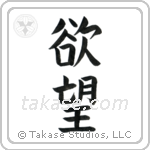
欲望 yokubō Desire
欲望 (yokubō) is the standard Japanese noun for desire as craving, the wanting that comes from a lack. A Meiji book of 1873 already puts it that way: the desire to have what one lacks. For more than half a century, Kenkyūsha's large Japanese-English dictionary also let it mean ambition.
Abstract
欲望, yokubō, is the standard Japanese noun for desire as craving: the wanting that comes from a lack. The Japanese dictionaries define it by that lack, and it carries two of the English word's senses outright, the eager longing and sexual desire. As a noun it is a word of Meiji prose: the 精選版 日本国語大辞典's earliest example is from 1889, and in the National Diet Library's digitized books as searched for this study, the oldest dated witnesses are translations and treatises of 1869 and 1873, where it is glossed as a wish and used of the desire to have what one lacks. The English dictionaries gave it desires, want in 1896, then an ambition as well in Kenkyūsha's large dictionary from 1918 to its fourth edition of 1974; the smaller Kenkyūsha of 1983 and JMdict today give desire, with lust second or later.
Overview
The sense. A standard, common noun: JMdict marks it common and gives it no usage tag [1], and no dictionary cited here marks it slang or vulgar. The Japanese definitions speak with one voice. デジタル大辞泉: 不足を感じてこれを満たそうと強く望むこと。また、その心, feeling a lack and strongly wishing to fill it; and the heart that does so. 精選版 日本国語大辞典: 不足を感じてこれを充足させようと望むこと。また、その心。ほしがること。ほしいと思い望む心, the same, ending wanting; the heart that wishes to have. 日本大百科全書 reaches for psychology and for Sartre: desire as a motive whose fulfillment is held back, and desire as seeking what one lacks in order to become what one is not [2]. The one thing every definition has is the lack. The English word desire has four senses in Wiktionary: the feeling of desiring; an eager longing for something; someone or something wished for; strong attraction, particularly romantic or sexual; and motivation [3]. 欲望 carries the first and the third outright; with 性的 in front of it, 性的欲望, it is sexual desire [4]. It names a craving that drives, 成功に対する欲望, a desire for success [4]. The word for a wish held and hoped for is 願望, 願い望むこと [5], and the word for a great ambition is 大望, read taimō and also taibō [6]. None of the Japanese definitions quoted here names ambition, though デジタル大辞泉 sets 野心 and 野望 among its related words for 欲望 [2]; Kenkyūsha's large Japanese-English dictionary glossed it an ambition from 1918 to 1974 (The historical record).
The words. Two characters. 欲 is wanting: デジタル大辞泉 glosses it ほしがること。自分のものにしようと熱心に願い求めること。また、その気持ち, wanting something; eagerly wishing to make it one's own; and the feeling of that [7]. 望 is hoping, looking toward: 願望, the wish held and hoped for, is 願い望むこと [5]. The older spelling 慾望, with 心 under 欲, is the same word written with a character outside the modern list of characters for general use [8]; the prewar books below write it both ways.
The text in English. The bilingual dictionaries today give desire; appetite; lust, in that order (JMdict) [1], and appetition; desire; lust; appetite (the JST dictionary of scientific terms) [9]; Kenkyūsha's 新和英中辞典 gives a desire and the example 彼は欲望のとりこになっていた, He was a slave to his passions, with no lust at all [9]. Lust is a real gloss, and everywhere a secondary one. The older bilingual dictionaries are dated witnesses and stand in The historical record.
The historical record
About 1216 and 1688. The character 欲. The national dictionary defines 欲 as 欲すること。願うこと。ほしがること。むさぼり求めること。また、その心。欲望。欲心。欲情, wishing; desiring; wanting; craving; and the heart that does so, with 欲望 among its synonyms, and cites the 発心集 of about 1216 and Saikaku's 日本永代蔵 of 1688 [7]. These date the character in the sense of wanting, not the compound.
The Buddhist 欲. The character has a Buddhist life that the dictionaries document for it and its compounds. 五欲 is 仏語。人間がもつ五つの欲。色・声・香・味・触の五境に対して起こす欲望, the five desires a person has, the desires that arise toward the five objects of sense: form, sound, scent, taste and touch [10]. 貪欲, greed, is in Buddhist use 三毒・十悪の一。欲望にまかせて執着しむさぼること, one of the three poisons and the ten evils: clinging and craving at the bidding of desire [11], and the three poisons are 人の善心を害する3種の煩悩。貪・瞋・痴, the three defilements that harm the good heart: greed, anger and delusion [12]. The dictionaries use 欲望 to define 五欲 and 貪欲, and define 三毒 by its three, of which 貪 is the first; they do not give 欲望 itself a Buddhist sense. A reader who knows the tradition may hear it in the word.
The Chinese pair. 普及版 字通 lists 欲望 among the compounds of 欲, 得たいとおもう感情, the feeling of wanting to have [2]. In classical Chinese the two characters can stand side by side as two verbs. 十八史略, in a Japanese school edition of 1884, has the wandering scholars who followed the king only because they 徒欲望尺寸之地, wished only to hope for a foot or an inch of land; its reading marks send the reader to 望 before 欲, to wish to hope for [13]. The other classical Chinese passages read among the oldest hits of the National Diet Library search made for this study (1869, below) read the same way.
1867 to 1909. No headword in the first Japanese-English dictionaries. Hepburn's dictionary has no entry for yokubō in its first edition of 1867 or in its fourth edition of 1888, copyright 1886; both enter 慾, yoku, as lust, inordinate desire, concupiscence, covetous (1867) and passion, appetite, lust, inordinate desire, concupiscence, covetousness (1888) [14][15]. Inouye's dictionary of 1909 has none either; its 慾 is avarice; greed; covetousness and desire; appetite [16]. Yet Inouye uses the word in an example under totetsu mo nai, extravagant: 途轍もない欲望を起した, He harboured extravagant desires [16].
1869. The noun, glossed as a wish. The National Diet Library's digitized books, searched for this study in a mirror of 10,529 books and in the library's public-domain full text, carry the noun from the first years of Meiji, in translations and treatises on Western law and economics [17]. The oldest dated one found is a Japanese reading of Henry Wheaton's international law, 萬國公法譯義, of 1869 in the library's record. Of the three parts of the law of nations it names, it says: コノ三ツノ者ハ。萬國ノ人情ノ欲望ヨリ出ヅト云フ, these three, it is said, come from the desire of the human heart in all nations, and it prints the ruby ネガヒ beside 欲望: negahi, a wish [18].
1873. The desire to have what one lacks. 高橋達郎's 自主新論, 1873 in the library's record, writes of the comforts of life: 人自カラ欠乏スル所ノ物ヲ有スルノ欲望アルハ天ノ然ラシムル所, that a person has the desire to possess the things one lacks is the work of Heaven [19]. This is the lack the dictionaries define the word by today.
1881 and 1884. A philosophers' glossary chooses 願望. The 哲学字彙, the Tokyo University glossary of philosophical terms, has no entry for Desire in 1881: Design ends one page and Despair opens the next [20]. Its enlarged edition of 1884 adds Desire and gives it 願望, not 欲望 [21].
1889. The national dictionary's earliest example. The 精選版 日本国語大辞典 dates the compound from 幸田露伴's 露団々 of 1889, as the dictionary quotes it: 「ぶんせいむの欲望(ヨクバウ)も畢竟徒労に属するだらう」, Bunseimu's desire too will come to nothing in the end [2].
1896. Brinkley: desires, want. Brinkley's dictionary enters Yokubō, よくばう, 欲望, n. with the mark Chin.: Desires, want, and the phrase 欲望ヲ懐ク, to have desires. It names as synonyms kokorozashi, negai and nozomi, aspiration, wish and hope [22].
1918 to 1974. Kenkyūsha: an ambition. Takenobu's dictionary of 1918 enters yokubō (慾望). n. A desire; an appetite; an ambition [23]. The American edition of 1942, photographed from the dictionary's printing of 1939, has also a craving and the economist's want, and glosses 欲望を滿たす as gratify (satisfy) one's desire (want, ambition) [24]. 竹原常太's Standard dictionary of 1946 splits the word by sense, heading each English gloss with a Japanese word: 願望 desire, 野望 ambition, 慾求 wants, with the example 支配人ニナリタイ慾望ガアツタ, His ambition was to be the manager [25]. The fourth edition of Kenkyūsha's large dictionary, 1974, keeps a desire; an appetite; a craving; an ambition; wants, and adds 世界支配の欲望, the lust for world domination [26].
1983. Kenkyūsha's smaller dictionary: a desire. The third edition of the 新和英中辞典 enters 欲望 as a desire, with the dictionary's mark for a formal word, and the examples 欲望を満たす, gratify (satisfy) one's desire(s), and 欲望を抑える, curb one's desire(s); under 欲 it adds a passion [27].
Today. The dictionaries define the word by lack [2]. The modern example sentences Weblio gathers run to restraint and struggle: 欲望を抑える, to hold desire down; 私は自分自身の欲望と戦わなければならない, I must fight my own desires; 私達はこのような欲望に打ち勝たなければなりません, we must overcome desires like these; and beside them 彼女はもう夫に対して性的欲望は持っていない, she no longer feels sexual desire for her husband, and 成功に対する彼の欲望を十分に満足させるものはないように思えた, nothing seemed enough to satisfy his desire for success [4]. Weblio's list of related words sets 人欲, 淫欲 and 邪欲 beside it [4]. The word デジタル大辞泉 sets beside it for ambition, 野望, it defines as 分不相応な望み, a hope beyond one's station [28].
What is not a source. The Buddhist 五欲 and 貪欲 are the character's company in the dictionaries [10][11], not a reading of the compound. The Chinese 欲望 read for this study is two verbs, not the noun [13][17]. Kenkyūsha's an ambition is a witness to what the English reached for from 1918 to 1974 [23][26], not to how a Japanese dictionary defines the word.
A reading
The word means what most English speakers mean by desire, and it means it without embarrassment: a standard noun, neither vulgar nor clinical. It came into Meiji prose as the word for what people want, glossed negahi, a wish, and already used of what one lacks; the Japanese dictionaries have kept that definition. Its edge is at ambition. For more than half a century Kenkyūsha's large dictionary let it reach there, and the Standard of 1946 says which ambition: 野望, the hope beyond one's station, the ambition that is an appetite. My reading is that this is still where the word's edge lies. A desire for success or a lust for world domination is 欲望; the aspiration held up as a good, 志 or 大望, is not. Lust is a real gloss and a secondary one: a rendering that leads with it loses the reader who meant longing, and a rendering that omits it hides a sense the word does carry.
References
- JMdict (EDRDG), 「欲望」, at gokanji. https://new.gokanji.com/word/欲望
- 「欲望」, デジタル大辞泉 · 精選版 日本国語大辞典 · 日本大百科全書 · 普及版 字通, at kotobank. https://kotobank.jp/word/欲望-653765
- "desire", Wiktionary (English), noun. https://en.wiktionary.org/wiki/desire
- 「欲望」の例文・使い方・用例・文例 and 関連用語, at Weblio 辞書. https://www.weblio.jp/content/欲望
- 「願望」, デジタル大辞泉, at kotobank. https://kotobank.jp/word/願望-471456
- 「大望」, デジタル大辞泉 · 精選版 日本国語大辞典, at kotobank. https://kotobank.jp/word/大望-558348
- 「欲」, デジタル大辞泉 · 精選版 日本国語大辞典, at kotobank. https://kotobank.jp/word/欲-653651
- KANJIDIC, 慾, at kanjiapi.dev. https://kanjiapi.dev/v1/kanji/慾
- 「欲望」, JST科学技術用語日英対訳辞書 · 研究社『新和英中辞典』, at Weblio 英和・和英辞典. https://ejje.weblio.jp/content/欲望
- 「五欲」, デジタル大辞泉 · 日本大百科全書, at kotobank. https://kotobank.jp/word/五欲-66412
- 「貪欲」, デジタル大辞泉, at kotobank. https://kotobank.jp/word/貪欲-564797
- 「三毒」, デジタル大辞泉, at kotobank. https://kotobank.jp/word/三毒-71221
- 曽先之 編, 石崎謙 校, 『十八史略校本』, 1884, 巻之二, leaf 24, scan 26, National Diet Library. https://dl.ndl.go.jp/pid/775483/1/26
- J. C. Hepburn, A Japanese and English Dictionary, Trübner & Co., London, 1867, p. 538. https://archive.org/details/japaneseenglishd00hepb
- J. C. Hepburn, A Japanese-English and English-Japanese Dictionary, 4th ed., Maruya, Tokyo, 1888 (copyright 1886), p. 745. https://archive.org/details/japaneseenglishe00hepbuoft
- Inouye Jūkichi, Inouye's Comprehensive Japanese-English Dictionary, Sanseidō, Tokyo, 1909, pp. 1693, 1813–1814. https://archive.org/details/inouyesjapanesee00inou
- A local mirror of 10,529 of the National Diet Library's digitized books, searched for 欲望 and 慾望 (3,830 books), and the library's public-domain full-text search (NDL Lab) sorted by year, 10 October 2026; the books and lines are held in the research record. https://lab.ndl.go.jp/dl/
- Henry Wheaton, 原著, 『萬國公法譯義』 一, 1869, leaf 16, scan 42, National Diet Library. https://dl.ndl.go.jp/pid/2938158/1/42
- 高橋達郎 編, 『自主新論』, 1873, scan 45, National Diet Library. https://dl.ndl.go.jp/pid/798477/1/45
- 和田垣謙三 等編, 『哲学字彙』, Tokyo University, 1881, pp. 23–24, scans 14–15, National Diet Library. https://dl.ndl.go.jp/pid/752942/1/15
- 井上哲次郎, 有賀長雄 増補, 『哲学字彙』, 東洋館, 1884, p. 31, scan 22, National Diet Library. https://dl.ndl.go.jp/pid/994560/1/22
- F. Brinkley, ed., An Unabridged Japanese-English Dictionary, Sanseidō, Tokyo, 1896, p. 1635. https://archive.org/details/cu31924082117288
- 武信由太郎 編, 『武信和英大辞典』 (Takenobu's Japanese-English Dictionary), 研究社, 1918, p. 2372, scan 1189, National Diet Library. https://dl.ndl.go.jp/pid/925665/1/1189
- Takenobu Yoshitarō, ed., Kenkyusha's New Japanese-English Dictionary, American edition (reproduced from the printing of 1939), Harvard University Press, Cambridge, Massachusetts, 1942, p. 2189.
- 竹原常太, 『スタンダード和英辞典』, 大修館書店, 1946, p. 1197, scan 604, National Diet Library. https://dl.ndl.go.jp/pid/1126792/1/604
- Masuda Kō, ed., Kenkyusha's New Japanese-English Dictionary (新和英大辞典), 4th ed., Kenkyusha, Tokyo, 1974, p. 1993.
- Kenkyusha's New Collegiate Japanese-English Dictionary (新和英中辞典), 3rd ed., Kenkyusha, Tokyo, 1983, pp. 1288–1289.
- 「野望」, デジタル大辞泉 · 精選版 日本国語大辞典, at kotobank. https://kotobank.jp/word/野望