

常に忠誠を tsune ni chūsei wo Semper Fi
常に忠誠を (tsune ni chūsei wo), always, loyalty, is fair Japanese for the Marines' semper fidelis, the verb withheld the way a Japanese vow withholds it. The words also have a Japanese home of their own: a civilian field code of 1943, modeled on the army's code of 1941, sets them in the article on reverence that heads its creed.
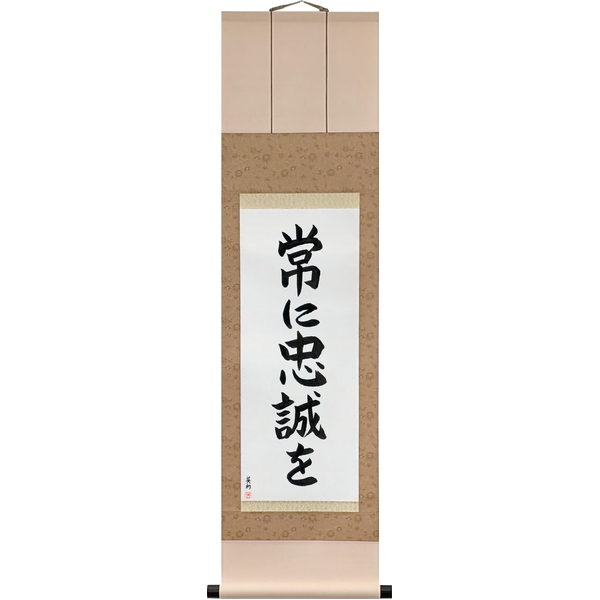
Abstract
常に忠誠を, always, loyalty, renders semper fidelis, the motto of the United States Marine Corps since 1883, and the Marines' motto has no received Japanese. The words themselves sit in twenty-five prewar Japanese books on their own account, and the most telling of them is a 1943 civilian field code modeled on the army's, where they stand in the article on reverence that heads its creed. The army's own code of 1941 has the same sentence with a different noun, 忠孝, so the exact words are the civilian imitation's, and they were once the words of the other side's.
Overview
The sense. Semper fidelis is the United States Marine Corps' motto since 1883. There is something a Japanese reader over eighty would know about the Japanese: the words have a Japanese home, and it is the wartime creed literature, where a 1943 citizens' field code sets them in the article on reverence that heads its creed.
The words. 忠誠 chūsei: 忠実で正直な心。また、忠義を尽くすこと, a faithful and honest heart; devotion to one's lord, with the dictionary's examples 国家に忠誠を尽くす and 忠誠を誓う; first cited from a 1530 commentary on Zhuangzi [1]. 常に tsune ni, always. 常に忠誠を, always, loyalty, ends on the particle を and leaves the verb, 尽くす or 誓う, unsaid, which is how Japanese makes an object-phrase into a vow.
The text in English. Semper fidelis is an adjective, always faithful; Japanese has no adjective for the Marine's virtue and says the noun instead, loyalty, always, with the verb withheld. The withheld verb is the Japanese vow, and a rendering keeps it.
The historical record
1883. Semper fidelis. The Marine Corps adopted the motto in 1883 on the initiative of Colonel Charles McCawley, its eighth commandant, after three earlier mottos; the phrase has older European lives on family crests and city arms, which are not this motto's [2].
1941 and 1943. 常に忠誠を, and where a Japanese reader has met it. The Marines' motto has no received Japanese, and 常に忠誠を is in 25 prewar books in the National Diet Library's full-text index on its own account, incidentally [3]. The one that matters is a 1943 book by Nakashiba Suezumi 中柴末純 titled 『国民戦陣訓』, a Field Service Code for the citizen, modeled on the army's 戦陣訓 of January 1941, the code that told soldiers not to be taken alive. The first article of its creed, on reverence, opens 神靈は遍く照覽し給ふ, the spirits of the gods look on all things, and goes on: 身を修め、心を正しうし、篤く敬神の「まこと」を致し、常に忠誠を心に念じ、誓て神明の心に通ふべし, cultivate the self, set the heart right, render the sincerity of reverence, hold loyalty always in mind, and vow to reach the heart of the gods [4]. The army's own 1941 text has the same sentence with a different noun: 心を正し身を修め篤く敬神の誠を捧げ、常に忠孝を心に念じ, hold loyalty and filial piety always in mind [5]. So these exact words, 常に忠誠を, are the 1943 civilian imitation's and not the army's. Either way, the phrase's Japanese home is the wartime creed: the words are honest Japanese for the Marine's virtue, and they were once the words of the other side's.
What is not a source. The Japanese renders its motto in no book known; its prewar life is its own and not the Marines'. The 1943 creed is where 常に忠誠を lives in Japanese, and is named here so it is not later taken for the army's 1941 code; the army wrote 忠孝.
A reading
Of the mottos of service rendered into Japanese, this one carries the most. 常に忠誠を is fair Japanese for semper fidelis, and it is also in the opening article of a 1943 Japanese creed written to make civilians think like soldiers. Both are true at once, and a reader of the Japanese may hear either.
References
- 「忠誠」, at kotobank. https://kotobank.jp/word/忠誠-97330
- "Semper fidelis", English Wikipedia. https://en.wikipedia.org/wiki/Semper_fidelis
- National Diet Library Digital Collections, next-generation full-text search on 常に忠誠を, counted to 1946. https://lab.ndl.go.jp/dl/
- 中柴末純, 国民戦陣訓, 二見書房, 1943, scan 17. https://dl.ndl.go.jp/pid/1039440/1/17
- 新体制問題資料 附録:戦陣訓, 北陸昭徳会, 1941, scan 29. https://dl.ndl.go.jp/pid/1266774/1/29