

危険を冒す kiken wo okasu Take Risks
危険を冒す (kiken wo okasu), brave the danger, is the Japanese idiom for taking a risk, and its roots are commercial: Meiji Japanese made it from the English run a risk, on record from an 1884 etiquette manual on horses and an 1889 treatise on life insurance.
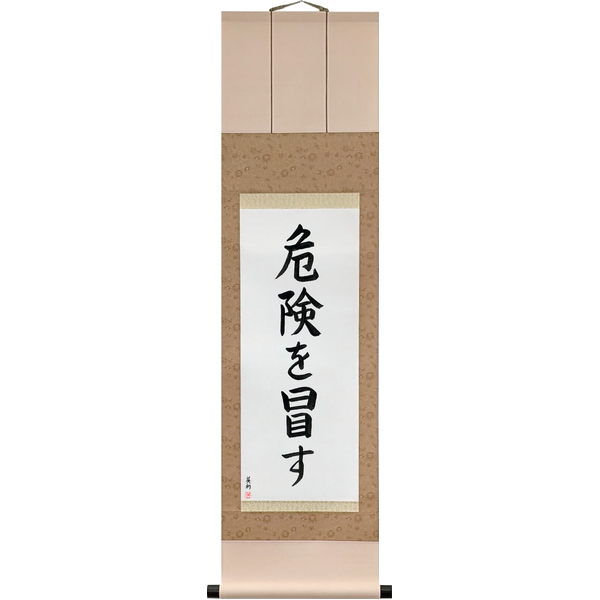
Abstract
危険を冒す, kiken wo okasu, brave the danger, is a set expression with its own dictionary entry, and a Meiji business idiom for running a risk, on record from 1884. It entered Japanese through translated manuals and the business schools as the equivalent of the English run a risk, before it reached a wall. Its verb 冒す is the one used of defying weather and profaning the sacred, which gives it more edge than the English.
Overview
The sense. Standard Japanese; 危険を冒す is a set expression with its own dictionary entry, and a sentence of decision. It is the Japanese idiom for taking a risk, and its verb 冒す is the one used of defying weather and profaning the sacred, so the phrase has more edge than the English take risks: it is what a person does knowing the cost.
The words. 危険 kiken, danger, cited from the 続日本紀 of 737 in the spelling 危嶮 [1]; 冒す okasu: 危険や困難を覚悟のうえで、あえてする, to do a thing knowingly in the face of danger or difficulty, then to defile what is sacred, then to take another house's name; the bilingual dictionary gives the whole phrase 危険を冒す as an expression, to brave a danger; to take a risk [2].
The text in English. Take risks is where the languages part: English takes a risk as one takes a chance, and Japanese braves it, 冒す, so the Japanese is a shade more serious, and the English plural has no counterpart, since 危険 is neither singular nor plural.
The historical record
1884 and 1889. 危険を冒す in the useful books of Meiji. The idiom's oldest dated page in the library is an etiquette manual translated from the American, on horses: a gentleman must not offer a lady a horse he has not tried himself, 甞て乘り試みざる馬を婦人に進むるは實に危險を冐すの虞あり, for that is truly to run a risk [3]. Five years later it is a term of art in the first Japanese treatise on life insurance, among the conditions under which insurance can work: 同樣の危險を冒す人の多人數なること、危險を冐す人の多人數なるに比して實際出來事に過ふ人の割合に少なきこと, that those who run the same risk be many, and that those who actually meet the event be few in proportion to those who run the risk [4]. Two undated Waseda correspondence-course texts of the same generation show where the phrase came from: a commercial-English lesson glosses the English idiom, Runs great risk. run a risk 熟語である.「危險を冐す」「危險に逢ふ」等の意味である. [5], and an economics lecture uses it of the entrepreneur, 危險を冐す多き者は其受くる所隨て多く, he who runs the greater risk receives accordingly the more [6]. 危険を冒す is Meiji Japanese for the English run a risk, and it entered through business before it reached a wall; the two leaves print the variant 冐 in some lines and 冒 in others, each quoted as printed.
What is not a source. No text stands behind the phrase. It is an idiom the language made out of the English run a risk in the 1880s.
Today. Take risks is the stock of the English motivational register and has no English author. The edge of 冒す is what a rendering keeps, so that take risks is not softened to try things.
A reading
The phrase a reader will trust least as Japanese is the one with the deepest roots, and they are commercial: a Meiji lecturer glossing run a risk for students of business English, an actuary counting the people who run the same risk. That is a good pedigree for a phrase of decision, and 冒す keeps the cost in view.
References
- 「危険」, デジタル大辞泉・精選版日本国語大辞典, at kotobank. https://kotobank.jp/word/危険
- 「冒す」, デジタル大辞泉・精選版日本国語大辞典, at kotobank. https://kotobank.jp/word/冒す
- ヒル, 『西洋礼式』, 坂部録三訳, 博聞社, 1884, scan 77. https://dl.ndl.go.jp/pid/759140/1/77
- 藤沢利喜太郎, 『生命保険論』, 文海堂, 1889, scan 7. https://dl.ndl.go.jp/pid/800566/1/7
- 今井友次郎講述, 『商業英語』, 早稲田大学出版部, undated, scan 19. https://dl.ndl.go.jp/pid/1082660/1/19
- 天野爲之講義, 『經濟原論』, 東京専門学校出版部, undated, scan 88. https://dl.ndl.go.jp/pid/1082462/1/88