

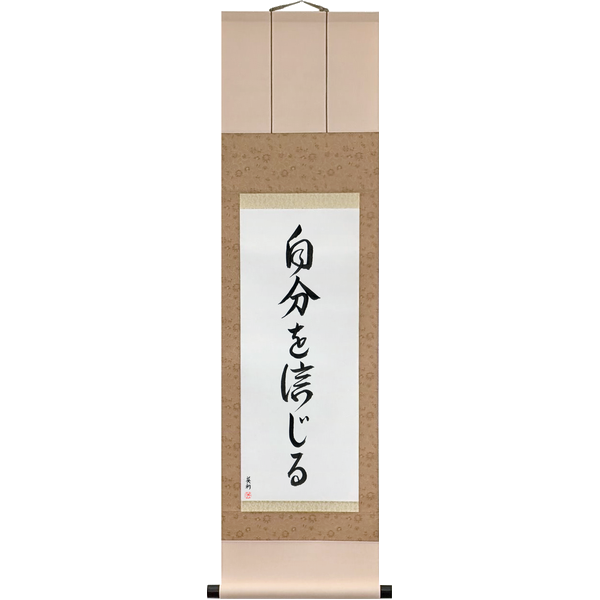
自分を信じる jibun wo shinjiru Believe in Oneself
自分を信じる (jibun wo shinjiru), believe in yourself, is a sentence anyone can say, and its first page in the National Diet Library's books is the most famous scene of Meiji fiction: Kan'ichi on the Atami beach in 1903, telling Miya he had believed in her as surely as he believed in himself.
Abstract
自分を信じる, jibun wo shinjiru, believe in yourself, is plain Japanese with a Japanese life of its own: its first page in the National Diet Library's books is spoken by the wronged lover of Meiji Japan's most famous novel, Ozaki Kōyō's 金色夜叉 of 1903, and a tanka critic of 1908 and a poet's memoir of 1920 carry it after him. The verb's one-step form 信じる, beside the older 信ずる, is first cited from 1902, so the verb in this spelling and Kōyō's sentence are of one decade.
Overview
The sense. Standard Japanese, a free phrase, and a sentence of decision. 自分を信じる is a verb with its object, and the object is the reflexive 自分, oneself, so the sentence works for any speaker.
The words. 自分 jibun: デジタル大辞泉 反射代名詞。その人自身。おのれ, the reflexive pronoun: the person himself, oneself, with 自分を省みる, to look at oneself; 精選版日本国語大辞典 cites the reflexive from a 1724 puppet play and the first-person use from 1425 [1]. 信じる shinjiru, to believe, is the modern one-step form of the older 信ずる; the dictionary's first citation for the new form is Uchida Roan in 1902, which means the verb in this spelling and Kōyō's sentence below are of one decade [2].
The text in English. Believe in yourself and 自分を信じる are the same verb and the same object; Japanese adds nothing and loses nothing [3].
The historical record
1903. 自分を信じる, in 金色夜叉. In the eighth chapter of Ozaki Kōyō's novel, the Atami beach parting, the novel's most famous scene, Kan'ichi says to Miya, who is leaving him for a rich man: 「宮さん、お前に限つては然云ふ了簡は無からうと、僕は自分を信じるほどに信じてゐたが、それぢや依樣お前の心は慾だね、財なのだね。」, Miya, I believed, as surely as I believe in myself, that you of all people would never think that way; so after all your heart is greed, is money. The phrase's first page in the library is not a maxim; it is the standard against which a betrayal is measured [4].
1908 and 1920. The tanka poet Kubota Utsubo, commenting on a poem, writes the sentence a self-help book would: 自分を信じるといふ事は、理窟としては、如何にもたやすい事のやうであるが、實際としては、案外困難の事である。此れは誰しも感ずる事だ, to believe in oneself seems, as a matter of theory, the easiest thing, but in practice it is surprisingly hard; everyone feels this [5]. And Murō Saisei, remembering a hungry adolescence: 自分は自分を信じるちからが大きかつたため、いま在る生活がきつと自分を善くしてくれることを考へてゐた, because my power to believe in myself was great, I thought that the life I was living would surely make me better [6]. Thirty-nine books carry the phrase to 1946, and these are its shapes: a lover's reproach, a critic's aside, a memoir's confession.
What is not a source. No text stands behind the sentence. It is a sentence anyone can say, and Kōyō's Kan'ichi said it memorably.
Today. Believe in yourself is the stock of the English motivational register and has no English author. The reflexive is what a rendering keeps: it makes the sentence true for whoever reads it.
A reading
The sentence has a better story than its English: the first Japanese to say it in print was a jilted man on a beach, and Kan'ichi's sentence shows the phrase carrying its full weight, belief in oneself as the measure of every other belief.
References
- 「自分」, デジタル大辞泉・精選版日本国語大辞典, at kotobank. https://kotobank.jp/word/自分
- 「信じる」, デジタル大辞泉・精選版日本国語大辞典, at kotobank. https://kotobank.jp/word/信じる
- JMdict (EDRDG), 「自分」, at jisho. https://jisho.org/word/自分
- 尾崎紅葉, 『金色夜叉』前編, 春陽堂, 1903, 第八章, printed pp. 148–149, scan 78. https://dl.ndl.go.jp/pid/886443/1/78
- 窪田空穂, 『新派短歌評釈』, 玄黄社, 1908, scan 91. https://dl.ndl.go.jp/pid/873602/1/91
- 室生犀星, 『性に眼覚める頃』, 新潮社, 1920, scan 148. https://dl.ndl.go.jp/pid/962886/1/148