

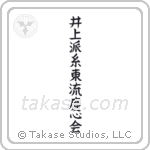
井上派糸東流慶心会 inoueha shitōryū keishinkai Inoue-Ha Shitoryu Keishin-Kai
井上派糸東流慶心会 (inoueha shitōryū keishinkai) is a karate school based in Tottori. Inoue Yoshimi 井上慶身 opened it after his teacher Hayashi Teruo died in 2004, and its 慶 is the first character of his given name. Before it, the yearbooks and directories read here, from 1978 to 1997, list him in his teacher's school.
Abstract
井上派糸東流慶心会 is the name of a school of karate based in Tottori: the Keishin-kai of the Inoue branch of Shitō-ryū. Its founder, Inoue Yoshimi 井上慶身 (1946–2015), was, by his school and a biography, the only live-in pupil of Hayashi Teruo 林輝男, and the yearbooks and directories read here, from 1978 to 1997, list him at the Tottori branch and then the Chūgoku regional headquarters of Hayashi's school, and as the 理事長, the head of the board, of Tottori's karate federation. The school's Hong Kong branch dates its founding to 2004, after Hayashi's death that year, and a biography to 2005. 慶, in the dictionaries joy, a matter for celebration, is the first character of the founder's given name, where it is read yoshi; no dictionary read here carries 慶心 or 慶心会, and the National Diet Library's full-text search returns 慶心会 only as the name of other bodies.
Overview
The sense. A proper name, the name of a karate school and its association.
The words. 井上 Inoue, a surname. 派 ha is, in the デジタル大辞泉, 一つのもとから分かれ出た、流儀や傾向・態度を同じくするそれぞれの仲間・系統, each of the groups or lines that branched from one source and share a style, a tendency and an attitude [1]. 糸東流 shitōryū is the style of Mabuni Kenwa 摩文仁賢和, named from the first characters of the surnames of his two teachers, 糸洲 and 東恩納 [2]. 慶 kei is, in the デジタル大辞泉, めでたいと祝う。よろこぶ, to celebrate a happy thing; to rejoice, and めでたいこと, a happy thing; in the 精選版 日本国語大辞典, めでたいこと。祝うこと。よろこび, a happy thing; celebration; joy; the 字通 gives its senses as よろこび・たまもの・さいわい, joy, a gift, good fortune, and explains the character as a sign of good fortune, from a suit won by divine judgment [3]. Among the readings the デジタル大辞泉 gives 慶 in names (名のり) is よし, and the 字通 quotes the 名義抄's ヨシ [3]. 心 shin is こころ。精神, the heart, the mind, and among its readings in names is み [4]. 会 kai is an association. No dictionary read here has an entry for 慶心 or 慶心会.
The text in English. The school writes its name in English Inoue-Ha Shito-Ryu Keishin-Kai on its Hong Kong branch's pages [5][6], and a biography writes Inoue-ha Shito-Ryu Keishin-kai [7]. The modified Hepburn is inoueha shitōryū keishinkai.
The historical record
1946 to 2004, the founder in his teacher's school. A pupil's memorial of August 2015 gives the founder's name with its reading beside it, 井上慶身, いのうえ・よしみ [8]. By the school's Hong Kong branch, Inoue was born in Tottori on 27 September 1946, was in Osaka at eighteen to study under Hayashi Teruo 林輝男, became his only live-in pupil (唯一入室弟子), and later returned to Tottori and opened a Tottori branch of Hayashi's school, which it writes 林派糸東流 [6]. A biography gives the same, with the years: Inoue trained with Hayashi for four years from 1964 to 1968, then returned to Tottori when his father fell ill and, with Hayashi's permission, opened a branch there [7]. Hayashi was born in 1924, by the biography and by a karate yearbook of 1979, which lists him 林輝男(全空連8段)大13・10・21 林派糸東流会々長 (snippet view) [7][9].
The yearbooks and directories, read in snippet view, keep Inoue inside Hayashi's school. The 日本武道年鑑 of 1978 lists 鳥取支部(林派糸東会) 井上慶身, the Tottori branch, at a youth hall's gymnasium in Tottori city (snippet view; the text layer reads 島取支部) [10]. The yearbook of 1979 reports 鳥取県空連発足, the founding of the Tottori karate federation, which had applied to join the 全空連 as its forty-fifth member body and was to be admitted, with 相沢英之 as its president (会長) and Inoue as its 理事長, the head of its board (snippet view) [9]. 中山三枝, who won the world title in women's individual kata in 1982, 1984 and 1986 [7], wrote in 1992, in an article whose byline is read from the same page, that her start in karate was a visit, in the summer of 1976, at nineteen, to the practice hall of 井上慶身師範, who came to Hamasaka to teach (snippet view) [11]. The album of the 1985 national games, held in Tottori, lists 空手道 監督 井上慶身 林派糸東流会, Inoue of the 林派糸東流会 as 監督, manager, of the karate entry, among Tottori entrants (snippet view; the text layer doubles the line) [12]. The 全国各種団体名鑑 of 1989 and 1997 list him as 井上慶身(林派糸東流会中国地区本部), of the Chūgoku regional headquarters of Hayashi's school (the dōjō lists of 1978 and 1979 write the school 林派糸東会, where the same yearbooks head Hayashi's own entry 林派糸東流会); the 1989 edition also lists him as 理事長 in an entry with the federation's 1979 secretary, 中川俊隆, and its address (snippet view) [13][14]. None of these names 慶心会.
2004 and 2005, the school. The Hong Kong branch's founder page says that after Hayashi died in 2004, Inoue, joining his reverence for his teacher to his own distinctive understanding and technique of karate, opened 井上派糸東流慶心会, with its headquarters in Tottori and branches abroad in the United States, Brazil, Sweden and elsewhere [6]; its page on the association says 於2004年創立, founded in 2004, names Inoue its first head (初代宗家) and president, and places its headquarters dōjō in Tottori [5]. The biography says: In 2005, one year after the death of his teacher, Teruo Hayashi, Inoue founded Inoue-ha Shito-Ryu Keishin-kai, incorporating his own knowledge and experience [7]. Both put Hayashi's death in 2004, and they differ on the founding by one year.
2012 to 2015, the founder's last years. The Japanese Wikipedia's article on 宇佐美里香, world champion in women's individual kata in 2012, says she studied under 井上派糸東流慶心会宗主井上慶身 [15]. By the biography Inoue died in May 2015 [7]; the memorial of August 2015 says the news of his death came that spring [8]. The Hong Kong branch says that after his death in 2015 the school, by his will, has 岡村将広 as its second head and 岡村行雄 as its president [5].
2016 and 2023, the school after him. The Hong Kong branch, 研心社, dates its own founding to 2016 and describes itself as directly under the Tottori headquarters [5]. The Tottori newspaper 日本海新聞, on 28 May 2023, reports four children of 井上派糸東流慶心会 qualifying for a national tournament, mentions the school's headquarters dōjō, and names its branches at 安長 in Tottori city and at 香住 [16].
What the searches return. The National Diet Library's full-text search returns 慶心会 26 times, from 1941 to 2018, and no window among them reads as karate; among them are a 慶心會 gathering in the collected writings of a man who had died, of 1941, a Tokyo cram school advertising in yearbooks of the 1980s, hospitals and a welfare corporation; it returns 井上派糸東流 not at all, and 井上慶身 22 times, from 1959 to 2005, the first another person of the name, in a class diary of 1959, and the other twenty-one this man, three of them with no window, in the yearbooks and directories above, honors lists and a prefectural bulletin [17]. CiNii Research returns 慶心会 in six records, none on karate [18]. In the Internet Archive's full text, Keishin-kai and Keishinkai name painters, a shrine society, publishers, a Tokyo pre-school, a hospital and local volunteers; one karate book of 2006 says that Kuniba Kōsei, Hayashi's first teacher, founded keishin-kai, where the same book elsewhere has Hayashi-ha shito-ryu is from seishin-kai [19][7], and the English Wikipedia, which spells him Kosei Kokuba, calls the karate organization he started the Seishinkai [20]. Nothing read joins that name to Inoue's school.
Today. The school writes its name in English Inoue-Ha Shito-Ryu Keishin-Kai [5][6]. The Japanese Wikipedia's list of karate bodies carries 日本空手道井上派糸東流慶心会 [21], and a Tottori newspaper writes the name [16]. A rendering keeps it a proper name, with 派 as -ha, a branch, and 流 as -ryū.
A reading
The name is built from the founder's branch, the style it belongs to, and the association. The yearbooks show Inoue from 1978 to 1997 in his teacher's school, and the name he gave his own school keeps that school's style in its middle. No witness I have read says why he chose 慶心, and I read it as his own name turned into the school's: 慶 is the first character of 慶身, and by the readings the dictionaries give in names, 慶 can be read yoshi and 心 mi, so that 慶心, written as a given name, could be read yoshimi, his name in sound, with the heart, 心, in the place of the body, 身. The school reads it keishin, and by the dictionaries' senses it is the joyful heart.
References
- 「派」, デジタル大辞泉 and 精選版 日本国語大辞典, at kotobank. https://kotobank.jp/word/派-597783
- 沢勲・摩文仁賢三・樋口豊治・長田眞男「空手道学の略史とITによる手技術と急所の相関モデル」, 大阪経済法科大学論集 88, 2004, pp. 83–121, the chronology at p. 91. https://keiho.repo.nii.ac.jp/records/1921
- 「慶」, デジタル大辞泉, 精選版 日本国語大辞典 and 普及版 字通, at kotobank. https://kotobank.jp/word/慶-488101
- 「心」, デジタル大辞泉, at kotobank. https://kotobank.jp/word/心-64563
- 日本空手道井上派糸東流慶心会香港研心社, 關於本會 (About). https://inoue-ha-kenshinsya.wixsite.com/home/about
- 日本空手道井上派糸東流慶心会香港研心社, 初代宗家 (1st Soke). https://inoue-ha-kenshinsya.wixsite.com/home/1stsoke
- "Yoshimi Inoue: The Life of a Legendary Karate Instructor", Karate Philosophy, 2022 (updated 9 August 2022). https://www.karatephilosophy.com/yoshimi-inoue-the-life-of-a-legendary-karate-instructor/
- 能見一範「井上慶身先生の思い出」, 光圓流, August 2015. https://kouenryu.jimdofree.com/光圓流について/井上慶身先生の思い出/
- 日本武道館『日本武道年鑑』 第2号 (昭和54年度版), 1979, snippet view, National Diet Library pid 12123405. https://dl.ndl.go.jp/pid/12123405
- 日本武道館『日本武道年鑑』 第1号 (昭和53年度版), 1978, snippet view, National Diet Library pid 12119266. https://dl.ndl.go.jp/pid/12119266
- 中山三枝, in 『学校体育』 45(4), April 1992, snippet view, National Diet Library pid 6027413. https://dl.ndl.go.jp/pid/6027413
- 『栄光への軌跡 : わかとり国体 第40回国民体育大会記念アルバム』, 1985, snippet view, National Diet Library pid 12138018. https://dl.ndl.go.jp/pid/12138018
- 『全国各種団体名鑑』 1989年版 (第14版) 下巻, snippet view, National Diet Library pid 12276164. https://dl.ndl.go.jp/pid/12276164
- 『全国各種団体名鑑』 1997年版 (第18版) 中巻, snippet view, National Diet Library pid 14304269. https://dl.ndl.go.jp/pid/14304269
- 「宇佐美里香」, the Japanese Wikipedia. https://ja.wikipedia.org/wiki/宇佐美里香
- 「空手少女、全国へ 井上派糸東流慶心会の児童4人」, 日本海新聞, 28 May 2023. https://www.nnn.co.jp/articles/-/51875
- National Diet Library Digital Collections, full-text search, sorted oldest first: 慶心会 (26 hits, 1941–2018), 井上派糸東流 (none), 井上慶身 (22 hits, 1959–2005), searched October 2026. https://dl.ndl.go.jp/search/searchResult?keyword=慶心会&fulltext=true&sortKey=ISSUED_ASC
- CiNii Research, search for 慶心会, October 2026: six records, none on karate. https://cir.nii.ac.jp/all?q=慶心会
- Jose M. Fraguas, Karate Masters, vol. 1, 2006, the chapter on Teruo Hayashi, in the Internet Archive's full-text search. https://archive.org/details/karatemastersvol0001frag
- "Shōgō Kuniba", the English Wikipedia. https://en.wikipedia.org/wiki/Shōgō_Kuniba
- 「空手道会派・団体一覧」, the Japanese Wikipedia. https://ja.wikipedia.org/wiki/空手道会派・団体一覧