

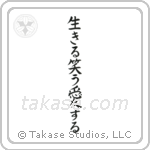
生きる笑う愛する ikiru warau aisuru Live, Laugh, Love
生きる笑う愛する (ikiru warau aisuru), live, laugh, love, is the English slogan's three verbs written in Japanese. They stand side by side in their dictionary forms with no particle, as the poster sets them. This study follows the slogan to a poem of 1904, and the 愛する that took on the sense of English love in Meiji.
Abstract
生きる笑う愛する, ikiru warau aisuru, live, laugh, love, is the English slogan's three verbs written in Japanese, in the slogan's order and in their dictionary forms, with no particle between them. The slogan is English, of the late 2000s and early 2010s, and the encyclopedia traces it to Bessie Anderson Stanley's poem Success of 1904; none of the public-domain books the National Diet Library's full-text search reaches prints the Japanese.
Overview
The sense. Plain spoken Japanese, the verbs in the dictionary form, which is how a resolution is written. 生きる笑う愛する, live, laugh, love, is modern Japanese for an English line; it is grammatical and reads at once.
The words. 生きる ikiru, to live. デジタル大辞泉: 人間・動物などが、生命があり活動できる状態にある。生命を保つ。生存する, to be in the state of having life and being able to act; to keep life; to exist, then to make a living, then to live in or for something, 研究一筋に生きる. 精選版日本国語大辞典 cites it from the 宇治拾遺物語 of about 1221, この里の人々、とく逃げのきて命いきよ, people of this village, flee quickly and live [1]. 笑う warau, to laugh, is cited from 794 [2]; 愛する aisuru, to love, from the 大鏡, and the dictionary's note on the word is worth its own sentence: in the mid-Meiji period it was adopted as the translation of English love and German lieben, and as a result of being joined to the Western idea of love it came to express, toward persons, affection between equals [3]. The three verbs of 生きる笑う愛する are set side by side in their dictionary forms with no particle, as the English poster sets them.
The text in English. The English words are the same words. Live covers 生きる exactly [4]; the difference is in what each language does without a subject. English live, laugh, love is three imperatives and the Japanese is not: the Japanese dictionary form is a statement of what one does or intends, which is why the phrase reads as a resolution rather than a command, and why a rendering should not put an exclamation mark after it.
The historical record
What is not a source. No Japanese text stands behind it. 生きる笑う愛する returns no page in the Library's full-text search of its public-domain books [5]; its source is in English.
Today. Live, Laugh, Love is the three-word slogan of motivational posters and home décor of the late 2000s and early 2010s; the encyclopedia traces it to Bessie Anderson Stanley's 1904 poem Success, he achieved success who has lived well, laughed often, and loved much [6]. The Japanese follows the slogan's order. What a rendering must keep is the verbs' mood: resolutions, not orders.
A reading
生きる笑う愛する is honest modern Japanese for an English line: a reader told that live, laugh, love is an old Japanese saying has been told something false, and a reader told it is the same three verbs, written in Japanese, has been told the truth and something worth having.
References
- 「生きる」, デジタル大辞泉・精選版日本国語大辞典, at kotobank. https://kotobank.jp/word/生きる
- 「笑う」, 精選版日本国語大辞典, at kotobank. https://kotobank.jp/word/笑う
- 「愛する」, 精選版日本国語大辞典, at kotobank. https://kotobank.jp/word/愛する
- JMdict (EDRDG), 「生きる」, at jisho. https://jisho.org/word/生きる
- National Diet Library next-generation full-text search on 生きる笑う愛する, searched again 26 September 2026: 0 books. https://lab.ndl.go.jp/dl/api/book/search?searchfield=contentonly&keyword=生きる笑う愛する
- "Live, Laugh, Love", English Wikipedia. https://en.wikipedia.org/wiki/Live,_Laugh,_Love