

五輪の書 gorin no sho Book of Five Rings
五輪の書 (gorin no sho), the Book of Five Rings, is the title of Miyamoto Musashi's five scrolls, written from 1643 to 1645. The book never calls itself that, and the title is in a Kumamoto biography finished in 1776. This study follows the title into print and into English, and the five elements the dictionaries frame as Buddhist.

Abstract
五輪の書, gorin no sho, the writing of the five rings, is the title of the five scrolls Miyamoto Musashi wrote in his last two years, 1643 to 1645, and the title is not in the book: the book calls itself only this book of five scrolls, earth, water, fire, wind and void. The title is in a Kumamoto biography finished in 1776, whose note of 1755 already names the book, and it is in print from 1886; the form with the particle is in print by 1898 and is the one the 1915 edition printed. The five scrolls give their own reasons for their titles rather than a Buddhist scheme, though the dictionaries frame the book's five elements as Buddhist. A Book of Five Rings is in English by 1964 and is the title of the first English translation, of 1974; the English translations read here since keep the rings.
Overview
The sense. The title of the five scrolls Miyamoto Musashi wrote in a Kumamoto cave in his last two years, named for the five elements, earth, water, fire, wind and void. The school the scrolls teach, 二天一流, has its own history; the two names meet in the same witnesses.
The words. 五輪 is a Buddhist word before it is anything else: the five 輪, wheels or rings, are the five 大 that make up the world, earth, water, fire, wind and void, and the great historical dictionary of Japanese gives the word that sense first, with a citation of 1296 [1]. The same five stack up in the five-ringed stūpa that stands in every old graveyard, and the same word is what Japanese now calls the Olympics: a Yomiuri sportswriter, Kawamoto Nobumasa, put it in a headline in the summer of 1936, the year of the Berlin games, and by his paper's account took it from the title of this book [1][2]. の is of, 書 a writing. Gorin no sho is the writing of the five rings, and the rings are the five scrolls, each named for one element. The dictionaries head the book 五輪書, without the particle; 五輪の書 with the particle is in print by 1898 and is the title the 1915 edition printed, while the 1939 edition printed 五輪書, so both forms are right.
The text in English. A Book of Five Rings is in English print by 1964, and Victor Harris's translation of 1974 made it the book's English title.
The historical record
1643 to 1645. Miyamoto Musashi 宮本武蔵, the five scrolls. The preface, as the copies give it: the way of strategy I call the Niten school, and I mean now for the first time to set down in a book what I have trained at for years; in the first ten days of the tenth month of 1643 I climbed Mount Iwato in Higo, bowed to heaven, paid reverence to Kannon, faced the Buddha, I, Shinmen Musashi Fujiwara no Genshin, a warrior born in Harima, sixty years old [3]. The Water scroll opens the same way, naming the Niten school. But when the Earth scroll comes to explain the name, the name it explains is the other one: to make known the use of these two swords it is called the two-sword school (the wording varies slightly witness to witness), and the Fire and Void scrolls open on the two-sword school, while the Wind scroll, which opens on the other schools, comes to the name only at its close. The book also never calls itself 五輪書; what it says is why this book of strategy is made in five scrolls: I divide the way in five and write it scroll by scroll so its reasons can be known … as earth, water, fire, wind and void, in five scrolls. The colophons are dated the twelfth or thirteenth day of the fifth month of 1645, a week before the received date of his death, and address the scrolls to different pupils across the surviving copies. No copy in Musashi's own hand survives; the copy the encyclopedias call the best is the one his pupil Terao Magonojō 寺尾孫之丞 made for a pupil of his own in 1667.
1755 to 1776. Toyota Kagehide 豊田景英, 二天記, the Kumamoto biography. Compiled over three generations of the Toyota family from what Musashi's surviving pupils told the grandfather, and the source of most of what is told about him. Its note on sources is dated 1755 and belongs to the book's first form, 武公伝, which Kagehide renamed 二天記 and had prefaced in 1776. The note says the old men's stories were set down as they were told, with a little added from the book of the five … and the like: the 1910 print writes that title 五倫の書, with 倫, the character of the five Confucian bonds, and the 1909 print 五輪ノ書, with the rings [4]. Its account of the death says he passed the five-ring scrolls to Terao Katsunobu and the thirty-five articles to Terao Kumanosuke Nobuyuki 寺尾求馬助信行; and of the school it says simply that it is called 二天一流. It also records where the name came from: Musashi took the Buddhist name Niten Dōraku through the monk Shunzan of Taishōji [4].
1886 to 1908. The title in print. The oldest print of the title the National Diet Library's full-text search finds is an 1886 life of Musashi by 藤野富之助, which retells the bequest of the 五輪ノ卷 to Terao; an 1893 fencing manual by 隈元実道 quotes the Water scroll under the heading 回天五輪ノ卷; 宮本武藏五輪の書, with the particle, is in the contents of a journal in 1898; and 五輪書, the dictionaries' form, is in a letter of 池辺義象 printed in 1908 [5].
1909. The Miyamoto Musashi Memorial Society, 『宮本武蔵』. The first modern biography prints the whole text of the five scrolls as its ninth chapter, headed 五輪書, from a copy then in a Kumamoto family's hands [6].
1915 and 1939. The two editions a reader could buy. A 1915 collection prints the text under the running title 五輪の書 with the particle, collated from two pupils' lines, and its editor notes that the book is also called the five-ring scrolls [7]. A 1939 edition, priced at sixty sen, prints the title 原本五輪書, without the particle, on its title page and in its colophon; it is a typeset, not a facsimile, and it drops the preface and the colophons [8].
The dictionary today. 五輪書, a book of the martial way of the early Edo period, five scrolls, by Miyamoto Musashi, composed about 1645 [1].
What is not a source. The Zen and Buddhist reading of the five elements is a frame the encyclopedias put around the title, not a source for it; the text itself says it borrows no old words of Buddhism or Confucianism. The Olympic 五輪 was taken from the book's title in 1936 [2] and is not a witness to it. Musashi's other texts are neighbors, not sources, for this title: his twenty-one articles of 1645 have their own history and are not a witness to it.
The title in English
1964. Junzo Sasamori and Gordon Warner, This Is Kendo. A kendo handbook in English gives the book as Gorin no Sho (A Book of Five Rings), ten years before any translation [9].
1974. Victor Harris, A Book of Five Rings. The first English translation, and the title the later ones keep. Harris grounds the title in the "Go Dai" (Five Greats) of Buddhism … the five elements which make up the cosmos [10].
1993. Thomas Cleary, The Book of Five Rings. Cleary's note says the book is more properly titled in English The Book of Five Spheres [11].
2004. William Scott Wilson, The Lone Samurai. Wilson's biography of Musashi has a chapter, The Concept of the Five Rings in Esoteric Buddhism, that reads the title as the Buddhist word [12]. Wilson's translation of the five scrolls appeared in 2002; its wording is not quoted here.
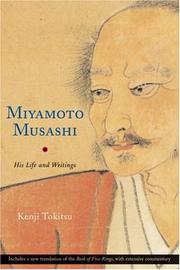
2004. Kenji Tokitsu, Miyamoto Musashi: His Life and Writings. Tokitsu calls the book "Writings on the Five Elements" (Gorin no sho), popularly known as The Book of Five Rings [13].
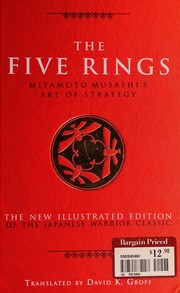
2012. David K. Groff, The Five Rings: Miyamoto Musashi's Art of Strategy. Groff's title keeps the rings [14].
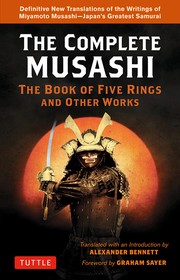
2018. Alexander Bennett, The Complete Musashi. The most recent scholarly translation says that the title was given by two later men of Kumamoto, Nagaoka Naoyuki 長岡直之 and Toyota Masakata 豊田正剛, and that the five elements point to Buddhist doctrine without that being Musashi's intention. He renders the fifth scroll Ether [15].
Today. JMdict: 五輪書, The Book of Five Rings [16]. A rendering of the title must keep the five, and rings is what sixty years of English have agreed on.
A reading
五輪の書 with the particle is the title the 1915 collection printed; 五輪書 without it is the dictionaries' and the 1939 edition's. What the sources say plainly is that the title is not in the book, which calls itself five scrolls, and that the book survives only in Musashi's pupils' copies. Book of Five Rings is not a translation of the Buddhist word, but it is what the book is called.
References
- 「五輪書」・「五輪」, デジタル大辞泉・精選版日本国語大辞典・改訂新版世界大百科事典・日本大百科全書, at kotobank. https://kotobank.jp/word/五輪書 · https://kotobank.jp/word/五輪
- 「なぜオリンピックは『五輪』と言うの?」, YOMIURI ONLINE, 4 July 2016, archived 6 July 2016. https://web.archive.org/web/20160706154802/http://www.yomiuri.co.jp/komachi/special/feature/CO024451/20160704-OYT8T50078.html
- 宮本武蔵, 五輪書, 1643–45, in three typesets: 『宮本武蔵』, 1909; 『武術叢書』, 1915; 『原本五輪書』, 教材社, 1939. https://dl.ndl.go.jp/pid/992019/1/97 · https://dl.ndl.go.jp/pid/945805/1/127 · https://dl.ndl.go.jp/pid/1071527/1/7
- 豊田景英, 『二天記』, 安永五年 (1776), in 『肥後文献叢書』, 第二巻, 1910, scans 94, 95 and 101. https://dl.ndl.go.jp/pid/766733/1/94 · the note as printed in 『二刀一流剣道秘要』, 武徳誌発行所, 1909 (NDL full-text excerpt; the page is not open outside Japan). https://dl.ndl.go.jp/pid/860425
- 藤野富之助, 『剣道達人武蔵実記』, 1886 (NDL full-text excerpt). https://dl.ndl.go.jp/pid/782065 · 隈元実道, 『武道教範』, 1893, scan 26. https://dl.ndl.go.jp/pid/860494/1/26 · 『國學院雜誌』, May 1898, contents (NDL full-text excerpt). https://dl.ndl.go.jp/pid/3364684 · 『東亜の光』, August 1908, 池辺義象's letter (NDL full-text excerpt). https://dl.ndl.go.jp/pid/1591421
- 宮本武蔵遺蹟顕彰会, 『宮本武蔵』, 金港堂, 1909, scan 97. https://dl.ndl.go.jp/pid/992019/1/97
- 吉丸一昌, editor, in 『武術叢書』, 国書刊行会, 1915, scan 5. https://dl.ndl.go.jp/pid/945805/1/5
- 『原本五輪書』, 教材社, 1939, scans 2 and 42. https://dl.ndl.go.jp/pid/1071527/1/2 · https://dl.ndl.go.jp/pid/1071527/1/42
- Junzo Sasamori and Gordon Warner, This Is Kendo: The Art of Japanese Fencing, Charles E. Tuttle, 1964, p. 49.
- Victor Harris, translator, A Book of Five Rings, Overlook Press, 1974.
- Thomas Cleary, translator, The Book of Five Rings, Shambhala, 1993.
- William Scott Wilson, The Lone Samurai: The Life of Miyamoto Musashi, Kodansha International, 2004, pp. 110 and 258.
- Kenji Tokitsu, Miyamoto Musashi: His Life and Writings, translated by Sherab Chödzin Kohn, Shambhala, 2004.
- David K. Groff, translator, The Five Rings: Miyamoto Musashi's Art of Strategy, Watkins, 2012; read in the Chartwell Books edition, 2016, pp. 22, 44, 61, 80 and 247.
- Alexander Bennett, translator, The Complete Musashi: The Book of Five Rings and Other Works, Tuttle, 2018.
- JMdict (EDRDG), 「五輪書」and「二天一流」, at jisho. https://jisho.org/word/五輪書 · https://jisho.org/word/二天一流
Books Cited
Books this article cites that can be ordered today.
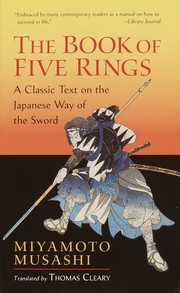
ISBN 0879510188
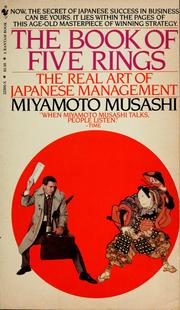
ISBN 055322509X
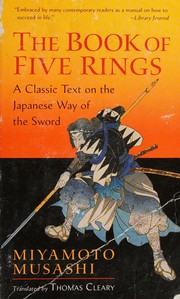
ISBN 1590302486
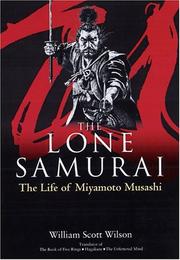
ISBN 477002942X
ISBN 1590300459
ISBN 9780785834007
ISBN 9784805316160