

過ぎたるは尚及ばざるが如し · sugitaru wa nao oyobazaru ga gotoshi · Going too far is as bad as falling short
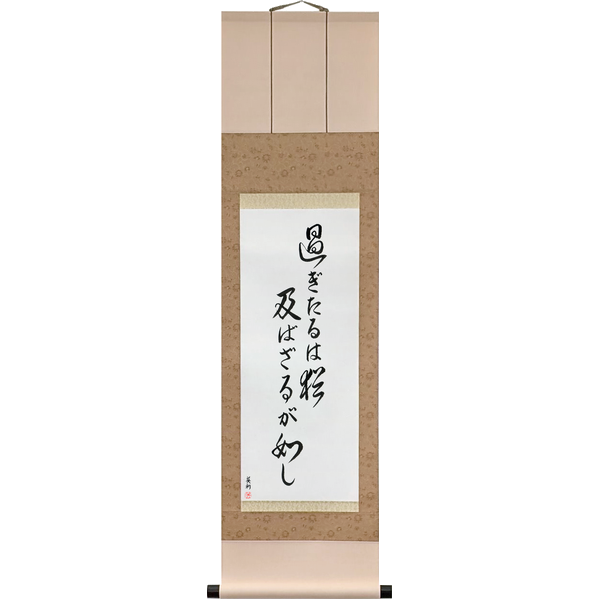
Sold as Going too far is as bad as falling short · Read sugitaru wa nao oyobazaru ga gotoshi · Oldest witness the Analects of Confucius, book eleven, the answer to a disciple who asked which of two others was the better man · Sense excess and shortfall are the same fault; the Japanese proverb made of the line is usually a warning against excess alone.
The words
Four Chinese characters, 過猶不及, and a Japanese sentence of eleven that reads them aloud. 過 is to go past, and 過ぎたる is what has gone too far. 猶 is still, just as much, and in the Japanese reading tradition this one character is read twice: once as なお, as much, and again at the end of the sentence as ごとし, is like. 不及 is not reaching, 及ばざる, falls short. So the Japanese says: having gone too far is just like not having reached. The brushed scroll writes 尚 where every dictionary writes 猶; both are read なお and both are current characters for the word, so the scroll spells the proverb rather than quoting one printing. One trap in the first word: in modern Japanese 過ぎた can also mean past, as in 過ぎた事, what is over and done. Nothing in this line means that, and no translator has ever read it so.
A history, from the earliest witness
The Analects, book eleven (先進). A disciple asks the Master to compare two others: 子貢問:「師與商也孰賢?」子曰:「師也過,商也不及。」曰:「然則師愈與?」子曰:「過猶不及。」 James Legge, whose 1861 translation is printed beside the Chinese at the Chinese Text Project: Zi Gong asked which of the two, Shi or Shang, was the superior. The Master said, "Shi goes beyond the due mean, and Shang does not come up to it." "Then," said Zi Gong, "the superiority is with Shi, I suppose." The Master said, "To go beyond is as wrong as to fall short." The four characters sold on the scroll are the last four words of this exchange, and the exchange is what gives them their edge: the questioner assumes that doing too much is the better fault, and the Master refuses the premise. [ctext.org/analects/xian-jin, section 16; text. The same passage at zh.wikisource.org/wiki/論語/先進第十一, 十一之十五, for a reader whose fetcher ctext refuses]
1872–1876. Fukuzawa Yukichi, An Encouragement of Learning (学問のすゝめ). The Japanese dictionaries' first modern example of the line in use, and it is already a proverb with no Confucius attached: 過ぎたるはなお及ばざるがごとしとは、すなわち弊害と本色と相反対するを評したる語なり。たとえば食物の要は身体を養うに在りといえども、これを過食すればかえってその栄養を害するがごとし, "going too far is as bad as falling short" is a saying about how a thing's harm and its true nature oppose each other: food exists to nourish the body, yet eat too much and it damages the nourishment it gives. [quoted in ことわざを知る辞典 and 故事成語を知る辞典 at kotobank; the book not opened]
1907. 大江文城, The Confucian Scriptures (儒教聖典), a Meiji canon in Japanese. The passage as a Meiji reader met it, a vernacular reading followed by the original and the chapter name: 子貢問ひけらく、師と商とは孰れが賢れるかと。子のたまはく、師や過ぎ、商は及ばずと。曰く、然らば師は愈れるかと。子のたまはく過ぎたるは猶ほ及ばざるが如きのみと。〔原文〕子貢問、師與商也孰賢。子曰、師也過、商也不及。曰、然則師愈與。子曰、過猶不及。((先進)). The reading ends のみ, only: it is only like falling short, no better. [3]
1901 and 1940. A grammar and a commentary. A middle-school Japanese grammar of 1901 prints the line, without comment, as a specimen sentence for the construction が如し; a 1940 commentary on the imperial rescript to students uses it to define 中, the mean: 中とは一方に偏せざることで、論語に「過ぎたるは猶及ばざるが如し」とあります, the mean is not leaning to one side; as the Analects says, going too far is as bad as falling short. Between those two dates the line is in some 240 books the National Diet Library has digitized. [5]
Today. デジタル大辞泉: 《「論語」先進から》何事でもやりすぎることはやり足りないことと同じようによくない. ことわざを知る辞典: 度が過ぎたものは、足りないものと同様によくない。不十分なのも困るが、過剰なものには弊害があり、物事にはほどよさが大切である, with the English equivalent Moderation in all things. 故事成語を知る辞典 tells the story of the two disciples and adds two variant forms, one of which, 過ぎたるは及ばざるに如かず, says that going too far is worse than falling short. [8]
The sense, from the Master's mouth to the proverb
The Japanese dictionaries draw one distinction and it is the whole history. As a passage of the Analects, the line teaches the mean, 中庸: the two faults are equal, and the questioner who thought excess the better one is corrected. As a proverb in Japanese use, 故事成語を知る辞典 says, 「行きすぎ」を戒める意味で用いられるのがふつうです, it is ordinarily used to warn against going too far: the shortfall half is dropped and only the excess is scolded, which is what Fukuzawa does with it and what the variant 及ばざるに如かず makes explicit. The same dictionary offers a reading of the passage itself worth keeping: the disciple who asked, Zigong, was a man of great talent who made a fortune in trade, and the Master's answer may have been aimed at him. A scroll carries the balanced form, and a reader who knows only the proverb's use has half the line.
What is not a source
Nothing has been set beside this line in the sources opened; it is a canon line with an author, not a folk saying with parallels. The two variant forms in 故事成語を知る辞典 are Japanese reshapings of the same passage, not sources for it.
The saying in English
The Meiji bilingual dictionaries were not checked for this line; the English begins with Legge.
1861. James Legge, The Chinese Classics, volume 1, the Analects, book XI. To go beyond is as wrong as to fall short. Balanced, and beyond keeps the spatial image of 過. [as the Chinese Text Project prints it beside the Chinese; text; the printed volume not opened]
1938. Arthur Waley, The Analects of Confucius, book XI, section 15. Tzu-kung asked which was the better, Shih or Shang. The Master said, Shih goes too far and Shang does not go far enough. Tzu-kung said, If that is so, then Shih excels. The Master said, To go too far is as bad as not to go far enough. Waley's last sentence is the house's English in all but two words. [archive.org in.ernet.dli.2015.174971, OCR text layer, not checked against the page; no ASIN collected]
Not opened. D. C. Lau (Penguin, 1979), Edward Slingerland (Hackett, 2003), and Ames and Rosemont (Ballantine, 1998): the modern lineage after Waley. The archive.org copies of the first two are lending copies and did not open; no address was found for the third.
Today. ことわざを知る辞典 gives Moderation in all things as the English equivalent, which is the proverb's sense rather than the line's. The house title, Going too far is as bad as falling short, is Waley's sentence, and it does the one thing a rendering of this line must do: it keeps both faults and calls them equal. This scroll is sold under a different English title, Let what is past flow away downstream, which renders no word of the Japanese and appears nowhere outside our own pages. The description beneath it has always said the right thing. On 2026-09-05 the title was ruled superseded by that description's sentence; the live page carries the old title until its owner changes it.
A reading
The line is a rebuke to a clever question, and it is balanced on purpose: the man who asked wanted to hear that too much beats too little, and was told they are the same. The Japanese proverb made of it leans, as proverbs do, toward the fault its users see more of, and the dictionaries say so honestly. The scroll should carry the balance and let the history carry the lean. On the character 尚 for 猶, both are なお and nothing turns on it. Signed, 典, 2026-09-05.
How this was read
By text, at the address: the Analects passage with Legge at the Chinese Text Project and, without Legge, at Chinese Wikisource; the three dictionary entries at kotobank; the 1907 canon at two scans of the NDL page API; Waley at the archive.org text layer; the two live product pages. By search snippet only, not opened at the page: the 1901 grammar and the 1940 commentary, and the count of some 240 books. Not opened: any Edo commentary on this book of the Analects; the line in Japanese before 1872, which would say whether it was a proverb before it was a schoolbook sentence; Fukuzawa's book itself; Lau, Slingerland, and Ames and Rosemont; the Meiji bilingual dictionaries. Every address in this history is a text address except Waley's print and the three unopened translators, and a reader's AI can open the rest. The full apparatus, with every address, is in the account.
References
- The scroll and the pages (ours) (—) — S0012SSVB7A; cultural_works 972
- 論語 先進 (canon) — ctext.org/analects/xian-jin §16 (TEXT)
- 大江文城 編『儒教聖典』開発社 (1907) — NDL pid 753280, koma 87–88, page API, OCR (the OCR reads 子貫 for 子貢 once and drops a character at the page break; read as printed here) ↩
- 福沢諭吉『学問のすゝめ』 (1872–76) — kotobank 541177 · 2236676, 用例; the book not opened
- 『中等国文典』3巻 (1901) — NDL pid 994664 koma 46, search snippet, OCR ↩
- 『青少年学徒ニ賜ハリタル勅語謹解』 (1940) — NDL pid 1100307 koma 28, search snippet, OCR
- デジタル大辞泉 (current) — kotobank 541177
- ことわざを知る辞典 (current) — kotobank 541177 ↩
- 故事成語を知る辞典 (current) — kotobank 2236676