

千里の道も一歩より · senri no michi mo ippo yori · Even a road of a thousand ri begins from one step
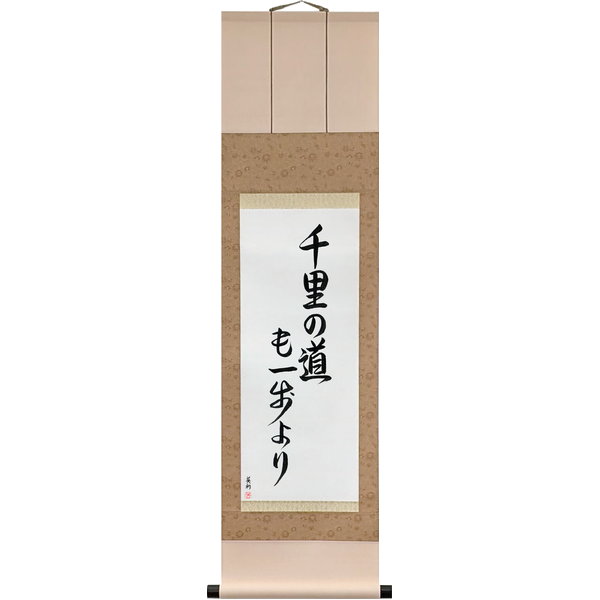
Sold as A Journey Of A Thousand Miles Begins With A Single Step · Read senri no michi mo ippo yori · Oldest witness the Laozi, chapter sixty-four, for the Chinese line; for the Japanese proverb in the form brushed, a moral reader for women printed in 1755 · Sense a great undertaking begins close at hand; the Japanese proverb has been a maxim about small beginnings for at least two and a half centuries, with Laozi unnamed.
The words
The Chinese line is 千里之行,始於足下: a journey of a thousand li begins beneath the feet. It has no road and no step. The Japanese proverb has both. 千里 is a thousand ri, a very long way; the Japanese ri and the Chinese li are different lengths and neither is a mile. 道, road, stands where the Chinese has 行, journey, the same image seen from the other end. も is even: even a road of a thousand ri. 一歩, one step, stands where the Chinese has 足下, beneath the feet; the Japanese proverb supplies the step, where the Chinese says only where you already stand. より is from, and it is the older particle; the modern proverb says から, and every current dictionary headword has から. The verb, はじまる, begins, is dropped on the scroll as the proverb usually drops it. So there are three Japanese forms. The reading of the Chinese as Chinese, 千里の行も足下に始まる, which is a dictionary headword and what a biographer writes in 1915; the proverb with より, in print by 1755; and the proverb with から, from 1908 in the books opened, and the headword today. The brush writes the oldest of the three. The line as words: even a thousand-ri road, from one step.
A history, from the earliest witness
The Laozi, chapter sixty-four. The line is the third of three images in a chapter about acting on things before they have grown: 合抱之木,生於毫末;九層之臺,起於累土;千里之行,始於足下. James Legge, whose 1891 translation is printed beside the Chinese at the Chinese Text Project: The tree which fills the arms grew from the tiniest sprout; the tower of nine storeys rose from a (small) heap of earth; the journey of a thousand li commenced with a single step. The chapter goes on to its own conclusion, 慎終如始,則無敗事, be as careful at the end as at the beginning and nothing will fail; the proverb keeps the first image and drops the warning. [ctext.org/dao-de-jing, chapter 64; text. The chapter in the Wang Bi recension with his commentary at zh.wikisource.org/wiki/道德經_(王弼本), for a reader whose fetcher ctext refuses]
1755. 晩香散人玉枝子, Instructive Poems for Women (女朗詠教訓歌), an illustrated moral reader with pictures by 西川祐信. The oldest Japanese witness opened, and the proverb is already a proverb, credited to the ancients: 古人も千里の道も一歩よりはじまるといへば善人となるもあらき人になるもこゝろひとつのわざなれば, as the ancients say, even a thousand-ri road begins from one step, so becoming a good person or a rough one is the work of one heart alone. It is a homily on small faults growing large; Laozi is not named. [3] An undated book under another title carries the same sentence, and whether it is the same book under a second catalogue record was not settled. [4]
1876 to 1893. Six Meiji schoolbooks. Readers on hygiene, morals and the training of the young carry the proverb in the より form, which is how a Meiji child met it. [5][5][5][5][5][5]
1908. Sermons for the Home (家庭説教). The earliest witness opened for the modern particle: 千里の道も一步から始まるものとすれば、私共は念々に反省し刻々に注意して, if even a thousand-ri road begins from one step, then we must examine ourselves thought by thought and take care moment by moment. The proverb is put to daily self-examination. [6]
1915. 横山健堂, Admiral Tōgō (大将東郷), 春陽堂. The Chinese line read as Chinese, at an admiral's first battle: 千里の行も足下に始まる。遠行の第一步は、愼重の覺悟あるべし, a thousand-ri journey begins beneath the feet; the first step of a long road should be taken with grave resolve. [7] Between 1755 and the present the より form is in some 231 books the National Diet Library has digitized, the から form in 40, and the Chinese reading in 5.
Today. デジタル大辞泉 has two headwords. Under 千里の道も一歩から: 遠い旅路も第一歩から始まる。どんな大事業も手近なところから始まることのたとえ, even a distant journey begins with the first step; a figure for how any great undertaking begins close at hand. Under 千里の行も足下に始まる, marked 《「老子」六四から》: どんな遠大な事業も手近なところから始まるというたとえ, with 千里の道も一歩より始まる listed as a variant. 故事成語を知る辞典 gives the sense as 大きなことを成し遂げるには、手近なところから着実に始めていくことが肝要である, to accomplish something great, what matters is to begin steadily from what is near, and its example is a novelist's warlord in the 1960s: いっぺんには天下はとれぬ。千里の道も一歩からだという, you cannot take the realm in one go; a thousand-ri road, from one step, as they say. [kotobank.jp/word/千里の道も一歩から-1729075 and /word/千里の行も足下に始まる-551444; text]
The sense across time
The tradition holds one sense, and it is the sense the 1755 homily already gives: great things are built from small beginnings, close at hand, and character above all. What changes is the frame around it. In the Laozi the image is one of three in an argument about the sage who acts before trouble has grown and who takes as much care at the end as at the beginning; the Japanese proverb has none of that, and in every Japanese witness opened it is a moral maxim, for a woman's conduct, a child's lessons, a sermon's self-examination, an admiral's first command. The dictionaries name Laozi as the source and the proverb's users do not. The three forms carry one sense; the particle changed around 1900, and the brushed form is the older one.
What is not a source
The popular English attributes the line to Confucius; the Laozi is its source, and the scroll makes no such error. The chapter's own conclusion, care at the end as at the beginning, is the line's context and not part of the proverb; a reader who wants the whole argument goes to the chapter. The 1755 book's the ancients is a proverb's way of citing, not a source.
The text in English
The Meiji bilingual dictionaries were not checked for this line; the English begins with Legge.
1891. James Legge, The Texts of Taoism, chapter 64. The journey of a thousand li commenced with a single step. Legge supplies single step for 足下, beneath the feet; he is the source of the step in English, as the Japanese proverb is the source of it in Japanese. [as the Chinese Text Project prints it beside the Chinese; text; the printed volume not opened]
1934. Arthur Waley, The Way and Its Power, chapter 64. The journey of a thousand leagues began with what was under the feet. Waley keeps 足下 literal and turns the li into leagues. [a third-party transcription at terebess.hu/english/tao/waley.html#Kap64, one long page with every chapter, so a fetcher that truncates sees only its index; the print, archive.org wayitspowerstudy0000wale, not opened; no ASIN collected]
Not opened. D. C. Lau (Penguin, 1963), the standard modern translation after Waley.
The popular form. A journey of a thousand miles begins with a single step is Legge's sentence with miles for li and the tense changed. Who first wrote miles was not found; the English Wikipedia article on the phrase names no one, and records the misattribution to Confucius. [en.wikipedia.org/wiki/A_journey_of_a_thousand_miles_begins_with_a_single_step; text]
Today. The house title, A Journey Of A Thousand Miles Begins With A Single Step, is the popular English of the Chinese line, and it sits closer to the Japanese proverb than to the Chinese: the Japanese has the road and the one step that Legge put into English, where the Chinese has a journey and the ground underfoot. Miles for 里 is the one liberty, and every English reader takes it. What a rendering of this line must keep is the pairing of the very long and the very small, and the word begins.
A reading
The brushed form is the oldest Japanese form, in print in a women's reader of 1755, and it stands. The English title is right in sense and is the sentence every English reader already knows; a scroll is not the place to teach that a ri is not a mile, and this page is. What the title cannot carry and this history does: the line is the third image of a chapter whose point is care at the end as at the beginning, and the Japanese proverb has been a maxim about small beginnings and the building of character since before Laozi's name was attached to it in a dictionary. A buyer who hangs it for a beginning is hanging what the Japanese made of it, which is a good thing to hang. Signed, 典, 2026-09-05.
How this was read
By text, at the address: the Laozi chapter with Legge at the Chinese Text Project and, with Wang Bi's commentary, at Chinese Wikisource; the two dictionary entries at kotobank; the 1755 reader, the 1908 sermons and the 1915 biography at three scans of the NDL page API; Waley in a transcription; the Wikipedia article; the catalogue rows. By search snippet only, not opened at the page: the undated second copy of the 1755 sentence, the six Meiji schoolbooks, and the three counts of books. Not opened: the 1755 leaf as an image, which would settle はじまる against the OCR's はらまる; the Japanese proverb before 1755, in the first proverb collections of 1638 and 1656; any Edo commentary on the Laozi; Lau; Waley in print; the first English use of thousand miles; the live scroll page. Every address in this history is a text address except Waley's print and Lau, and a reader's AI can open the rest. The full apparatus, with every address, is in the account.
References
- The scroll (ours) (—) — S0009SSVB4A; cultural_works 970
- 老子 六十四章 (canon) — ctext.org/dao-de-jing#n11655 (TEXT)
- 晩香散人玉枝子 作『女朗詠教訓歌』 (宝暦5 (1755)) — NDL pid 2533881 koma 39, page API, OCR; the search API reported page 1 ↩
- 『風俗見立百人一首』 (undated (catalogue sentinel)) — NDL pid 2541056, search snippet; the same sentence as the 1755 book; relation not settled ↩
- 『養生のすゝめ』 · 『修身訓蒙』 · 『少年教誨』 · 『修身訓』 · 『幼児教訓唱歌』 · 『法華経大意』 (1876–1893) — NDL pids 837276, 756433, 1169242, 756418, 855767, 818215; search snippets only ↩
- 『家庭説教』 (1908 (M39 on the leaf)) — NDL pid 818384 koma 71 (printed p. 百三十四), page API, OCR ↩
- 横山健堂『大将東郷』春陽堂 (1915) — NDL pid 950830 koma 111, page API, OCR ↩
- デジタル大辞泉 (current) — kotobank (two pages)
- 故事成語を知る辞典 (current) — kotobank