

I. INTRODUCTION
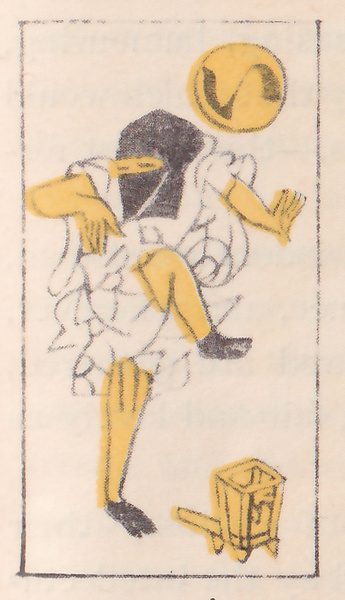
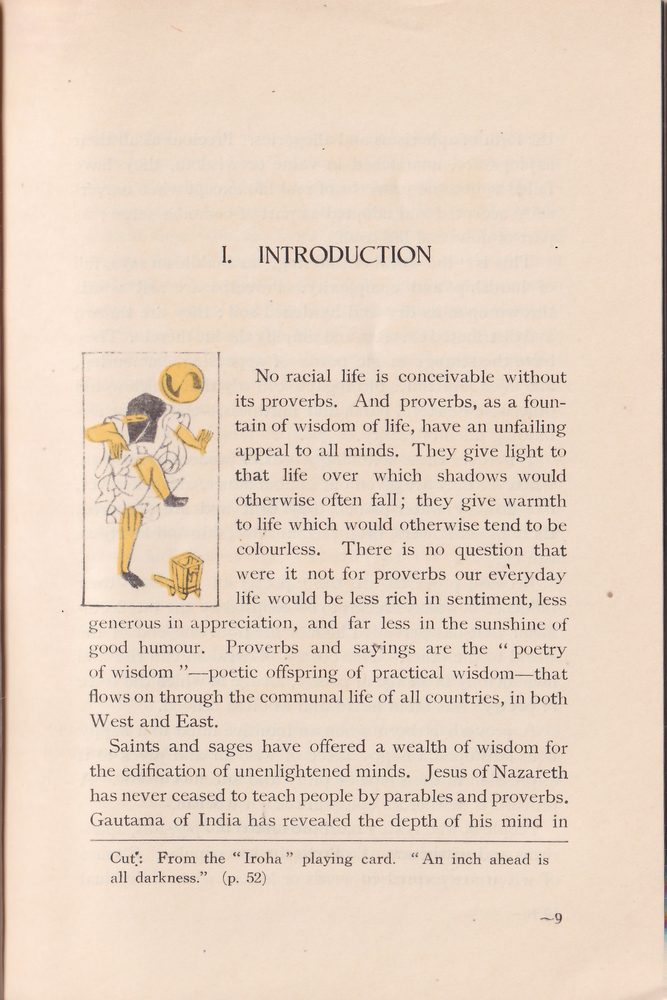
No racial life is conceivable without its proverbs. And proverbs, as a fountain of wisdom of life, have an unfailing appeal to all minds. They give light to that life over which shadows would otherwise often fall; they give warmth to life which would otherwise tend to be colourless. There is no question that were it not for proverbs our everyday life would be less rich in sentiment, less generous in appreciation, and far less in the sunshine of good humour. Proverbs and sayings are the “poetry of wisdom”—poetic offspring of practical wisdom—that flows on through the communal life of all countries, in both West and East.
Saints and sages have offered a wealth of wisdom for the edification of unenlightened minds. Jesus of Nazareth has never ceased to teach people by parables and proverbs. Gautama of India has revealed the depth of his mind in
the form of aphorisms and allegories. Precious as all their sayings are, unmatched in value or wisdom, they have failed to become proverbs of real life except when universally accepted and adopted as part of common sense; as part of universal life itself.
This is “the world of suffering,” as Buddhism says, full of hardship and complexity. Proverbs are soft words thrown upon its dry and hardened soil: they are thrown and distributed to soften and simplify the life therein. They have the strange magic power of appeasing, humouring, and even sometimes turning into comedy that which would otherwise be stern, harsh and mirthless,—the almost forbidding mien of reality.
Wherever these softening words of wisdom are strewn, wherever they are given out in abundance, and wherever, like flowery water-plants, they drift and are gathered, there bloom flowers, bright as sunshine, fair and lovely as can be.
Because proverbs are the “poetry of wisdom,” their influence nowadays seems to be eclipsed by the intellectualism that has pervaded human life from one end of the world to the other. The poetry of wisdom can rise and flourish only in an age of poetry, an age in which the voice of poetry was often heard and as often echoed.
A proverb is born when an intuitive mind in a happy hour falls upon a happy piece of wisdom and gives to it expression in the shape of pithy and succinct words. A proverb is neither an epigram nor a witticism.
People nowadays are more interested in epigrams, aphorisms and witticisms. Proverbs are less popular. Flashes of wit are expressed in words or letters when individual
minds strike upon some poignant thoughts, and there are born epigrams. They are less universal and less generic than proverbs, which are expressions of communal psychology or sentiment. For this reason the people of the present time who are more interested in the individual than in the community are less responsive to the note of proverbs or less appreciative of the wisdom contained in them. “I am a Cat” is one of the literary works very widely read through the Meizi Era (1868–1912), and its author Sōseki Natume (1867–1916), perhaps unequalled as a satirist, gives a plethora of epigrams and aphorisms in that most popular story of his. But none of his witty expressions has won currency as a proverb.
It is no less true that an age of romanticism seldom provides fertile soil for proverbs, the age in which people dream of the stars, and their artistic instinct is translated into emotional exuberance. It is for this reason that the artistic and literary age of Heian (794–1185), a period of emotionalism, and its art, perhaps with few equals in the history of the world, was barren of proverbs. This shows that there can be no proverb except when or where worldly wisdom finds its expression in terse and sententious forms. It is for the same reason that when enlivened social life provided in later periods a cradle for social developments, balanced and well proportioned, and modern science was yet to lend a sharp and analytical edge to the intellect and to intensified individualistic demands, proverbs were produced in abundance. Such an age was seen in the so-called Edo Period (1600–1867).