





Block · kaisho 楷書 · VB5J
Block or kaisho (楷書) styles are the most common and recognizable styles. Block styles are easily read and are noted for their angular form and their vertical and horizontal lines.
松樹千年翠
shōju sennen no midori
The Pine Stays Green a Thousand Years
The pine keeps its green a thousand years, an image of what lasts.
Master Takase creates this beautiful scroll when your order is placed, personally preparing the ink and brushing your art, which proudly bears her signature and seal. This is an original work of art.
Description
松樹千年翠 (shōju sennen no midori): the pine keeps its green a thousand years, an image of what lasts.
In the phrase, 松樹 is the pine tree and 千年 is a thousand years, by extension a long span of years. 翠 is green, with the native reading midori. In Japan the pine has long been prized as a sign of long life and celebration. With bamboo and plum it is held an auspicious pairing.
The line opens a couplet whose second half, 不入時人意, says that the people of the day do not take to it.
A Song lamp history, presented to the court under the title of the Jiatai era, 1201 to 1204, prints a sermon by the master Jingduan. The book calls him Lion Duan, for the lion skin of colored silk he made himself and wore. On the second day of the second month, he said, a hundred flowers open and the young lords are drunk day after day. The juniper before the hall alone is not to the taste of the people of the day. After the meal, a bowl of tea; on the long bench, stretch your legs and sleep.
The Jiatai lamp history lists the master Meng'an Siyue among the heirs of Dahui Zonggao. Meng'an took up the case of the old stream and the cold spring, which Xuefeng and Zhaozhou had answered in two ways. Beside Xuefeng's it does not go in by the mouth, Meng'an set the pine and cypress; beside Zhaozhou's he dies, the peony.
Shitian Faxun spoke to his assembly on the fifteenth of the third month of 1244, in the last year of his life. He quoted the ancients, get the root, and do not worry about the branches, asked what to call the root and what the branches, and gave the pine-and-cypress couplet and the peony couplet.
In Japan, Jakushitsu Genkō, giving a student the name Pine Crag, wrote: let him not mind that he is not to the taste of the people of the day.
Shun'oku Myōha preached at a lady's memorial by a chancellor's command. He ended the sermon with the five characters in a seven-character couplet that has no peony, and it blesses a house: on the level ridge the pine keeps its green a thousand years, and shades the children and grandchildren a hundred generations of spring.
In the Zen phrase book printed in 1645, the pine couplet and the peony couplet stand as two entries, five leaves apart.
Manzan Dōhaku, in a verse for a lady whose house name was Green Pine Cloister, set the pine against the peony: Do not trade the pine's thousand years of green for the peony's one day of red.
A volume of Kyoto sale catalogues, dated 1913 to 1917 by the National Diet Library, and a magazine of 1922, each list a single line of 松樹千年翠. In 1929, 1931 and 1935 the tea magazine 茶道月報 reports it hung at tea gatherings, once in a large horizontal piece. A book of 1928 on the Zen phrases of tea-room hangings says it means the same as 松無古今色, the pine has no color of old or new. These records are read in the Library's snippet view.
In English, Sōiku Shigematsu's A Zen Forest (1981) gives the couplet as no. 563: The pine is green / for a thousand years: / No one now / understands it. Victor Sogen Hori's Zen Sand (2003) gives the line alone as The pine tree, a thousand years of green, and the couplet in another section.
The Song Chan books have the couplet as 松栢千年青,不入時人意, the pine and cypress are green a thousand years, and are not to the taste of the people of the day, paired with the peony that is red for one day; Japanese Zen records write 翠 for 青 from the recorded sayings of Hakuun Egyō 白雲慧暁 (1223–1298), the five characters 松樹千年翠 are read first in a memorial sermon of Shun'oku Myōha 春屋妙葩 in 1382, and the couplet in this wording stands in the Zen phrase book printed in 1645.
We want you to be as happy with the meaning as you are with Master Takase's art. To learn more, visit Philology of 松樹千年翠.
Delivery
Your scroll is brushed when you order it and completed within 1 to 3 business days. It ships by USPS Priority Mail from Master Takase's studio in Washington State, boxed and ready to hang, with a printed page giving the art's English, romaji and Japanese.
Sending it as a gift? Add your message at checkout and we will include it.
Shipping is calculated at checkout from your address; within the United States it is $13 to $23. We ship worldwide, and any import charges for your country are shown at checkout before you pay.
Every order is covered by our 30-day money-back guarantee. If your scroll arrives damaged, or we made an error, we replace it or refund you in full, including shipping. Refund policy
About Our Scrolls
Master Japanese Calligrapher Eri Takase brushes your scroll by hand when you order it. Each scroll bears her red seal, 英利, and her signature.
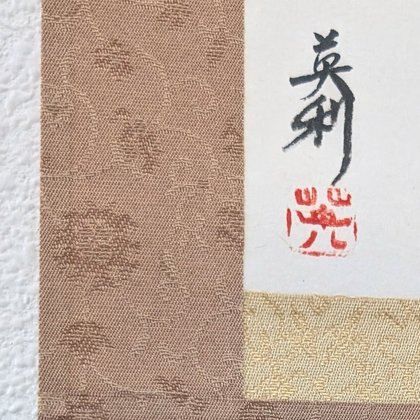


The scrolls are 12 1/4" W × 43" H (31 × 109 cm) with woven damask borders and Japanese paper that are layered so the scroll hangs straight and will not warp over time. The scrolls themselves are made by a scroll maker in Gifu, Japan, and we have worked with them for over two decades.
Eri Takase was born and raised in Osaka, Japan, and holds the rank of Shihan, the highest rank in Japanese calligraphy, from the Bokuteki-kai and the Bunka-shodo. About Master Takase


