


Block · kaisho 楷書 · VB5J
Block or kaisho (楷書) styles are the most common and recognizable styles. Block styles are easily read and are noted for their angular form and their vertical and horizontal lines.
平常心是道
heijōshin kore dō
Ordinary Mind Is the Way
The ordinary mind is the Way: the plain, everyday mind is itself the Buddhist Way.
Master Takase creates this beautiful scroll when your order is placed, personally preparing the ink and brushing your art, which proudly bears her signature and seal. This is an original work of art.
Description
平常心是道 (heijōshin kore dō): the ordinary mind is the Way, meaning that the plain, everyday mind is itself the Buddhist Way.
In the phrase, 平常心 is the everyday, ordinary mind and 道 is the Way. Asked what the Way is, a teacher answers that the ordinary mind is the Way. Asked whether one can aim at it, he says that to aim at it is to miss it.
Japanese books read the phrase in more than one way. Beside heijōshin kore dō, printed readings include heijōshin ze dō, and byōjōshin kore dō, with the Buddhist reading of 平常.
The verse that closes the case in Wumen Huikai's book runs: Spring has its hundred flowers, autumn its moon, summer its cool breeze, winter its snow. If no idle matter hangs on the mind, that is the good season of the human world. Its second couplet is in a lamp history of 1101, in a verse on a case by the master Weiyue.
In the month after the shogun Ashikaga Yoshiakira died at the end of 1367, the Rinzai master Shun'oku Myōha spoke at the shogun's memorial. If you know the phrase, he said, you know Vimalakīrti's the straight mind is the place of practice. And knowing that, you know that putting on clothes and eating rice, lifting a foot and setting it down, are the place of practice. He praised the dead shogun for meeting everything with the straight mind alone.
In tea, the phrase became a rule of practice. A tea monthly wrote in 1932 that the way of tea is in the everyday. Buddhism says the ordinary mind is the Way, it went on, and tea is the same.
A book of Daitokuji one-line scrolls noted in 2000 that many Zen monks have written the phrase. The book calls it the most obvious of things, and a phrase hard to live up to. The baseball manager Kawakami Tetsuharu listed it in 1991 among the words he brushes. A shogi magazine of 1990 reports the phrase on the hanging scroll behind the Ōshō.
Nyogen Senzaki and Paul Reps titled the case Everyday life is the path in a translation of 1934, read widely in Zen Flesh, Zen Bones (1957). Kōun Yamada's translation of 1979 titles it Ordinary Mind Is the Way. His commentary sets apart two readings of 道: michi, the way of everyday life, and dō, the absolute Way.
A Chinese Zen saying of the ninth century: Nanquan 南泉's answer to Zhaozhou 趙州, in the 祖堂集 of 952 (the oldest record read here) and the 無門関 of 1228, case 19; Dōgen 道元 used it in 1241 and Lanxi Daolong 蘭溪道隆, a Song master teaching in Japan, set it to his pupils as a line to hold; the 無門関 reached Japan in 1254 with 心地覚心; in Japanese tea writing by 1811, hung as a 一行 in the tea alcove in the 1930s, and brushed as a 一行書 by the Daitokuji abbot 古渓宗陳 (1532–97), by a catalogue of 1977.
We want you to be as happy with the meaning as you are with Master Takase's art. To learn more, visit Philology of 平常心是道.
Delivery
Your scroll is brushed when you order it and completed within 1 to 3 business days. It ships by USPS Priority Mail from Master Takase's studio in Washington State, boxed and ready to hang, with a printed page giving the art's English, romaji and Japanese.
Sending it as a gift? Add your message at checkout and we will include it.
Shipping is calculated at checkout from your address; within the United States it is $13 to $23. We ship worldwide, and any import charges for your country are shown at checkout before you pay.
Every order is covered by our 30-day money-back guarantee. If your scroll arrives damaged, or we made an error, we replace it or refund you in full, including shipping. Refund policy
About Our Scrolls
Master Japanese Calligrapher Eri Takase brushes your scroll by hand when you order it. Each scroll bears her red seal, 英利, and her signature.
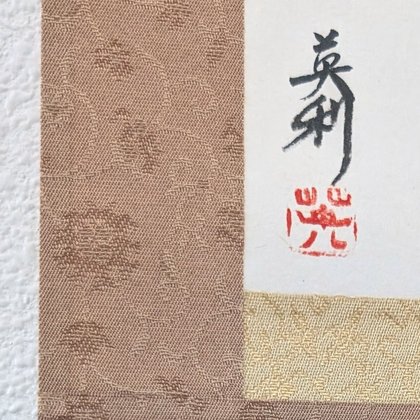
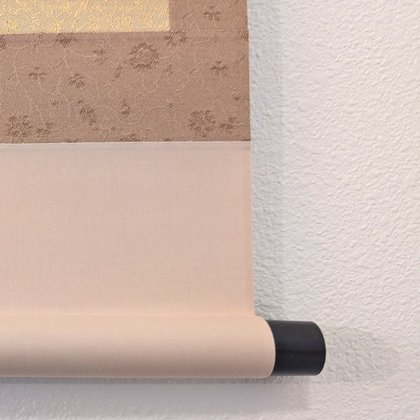
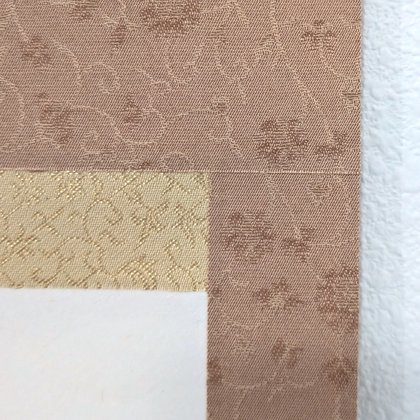
The scrolls are 12 1/4" W × 43" H (31 × 109 cm) with woven damask borders and Japanese paper that are layered so the scroll hangs straight and will not warp over time. The scrolls themselves are made by a scroll maker in Gifu, Japan, and we have worked with them for over two decades.
Eri Takase was born and raised in Osaka, Japan, and holds the rank of Shihan, the highest rank in Japanese calligraphy, from the Bokuteki-kai and the Bunka-shodo. About Master Takase


