





Jiun · 自運 · VD5J
Jiun (自運) is the calligrapher's word for writing from one's own invention. As a Shihan, Master Takase has a hand of her own, and these designs are that hand: she draws freely on the classic scripts to create exactly the look she wants.
看脚下
kankyakka
Look Under Your Feet
Look under your feet: watch your step, and look to where you stand.
Master Takase creates this beautiful scroll when your order is placed, personally preparing the ink and brushing your art, which proudly bears her signature and seal. This is an original work of art.
Description
看脚下 (kankyakka): look under your feet, watch your step, and look to where you stand.
In the phrase, 看 is look and 脚下 is under the feet. The dictionaries enter its kin 脚下照顧, kyakka shōko: in Zen, watch your feet, words that urge one to reflect on oneself or look squarely at daily life. The two share 脚下, but they are two texts with two histories.
In Japan's Zen records, where the phrase is an answer, its sense turns on what it answers. To the question where the road is, it answers: under your feet; to a monk's boast, it answers: watch your step.
After Xuedou's verse on the turtle-nosed snake on South Mountain, which ends you who come, look each of you for the way, the master shouted aloud: Look under your feet! The verse and the shout are case 22 of the Blue Cliff Record.
In one telling the lamp is already out, and Wuzu Fayan asks his three disciples, in the dark, for a turning word. Fojian answered: A painted phoenix dances in the red sky. Foyan said: An iron snake lies across the old road. Yuanwu Keqin, called Foguo, said: Look under your feet. Wuzu said: The one who will destroy my school is Keqin. Thomas Kirchner's note calls Wuzu's reply an expression of the highest praise.
A Song book of about 1202 tells of a monk who came to Yuanwu: just as he set foot in the door, Yuanwu said: Look under your feet!
On the Buddha's birthday a monk asked Nanpo Shōmyō where is the Buddha right now?, and Nanpo said: Look under your feet. At the end of a summer retreat Nanpo asked the assembly where is the road?, and answered himself the same way. In Nanpo's use, the phrase says that the Way is where one stands.
Nanpo's heir Shūhō Myōchō, Daitō, used the phrase in a different sense from Nanpo's. A monk ended an exchange with a boast, if one does not walk the noble road, how can one tread the top barrier?, and bowed. Daitō said: now, watch your step. Daitō's record has him answer that boast three times.
Hakuun Egyō, writing a farewell for a monk setting out, closed with the phrase and glossed it himself: I earnestly hope you will work hard at the one matter under your feet; at your heels there is a road through the sky.
A book of 1908 prints a reporter's account of a training hall whose entrance says 脚下照顧, and the clogs are set neatly side by side, like a pair of mandarin-duck shoes. In a book of his talks printed in 1915, Nantenbō teaches that 照顧脚下 at a Zen temple's entrance means mind your feet. It comes, he says, from Yuanwu's story, though in the Song books we have read Yuanwu says 看脚下, or 看脚趯. Footwear, he says, must always be turned to face out before you step up. In a book of 1922, Yamanaka Minetarō sees a 脚下照顧 slip on a Zen priest's wall, the clogs below it kicked off in disorder: this is not 脚下照顧 at all.
The tea master Takahashi Sōan brushed 看脚下 in three large characters as a horizontal scroll and sent it as a prize. Its winner, the tea-room architect Ōgi Rodō, at once held a morning tea in his three-mat room, with the scroll in the alcove. Sōan's record of tea gatherings for 1922, printed in 1923, tells the story. The priest Mibu Yūshun, at Sensōji, asked the calligrapher Bundō Shunkai for two or three characters for a frame, and received 看脚下. He had them mounted over a lintel and preached from them on those who look upward, not at their feet, and fall into the ditch.
A dictionary of four-character phrases quotes the diary of the poet Taneda Santōka for 1931. His clogs swapped at a bathhouse, he followed the brand on the worn pair to their inn, changed them back, and wrote: truly, 脚下照顧 is hard.
In 2004 Itō Akemi wrote that 看脚下 does not stop at setting one's footwear side by side: its true intent is look well at yourself.
Miura and Sasaki's Zen Dust (1966) gives the lifted-foot telling: Look at my uplifted foot! Zenkei Shibayama (1974) writes of a small wooden board in a Japanese Zen temple's entrance hall, reading Look under your feet: It asks you to see clearly the very place where you stand. He does not give the Japanese. Katsuki Sekida (1977) gives Xuedou's shout as Look out beneath your feet!, a popular Zen saying. Thomas Kirchner (2013) gives Yuanwu's answer as Watch where you step!, and notes that the expression is frequently written on boards and placed in the entrance halls of Zen temples.
The phrase is Chinese: Xuedou's shout in a book prefaced in 1101, and Yuanwu Keqin's answer to Wuzu Fayan, told in the 宗門武庫, a book listed among the works of Dahui (he died in 1163), and in Song books dated 1183 to 1254, one of which has him lift his foot and say 看脚趯 instead; in Japan Nanpo Shōmyō answers with it at Dazaifu from 1272, the phrase books carry it from 1645, the reading kankyakka is printed by 1910, and it is written at temple entrances beside 脚下照顧, a Japanese order of a Song sermon's close.
We want you to be as happy with the meaning as you are with Master Takase's art. To learn more, visit Philology of 看脚下.
Delivery
Your scroll is brushed when you order it and completed within 1 to 3 business days. It ships by USPS Priority Mail from Master Takase's studio in Washington State, boxed and ready to hang, with a printed page giving the art's English, romaji and Japanese.
Sending it as a gift? Add your message at checkout and we will include it.
Shipping is calculated at checkout from your address; within the United States it is $13 to $23. We ship worldwide, and any import charges for your country are shown at checkout before you pay.
Every order is covered by our 30-day money-back guarantee. If your scroll arrives damaged, or we made an error, we replace it or refund you in full, including shipping. Refund policy
About Our Scrolls
Master Japanese Calligrapher Eri Takase brushes your scroll by hand when you order it. Each scroll bears her red seal, 英利, and her signature.
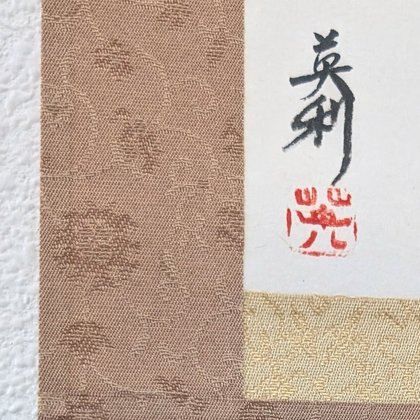


The scrolls are 12 1/4" W × 43" H (31 × 109 cm) with woven damask borders and Japanese paper that are layered so the scroll hangs straight and will not warp over time. The scrolls themselves are made by a scroll maker in Gifu, Japan, and we have worked with them for over two decades.
Eri Takase was born and raised in Osaka, Japan, and holds the rank of Shihan, the highest rank in Japanese calligraphy, from the Bokuteki-kai and the Bunka-shodo. About Master Takase


