



Semi-Cursive · gyōsho 行書 · VS5J
Semi-Cursive or gyōsho (行書) styles are a simplified and softer form of the kaisho styles. Gyōsho styles can be read by most Japanese.
運水搬柴
unsui hansai
Carrying Water, Hauling Firewood
Carrying water and hauling firewood: the daily work of Zen monks.
Master Takase creates this beautiful scroll when your order is placed, personally preparing the ink and brushing your art, which proudly bears her signature and seal. This is an original work of art.
Description
運水搬柴 (unsui hansai): carrying water and hauling firewood, the daily work of Zen monks.
In the phrase, 運 is to carry, 水 is water, 搬 is to carry and move, and 柴 is brushwood cut for fuel.
Asked by the master Shitou how his daily affairs have been, the layman Pang says there is nowhere to open his mouth. Then he offers a verse. It ends: Supernatural power and marvelous function: carrying water and hauling firewood. Shitou approves it, and Pang does not shave his head and stays a layman.
In Pang's verse, 神通 is a Buddhist word for the powers won by meditation, among them the divine eye and the divine ear. Two chores answer them: the marvel is the chore.
The master Yuanwu Keqin recalls the fifteen hundred monks taught by Xuefeng. Each day they all worked together, carrying water and hauling firewood. How unlike the brothers of his own day, he says, who sit up straight and eat their fill.
In his rule of 1246 for the officers of a monastery, Dōgen writes of Guishan, cook under Baizhang. Guishan carried water and hauled firewood, Dōgen says, and did not shrink from the hardships of the monks' assembly.
Pang's line also drew objections. The philosopher Zhu Xi answered that the water has to be carried rightly before it is a marvel. In Japan, the appendix to the Confucian Yamaga Sokō's history of 1669 mocks the monks who take carrying water and hauling firewood for the Way.
The Nanbōroku is a book on tea presented as the record of Sen no Rikyū's teaching. In its opening part, tea in a small room is carrying water, gathering firewood, boiling the water and making tea. Tachibana Jitsuzan, who is thought to have written the book, named it in 1690.
A phrase book for calligraphers of 1966 enters 運水搬柴 among phrases for the brush. The tea monthly 淡交 listed the phrase in 1993 beside 著衣喫飯, putting on clothes and eating rice.
In English, D. T. Suzuki gave the line in 1922 as I draw water, and I carry fuel! Fung Yu-lan rendered it in 1947 as carrying water and chopping firewood, beside Baizhang's words on the man before enlightenment and after. In the books archive.org can search, the saying Before enlightenment, chop wood and carry water; after enlightenment, chop wood and carry water is in print from 1972. Pang's line stands behind the saying, though it is not its source.
The last line of a verse given to the Tang layman Pang Yun 龐蘊, who died in 808 or 815; the oldest record of it read here is the Chinese lamp history of 1004; the four characters stood as a phrase of their own for the work of a monastery in Song China, and were used in Japan from Dōgen's talk of 1241.
We want you to be as happy with the meaning as you are with Master Takase's art. To learn more, visit Philology of 運水搬柴.
Delivery
Your scroll is brushed when you order it and completed within 1 to 3 business days. It ships by USPS Priority Mail from Master Takase's studio in Washington State, boxed and ready to hang, with a printed page giving the art's English, romaji and Japanese.
Sending it as a gift? Add your message at checkout and we will include it.
Shipping is calculated at checkout from your address; within the United States it is $13 to $23. We ship worldwide, and any import charges for your country are shown at checkout before you pay.
Every order is covered by our 30-day money-back guarantee. If your scroll arrives damaged, or we made an error, we replace it or refund you in full, including shipping. Refund policy
About Our Scrolls
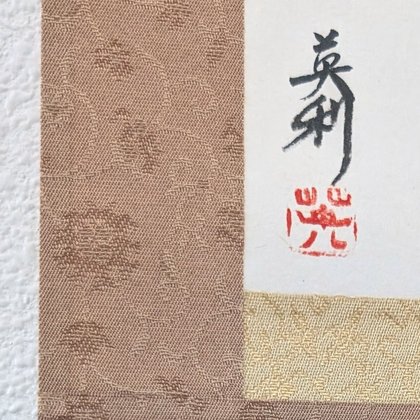
Master Japanese Calligrapher Eri Takase brushes your scroll by hand when you order it. Each scroll bears her red seal, 英利, and her signature.
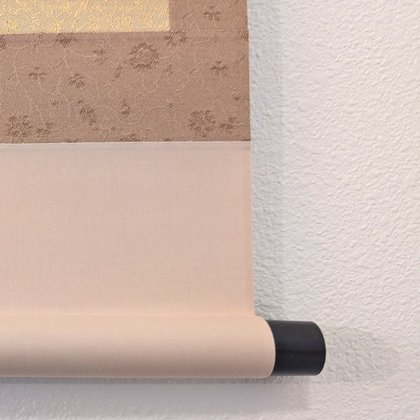
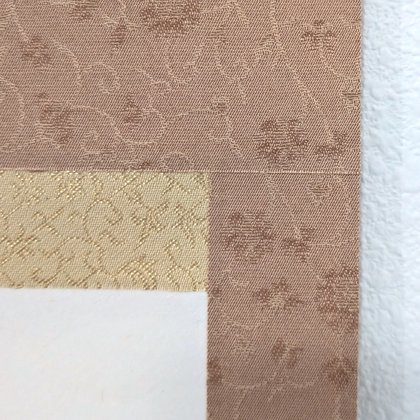
The scrolls are 12 1/4" W × 43" H (31 × 109 cm) with woven damask borders and Japanese paper that are layered so the scroll hangs straight and will not warp over time. The scrolls themselves are made by a scroll maker in Gifu, Japan, and we have worked with them for over two decades.
Eri Takase was born and raised in Osaka, Japan, and holds the rank of Shihan, the highest rank in Japanese calligraphy, from the Bokuteki-kai and the Bunka-shodo. About Master Takase


