





Jiun · 自運 · VD5J
Jiun (自運) is the calligrapher's word for writing from one's own invention. As a Shihan, Master Takase has a hand of her own, and these designs are that hand: she draws freely on the classic scripts to create exactly the look she wants.
一寸の虫にも五分の魂
issun no mushi ni mo gobu no tamashii
Even the Smallest Has Its Pride
However small or weak, any being has a mind and a pride of its own, and is not to be made light of.
Master Takase creates this beautiful scroll when your order is placed, personally preparing the ink and brushing your art, which proudly bears her signature and seal. This is an original work of art.
Description
一寸の虫にも五分の魂 (issun no mushi ni mo gobu no tamashii): however small or weak, any being has a mind and a pride of its own, and is not to be made light of.
Word by word, an insect one inch long has a soul of half an inch. One sun is the old Japanese inch, and five bu is half a sun. So the soul is half the size of its body, large out of all proportion to its owner.
A proverb dictionary gives the older sense too: any creature, however small, has its life and is not to be treated carelessly. Lafcadio Hearn read the proverb that way in 1899: any life, however small or mean, is entitled to mercy.
On Chikamatsu Monzaemon's stage, the proverb belongs to the small who stand up to the great, and to the great who sneer at them. In his play 天智天皇, Kanaoka, whom a prince has mocked as an insect, answers him with it. Issa gives the soul to a mantis rearing up: the mantis: "look, here is my half-inch soul!" Two editors of Issa date the verse 1819.
The karate teacher Funakoshi Gichin turned the proverb on the strong, in books from 1922 to 1956. In a world where an inch-long insect has a half-inch soul, he wrote, the further one advances, the more one must guard one's tongue.
A saying already when the warrior Hōjō Shigetoki, by tradition, set it in his letter of precepts in the mid-thirteenth century, as a reason not to take even an insect's life; the Edo proverb books list it from 1638, and no witness read names its maker.
We want you to be as happy with the meaning as you are with Master Takase's art. To learn more, visit Philology of 一寸の虫にも五分の魂.
Delivery
Your scroll is brushed when you order it and completed within 1 to 3 business days. It ships by USPS Priority Mail from Master Takase's studio in Washington State, boxed and ready to hang, with a printed page giving the art's English, romaji and Japanese.
Sending it as a gift? Add your message at checkout and we will include it.
Shipping is calculated at checkout from your address; within the United States it is $13 to $23. We ship worldwide, and any import charges for your country are shown at checkout before you pay.
Every order is covered by our 30-day money-back guarantee. If your scroll arrives damaged, or we made an error, we replace it or refund you in full, including shipping. Refund policy
About Our Scrolls
Master Japanese Calligrapher Eri Takase brushes your scroll by hand when you order it. Each scroll bears her red seal, 英利, and her signature.
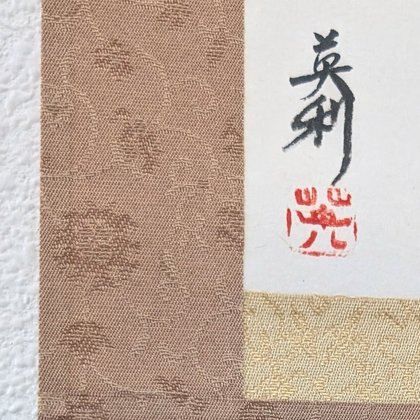


The scrolls are 12 1/4" W × 43" H (31 × 109 cm), with woven damask borders and layered Japanese paper, designed to last generations. The scrolls themselves are made by a scroll maker in Gifu, Japan, and we have worked with them for over two decades.
Eri Takase was born and raised in Osaka, Japan, and holds the rank of Shihan, the highest rank in Japanese calligraphy, from the Bokuteki-kai and the Bunka-shodo. About Master Takase


