





Semi-Cursive · gyōsho 行書 · VS5J
Semi-Cursive or gyōsho (行書) styles are a simplified and softer form of the kaisho styles. Gyōsho styles can be read by most Japanese.
心頭滅却すれば火もまた涼し
shintō mekkyaku sureba hi mo mata suzushi
Empty the Mind of Thought, and Even Fire Is Cool
Clear the mind of all thought, and even fire feels cool: any hardship is nothing once you have risen above it.
Master Takase creates this beautiful scroll when your order is placed, personally preparing the ink and brushing your art, which proudly bears her signature and seal. This is an original work of art.
Description
心頭滅却すれば火もまた涼し (shintō mekkyaku sureba hi mo mata suzushi): clear the mind of all thought and even fire feels cool, said of any hardship that is nothing to one who has risen above it.
心頭 is the heart or mind, and 滅却 is to do away with entirely; 火もまた涼し is fire, too, is cool. The coolness comes from the mind, not from the fire. The form here writes 心頭滅却 as one compound, without を, and JMdict enters the saying both ways.
Three dictionaries tell, with it is said, that the Zen abbot Kaisen Jōki spoke the saying as he burned with his monks. Among the tellings read for its history, a book of lives of Zen monks written in 1678 has Kaisen chant the line. A book printed before that gives the line to another monk, answering Kaisen's question.
Two writers said the words were not the abbot Kaisen's own. They were the topographer Ōmori Kaian, in a book printed in 1851, and the novelist Kōda Rohan, in an essay dated 1916. A Zen monk's capping word, Rohan wrote, may come from scripture, poetry, old sayings or a shout.
In English, R. H. Blyth gave the line in 1952 as When the mind is extinguished, fire feels cool of itself. He set it against the poets, who either complain of the heat or speak whimsically of it. D. T. Suzuki's rendering of 1959 reads When thoughts are quieted down, fire itself is cool and refreshing.
The last two lines of a summer poem by the Tang poet Du Xunhe, which the 碧巌録 (1125) quotes with 心頭 for its 心中; used in Japan by 1486, and tied to the burning of Erin-ji in 1582 by tellings printed from 1646 on.
We want you to be as happy with the meaning as you are with Master Takase's art. To learn more, visit Philology of 心頭滅却すれば火もまた涼し.
Delivery
Your scroll is brushed when you order it and completed within 1 to 3 business days. It ships by USPS Priority Mail from Master Takase's studio in Washington State, boxed and ready to hang, with a printed page giving the art's English, romaji and Japanese.
Sending it as a gift? Add your message at checkout and we will include it.
Shipping is calculated at checkout from your address; within the United States it is $13 to $23. We ship worldwide, and any import charges for your country are shown at checkout before you pay.
Every order is covered by our 30-day money-back guarantee. If your scroll arrives damaged, or we made an error, we replace it or refund you in full, including shipping. Refund policy
About Our Scrolls
Master Japanese Calligrapher Eri Takase brushes your scroll by hand when you order it. Each scroll bears her red seal, 英利, and her signature.
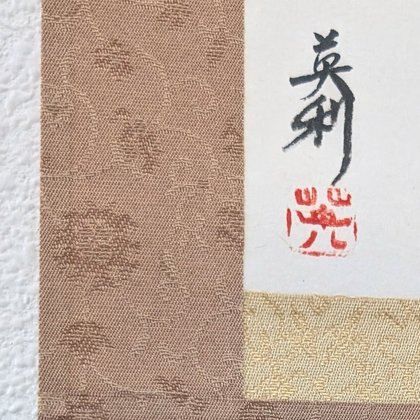


The scrolls are 12 1/4" W × 43" H (31 × 109 cm), with woven damask borders and layered Japanese paper, designed to last generations. The scrolls themselves are made by a scroll maker in Gifu, Japan, and we have worked with them for over two decades.
Eri Takase was born and raised in Osaka, Japan, and holds the rank of Shihan, the highest rank in Japanese calligraphy, from the Bokuteki-kai and the Bunka-shodo. About Master Takase


