




Block · kaisho 楷書 · VB5J
Block or kaisho (楷書) styles are the most common and recognizable styles. Block styles are easily read and are noted for their angular form and their vertical and horizontal lines.
腹八分目
hara hachibunme
Eating Until Eight Parts Full
Eating until eight parts full: a Japanese saying for stopping a meal before you are full, at about eight parts in ten.
Hand-brushed by Master Eri Takase
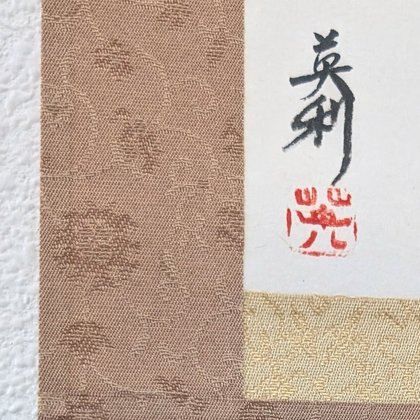
Master Japanese Calligrapher Eri Takase brushes your scroll by hand when you order it. Each scroll bears her red seal, 英利, and her signature.
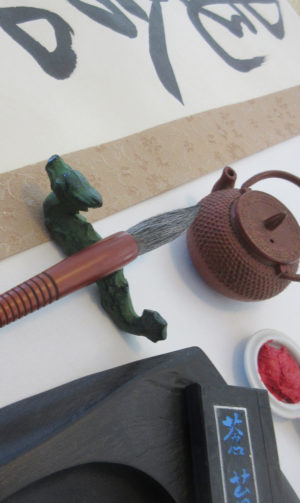
Eri Takase was born and raised in Osaka, Japan, and holds the rank of Shihan, the highest rank in Japanese calligraphy, from the Bokuteki-kai and the Bunka-shodo.
12 1/4" × 43" Japanese Scroll
The scrolls are 12 1/4" W × 43" H (31 × 109 cm), with woven damask borders and layered Japanese paper (washi), designed to last generations. The scrolls themselves are made by a scroll maker in Gifu, Japan, and we have worked with them for over two decades.


Ships in 1-3 days from Washington State
Your scroll is brushed when you order it and completed within 1 to 3 business days.
Your scroll ships from Master Takase's studio in Washington State. Shipping is calculated at checkout. We ship worldwide.
Includes detailed explanation, gift-ready
Your scroll arrives boxed, with a printed insert describing the words in detail.
Sending it as a gift? Add your message at checkout and we will include it with the insert.
30-day money-back guarantee
Every order is covered by our 30-day money-back guarantee. If your scroll arrives damaged, or we made an error, we replace it or refund you in full, including shipping.
Explanation
腹 is the belly and 八分 eight tenths, so 八分目 is eight tenths of a measure. The shorter 腹八分 is read hara hachibu. 腹八合 says the same in gō, a measure of volume.
In the sources read, 腹八分 is a cup's measure before it is a rule of food. In a prose piece printed in 1707, the poet Kikaku tells of travelers poured the season's sake. One sees his conch-shell cup filled to eight parts of its belly, and drains it gladly.
A modern commentary sums up Kaibara Ekiken's 養生訓, written in 1713, with the word 腹八分目. In the Meiji text read, Ekiken counsels stopping at seven or eight parts, and at eight or nine. The National Diet Library's full-text search of that Meiji text finds no 腹八分: the counsel is the same, in other numbers.
Mizuno Nanboku, a physiognomist of Ōsaka, held that the good and ill of a whole life all arise from food. An 1871 tract counsels eating to eight gō of the belly, for a strong body and a longer life. On the next page it tells Nanboku's own habit: two meals a day, morning and evening, of two bowls.
Fujii Otoo's proverb dictionary of 1910 enters the longer saying, eight parts of the belly and no need of a doctor, headed by its 腹八合 form. It explains: if one does not eat much, illness does not strike. It cites no Japanese text for it, and sets a Chinese saying beside it as a parallel: eat a mouthful less at supper and live to ninety-nine.
Two English proverb books, Rokuo Okada's and Daniel Crump Buchanan's, give the saying with the doctor in its 腹八合 form. Okada's, read in its second edition of 1958, writes hara hachi-gō ni isha irazu. Buchanan's, of 1965, renders it Temperance calls no doctor. Both print the English temperance is the best physic, which the 1910 proverb dictionary had set beside the saying.
The English books on Okinawa read, from 2001 on, give it as Okinawa's. The Okinawa Program, a book on the Okinawan diet and health, writes of Okinawans: They call their secret hara hachi bu. In The Blue Zones, Dan Buettner's companion Craig says: All of the old folks say it before they eat. No witness read from before 2001 speaks of Okinawa.
Japanese saying. The earliest known use of 腹八分 as a measure of eating, in the sources read, is Mizuno Nanboku's, in his physiognomy book 『相法脩身録』, cut in 1813 (腹八分を以て節とす); the longer saying 腹八分に醫者いらず is in print by 1898.
Learn More About These Words
We want you to be as happy with the meaning as you are with Master Takase's art. To learn more, visit Philology of 腹八分目.


