




Cursive · sōsho 草書 · VC5J
Cursive or sōsho (草書) styles are the most simplified styles and Master Takase's favorite. While very beautiful, these styles are often difficult to read even by specialists.
花は桜木人は武士
hana wa sakuragi hito wa bushi
Among Flowers the Cherry, Among Men the Warrior
Among flowers the cherry, among men the warrior: each the best of its kind.
Master Takase creates this beautiful scroll when your order is placed, personally preparing the ink and brushing your art, which proudly bears her signature and seal. This is an original work of art.
Description
花は桜木人は武士 (hana wa sakuragi hito wa bushi) sets two halves side by side with no verb, as in a list, and は marks each as its topic. 桜木 is a cherry tree, and 武士 is the warrior.
尤之双紙, a Kyoto book of lists, has a section on the heads of all kinds of things, from the gods to the twelve signs. The section closes on a comic verse: among people the warrior, among pillars cypress, among fish the sea bream, among robes the plum-red, among flowers Yoshino. The book gives the verse to the Zen monk Ikkyū about a century and a half after his death. The dictionary Daijisen says the witty tales told of him are of later date.
In the play 仮名手本忠臣蔵, the leader of the loyal retainers bows to a townsman and says: they say among flowers the cherry, among people the warrior; but never, never could a warrior match your resolve. The play quotes the saying in order to overturn it.
In English, Nitobe Inazō's Bushido (1900) has "As among flowers the cherry is queen, so among men the samurai is Lord." Daniel Buchanan's Japanese Proverbs and Sayings (1965) says of the cherry and the warrior: Both are supreme in their line.
A credit-union monthly of 2012 says any Japanese has probably heard the saying. A retail-trade monthly of 2011 quotes it with the rest of the list, pillars cypress, fish sea bream.
Japanese proverb. The earliest witness read is a 狂歌 credited to 一休 in 『尤之双紙』, read at the page in its 1634 printing (first printed 1632, by the catalogues; that edition not opened), in the form 人は武士 … 花はみよし野; the form with 桜木 is the Nihon kokugo daijiten's first instance, 『仮名手本忠臣蔵』 (1748).
We want you to be as happy with the meaning as you are with Master Takase's art. To learn more, visit Philology of 花は桜木人は武士.
Delivery
Your scroll is brushed when you order it and completed within 1 to 3 business days. It ships by USPS Priority Mail from Master Takase's studio in Washington State, boxed and ready to hang, with a printed page giving the art's English, romaji and Japanese.
Sending it as a gift? Add your message at checkout and we will include it.
Shipping is calculated at checkout from your address; within the United States it is $13 to $23. We ship worldwide, and any import charges for your country are shown at checkout before you pay.
Every order is covered by our 30-day money-back guarantee. If your scroll arrives damaged, or we made an error, we replace it or refund you in full, including shipping. Refund policy
About Our Scrolls
Master Japanese Calligrapher Eri Takase brushes your scroll by hand when you order it. Each scroll bears her red seal, 英利, and her signature.
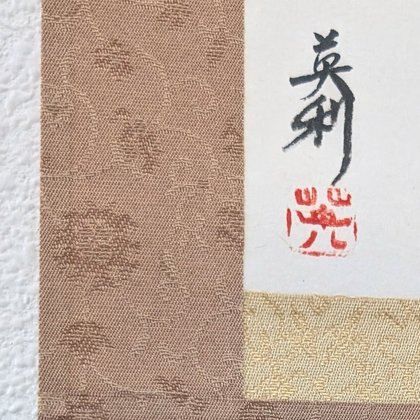


The scrolls are 12 1/4" W × 43" H (31 × 109 cm), with woven damask borders and layered Japanese paper, designed to last generations. The scrolls themselves are made by a scroll maker in Gifu, Japan, and we have worked with them for over two decades.
Eri Takase was born and raised in Osaka, Japan, and holds the rank of Shihan, the highest rank in Japanese calligraphy, from the Bokuteki-kai and the Bunka-shodo. About Master Takase


