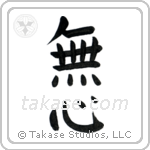
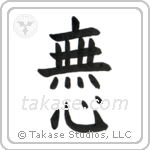
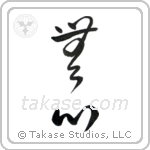
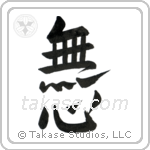
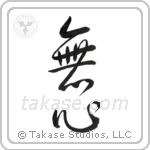
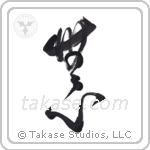
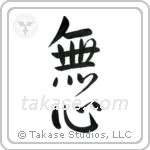
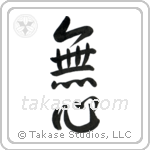
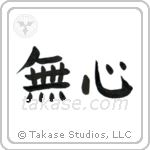
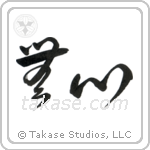
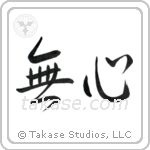
無心 is a mind that settles nowhere. The sword master who made this Zen word his teaching put it plainly: it does not mean having no mind at all. It is only the ordinary mind, and with it every stroke lands. His teacher in Zen wrote that a mind that fixes on one thing is like ice, frozen in place. This mind, he wrote, is like water, free to go wherever it is needed. Archers and nō actors have used the word the same way.
No-Mindedness, our title, is the Kenkyūsha dictionary's word for this sense, and most English books call it no-mind. The Japanese word has other lives that the English does not carry. It can mean innocence, or things that feel nothing, like grass and trees. In everyday speech it can also mean asking someone for money. The design carries only the Zen sense.
The Japanese word 無心 is composed of the kanji 無 (read mu) meaning "no; nothingness" and 心 (read shin) meaning "heart; mind; spirit".
The word is in the 莊子 three times and became a term in Guo Xiang's commentary of about 300, five centuries before the Zen masters took it up; in Japan it is in the court anthologies of 814 and 818, and the sense the design carries, the mind that stops nowhere, is the sword-Zen teaching of Takuan and Yagyū Munenori in the 1630s.
We want you to be as happy with the meaning as you are with Master Takase's art. To learn more, visit Philology of 無心.