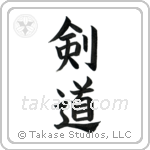
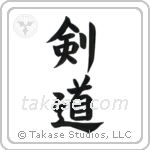
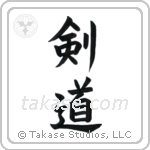
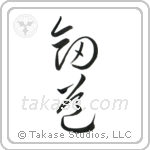
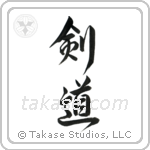
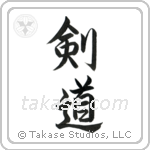
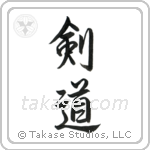
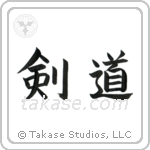
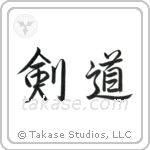
A Japanese dictionary calls 剣道 one of Japan's martial ways, a contest fought in armor with bamboo swords. The players strike or thrust at set places on the opponent, armored at the head, forearms, trunk and waist. 剣 is the sword. 道 is a road, a way, and by extension a teaching or the course of an art. Character by character, the name says the way of the sword; the dictionaries give the art.
Before 剣道 became the art's general name, the sword art was usually called 剣術 (kenjutsu), the ordinary Edo word, with 術 a technique or art. Another name was 撃剣 (gekiken, also read gekken), striking with the sword, the common Meiji word for fencing in armor with bamboo swords.
A school of the sword, the Abe school, wrote 劔道 for its art on a license of 1816. About 1845–46 a series of woodblock prints by Utagawa Kuniyoshi put the word in its title, and one sheet shows the reading kendau beside it. A board game of martial heroes, of between 1847 and 1852, and a popular tale of 1858 wrote it for a hero's sword art too, the tale again with kendau.
In 1884 the sword master Negishi Shingorō titled his book 撃剣指南, a guide to gekiken. Its preface says that Japan had had 劒道 from of old, and that of late 劒道 had revived. He named the book with one word and the art with the other.
In a popular manual of 1887, the author tells of a swordsman who says he studies 剣道 to cultivate himself. In 1895 Kumamoto Jitsudō, a teacher of a school of his own, wrote: morality is the source of 剣道; 剣道 is the flower of morality.
From about 1897, as one study finds, editors put 剣道 in titles, among them a magazine article of 1898. The same study has school clubs renaming themselves 剣道部, the Fourth Higher School in 1901 as an early case. Our count of the National Diet Library's catalogue finds fifteen book titles of the 1890s with 撃剣 and none with 剣道. Of the 1910s, it finds thirty-eight with 剣道 and five with 撃剣.
The Dai Nippon Butokukai, the national martial arts body, called the art 剣道 in its rules for masters by September 1914, as one historian reads them. In 1919, as an account from its records sets out, the association told its branches to use the name. The Ministry of Education wrote 撃剣 in its ordinance of 1911 and 剣道 in its rule for the higher schools in March 1919. In April and May 1926 the Ministry changed 撃剣 to 剣道 in the rules for the normal schools and the middle schools.
The Ministry's gymnastics syllabus was revised on 27 May 1926 to read 剣道. The revision added a caution: in 剣道, 柔道 and contests, courtesy is to be especially valued. There must be nothing like being needlessly caught up in winning and losing.
English prose has kendo from 1910, glossed fencing, as far as the Internet Archive's full-text search shows. Hepburn's Japanese-English dictionary of 1886 gave the art of fencing; Brinkley's of 1896 gave the way or art of fencing. The way of the sword stands beside kendo from 1936 in the same search.
D. T. Suzuki's Zen and Japanese Culture, in its edition of 1959, says: In the Kendō ("the Way of the Sword"), what is most essential to attain besides its technique is the spiritual element controlling the art throughout.
The two characters stand together as a book title in the Han imperial catalogue; in Japan 剣道 was a school's name for its art by 1816 and the popular word for a swordsman's art by the 1840s, and it became the general name of Japanese fencing between the 1880s and 1926, when the Ministry of Education's ordinances took it.
We want you to be as happy with the meaning as you are with Master Takase's art. To learn more, visit Philology of 剣道.