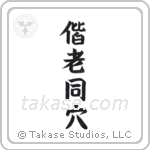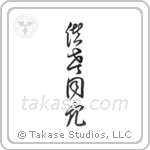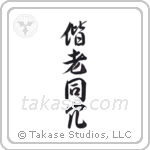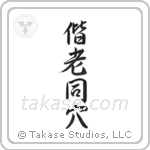

In today's dictionaries, 偕老同穴 is said of a husband and wife who stay together to the end, and of the firmness of their vow. The four characters say grow old together, share one grave. Letter manuals of the 1870s give the phrase among the phrases for a wedding letter. A Japanese wedding guide of 2024 calls it a phrase often used in wedding speeches.
In a novel by Kyokutei Bakin, published from 1807, a retainer speaks of the vow of 偕老同穴. In his words it is the vow to share the safety and peril of one life and the joys and griefs of a hundred years.
偕老同穴 is also the Japanese name of a deep-sea sponge, in English the Venus's flower basket. A male and a female shrimp live inside the sponge, and the name passed from the shrimp to the sponge. A writer heard in 1933 that around Fukuoka the sponge had long been a wedding decoration.
The phrase joins two lines from two poems of the Book of Songs, 與子偕老 from a soldier's song and 死則同穴 from a vow to share a grave, and the four characters stand as one vow in Japan by the 1190s, in a husband's memorial for his dead wife, long before they became the stock words of the wedding speech.
We want you to be as happy with the meaning as you are with Master Takase's art. To learn more, visit Philology of 偕老同穴.