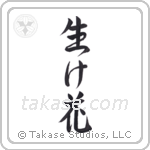
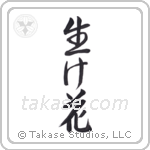
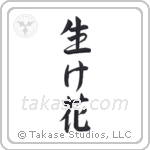
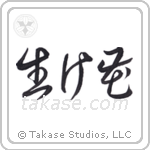
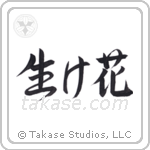
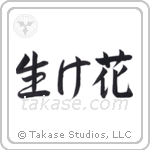
Flower arranging: the Japanese name of the art and of what it makes.
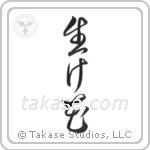
生け花 ikebana Flower Arrangement
More about 生け花
生け花 names three things at once: the act of setting cut branches and flowers in a vessel, the arrangement that results, and the art itself. The flowers are cut, yet the word calls them alive. The art reads it more boldly: the arranger gives a cut branch back the life it had on the hill. Whether it is for your own arranging or for someone who studies the art is yours.
The word joins 生ける, to keep alive, to 花, flowers; it is first known in a movable-type print of the flower manual 仙伝抄 from the years 1615 to 1644, whose colophon claims a transmission going back to 1445, and there it names flowers set in a vessel, one kind of arrangement beside others, a sense it kept until at least the end of Meiji before it came mostly to name the whole art.
We want you to be as happy with the meaning as you are with Master Takase's art. To learn more, visit Philology of 生け花.
About the Designs
Each design is Master Japanese Calligrapher Eri Takase's hand-brushed calligraphy of the word or phrase on this page, delivered as a PDF you can print. Every PDF includes the line art, so a tattoo artist or a craftsperson can work from the outline as well as the brushed image.
Licensing
Your purchase includes a personal-use license: use the design as a tattoo reference, frame it, engrave it, print it for yourself, or make it into a gift. For more information see Licensing, which also covers commercial-use options that may be purchased separately.
Delivery
Your PDF is available for download the moment your order completes, and a copy is attached to your emailed receipt.
If you need your design again later, ask us for it and we will send it.
Flower Arrangement as a hand-brushed scroll
Master Takase personally brushes your scroll when you order, and it bears her red seal and her signature. The scroll has woven damask borders and layered Japanese paper. It is designed to last generations and arrives ready to display.