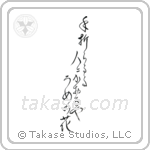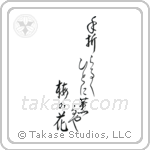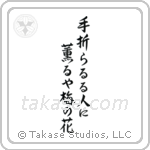

手折らるゝ人に薫るや梅の花 (taoraruru hito ni kaoru ya ume no hana)
| To the person breaking off the branch giving its fragrance the plum blossom | taoraruru hito ni kaoru ya ume no hana | 手折らるゝ 人に薫るや 梅の花 |
| Chiyojo | chiyojo | 千代女 |
手折らるゝ人に薫るや梅の花 (taoraruru hito ni kaoru ya ume no hana): to the one who breaks off its branch, the plum blossom gives its scent. Chiyo gave the verse a title, and the title is the sense: 仇を恩にて報するといふ事を, *on repaying enmity with kindness*. 手折らるゝ人に is *to the person by whom it is broken off*, the passive making the plum the subject and the breaker the recipient; 薫るや is *it gives its scent*, with the や of exclamation; 梅の花 is the plum blossom, the first flower of spring. It is hers by her own book: 千代尼句集, printed in 1764 with her preface, eleven years before her death, carries the verse under that headnote in its plum section, and a Kyoto garden guide of 1799 kept the headnote beside it. A textbook of 1909 made it the model of a verse with two faces, the plum that scents the hand that broke it and the gentleman who repays harm with good, and the maxim books of those years filed it among rules of conduct. The critics were cooler, *light and deft* in 1899, *moralistic* in Blyth; the public kept it, and a 1940 primer calls it famous among ordinary people. On one design Master Takase brushes 薫る and 梅 in kana, as some of the Meiji printings did; the other three carry the kanji. The English is Timothy L. Jackowski's, made for Takase Studios.
Couldn't add to cart. Please try again.