

The white dew it does not spill, the swaying of the bush clover.
白露をこぼさぬ萩のうねりかな (shiratsuyu o kobosanu hagi no uneri kana): the white dew it does not spill, the swaying of the bush clover. 萩, hagi, is bush clover, one of the seven grasses of autumn, its long stems bending in wind; 白露 is the white dew of the same season; うねり is the long undulation of a bough; かな closes on the swaying. The poem turns on one restraint: the clover moves, and the dew still does not fall. Two early books of the verse differ by one particle. The first collection after Matsuo Bashō's death, in 1696, reads 白露も, even the dew. A disciple's book of 1698 reads 白露を, the text the scroll brushes. In 1948 Ebara Taizō, the twentieth century's leading Bashō scholar, argued that を was the poet's own revision. Shiki praised the verse in 1893 as a perfect rendering of the clover's bearing, quoting it with も. Some of the designs write 白露 or 萩 in kana. The English is Timothy L. Jackowski's, made for Takase Studios.
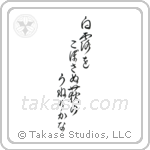
Bashō - Not spilling the glistening dew, the bush clover, undulating
白露をこぼさぬ萩のうねりかな
shiratsuyu o kobosanu hagi no uneri kana
Vertical Cursive VC6B
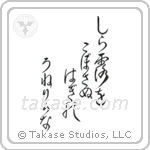
Bashō - Not spilling the glistening dew, the bush clover, undulating
白露をこぼさぬ萩のうねりかな
shiratsuyu o kobosanu hagi no uneri kana
Vertical Jiun VD5B
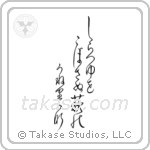
Bashō - Not spilling the glistening dew, the bush clover, undulating
白露をこぼさぬ萩のうねりかな
shiratsuyu o kobosanu hagi no uneri kana
Vertical Jiun VD6B
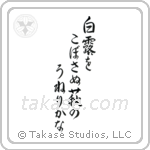
Bashō - Not spilling the glistening dew, the bush clover, undulating
白露をこぼさぬ萩のうねりかな
shiratsuyu o kobosanu hagi no uneri kana
Vertical Semi-Cursive VS6C
