
Kabuki Drama
Kabuki Drama
Tourist Library: 23
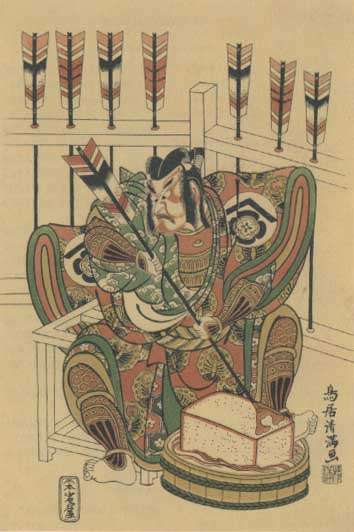
"YANONE," ONE OF EIGHTEEN BEST PLAYS
By Kiyomitsu Torii
KABUKI DRAMA
By
Syutaro Miyake

BOARD OF TOURIST INDUSTRY
JAPANESE GOVERNMENT RAILWAYS
COPYRIGHT 1938
EDITORIAL NOTE
It is a common desire among tourists to learn something of the culture of the countries they visit, as well as to see their beautiful scenery. To see is naturally easier than to learn, but flying visits merely for sightseeing furnish neither the time nor opportunity for more than a passing acquaintance with the culture of any foreign people. This is specially true of Japan and her people.
The Board of Tourist Industry recognizes both the obligation and the difficulty of providing foreign tourists with accurate information regarding the various phases of Japan's culture. It is, therefore, endeavouring to meet this obligation, as far as possible, by publishing this series of brochures.
The present series will, when completed, consist of more than a hundred volumes, each dealing with a different subject, but all co-ordinated. By studying the entire series, the foreign student of Japan will gain an adequate knowledge of the unique culture that has evolved in this country through the ages.
Board of Tourist Industry,
Japanese Government Railways.
NOTE
The Japanese Government has adopted a new system of spelling for certain Romanized Japanese syllable sounds. Though the spelling has been modified, the pronunciation remains the same. The modified spelling is given below with the old phonetic spelling in brackets:
si (shi) |
||
ti (chi) |
tu (tsu) |
|
hu (fu) |
||
zi (ji) |
||
sya (sha) |
syu (shu) |
syo (sho) |
tya (cha) |
tyu (chu) |
tyo (cho) |
zya (ja) |
zyu (ju) |
zyo (jo) |
Naturally, the change has caused the spelling of certain familiar names of places and things to be altered, for instance:
| Old Spelling | New Spelling |
| Shinto shrine | Sinto shrine |
| Chion-in temple | Tion-in temple |
| Mt. Fuji | Mt. Huzi |
| Chanoyu | Tyanoyu |
| Chosen | Tyosen |
| Jujutsu | Zyuzyutu |
| Jinrikisha | Zinrikisya |
CONTENTS
I. How to Appreciate the Kabuki
An Analysis of the Kabuki - A Land of Dreams - "Daikon" - Its Power of
Expression.
II. Characteristics of the Kabuki
Female Roles - Their Noted Players - High-born Daughters - Courtesans.
III. Machinery Peculiar to the Kabuki Stage
Curtains - "Hanamiti" - The Revolving Stage - "Ki" - "Tyobo"
- "Geza" - "Debayasi" - "Kurogo"
IV. Principal Kabuki Plays
The Eighteen Best Plays - "Aragoto" - Classical Plays - "Sewamono" -
"Kizewamono"
V. Technique Peculiar to the Kabuki
"Seppuku" (Harakiri) - The Dumb Show - "Korosi" -
"Mitiyuki" - "Tatimawari" - "Monogatari" - Inspection of the
Head - Vendetta.
VI. Symbolism and Impressionism in the Kabuki
The Black Curtain - "Yabudatami" - "Namiita" - The Story of Rice.
VII. The Story Value of the Kabuki
"Sukeroku" - "Kumagai's Camp" - "Kanpei"
Practical Guide to the Present-day Kabuki
1. HOW TO APPRECIATE THE KABUKI
What is Kabuki?
An answer for the uninitiated may be supplied by the study of the etymology of the word itself, which shows that "Kabuki" is a type of acting based on the arts of singing and dancing. It will thus be seen that Kabuki is not acting, pure and simple; it is fundamentally different from Western drama.
In Kabuki the play, singing and dancing, occurs during the course of the development of a story characterized by dramatic elements, and the whole performance is executed as a highly refined art. To be exact the Kabuki may be described as a play more like a revue than a drama, in the European sense - a play in which a classical story is enlivened with spectacular scenes.
The Kabuki is a classical play for the masses and rich in artistic qualities. It naturally follows that the Kabuki is presented in large theatres, and not, as with modern plays of the West, in a small theatre intended to serve the sole purpose of art for its own sake.
 Moreover, the
Kabuki is a very complicated dramatic form. A Kabuki play contains material not in
accordance with reason, and its classic style is but a feeble excuse. Foreigners seeing a
Kabuki play for the first time invariably think it is "wonderful." And
"wonderful" is a fitting epithet for the irrational element in Kabuki. So a
theatre built with the principles of modern stage science in mind is far from appropriate
for the presentation of a Kabuki play. For a full appreciation of the Kabuki, therefore,
one must prepare oneself, before entering the play-house, for a trip to a land of dreams -
to a land of poetic vision. One's mind should be prepared to receive the poetic and the
beautiful.
Moreover, the
Kabuki is a very complicated dramatic form. A Kabuki play contains material not in
accordance with reason, and its classic style is but a feeble excuse. Foreigners seeing a
Kabuki play for the first time invariably think it is "wonderful." And
"wonderful" is a fitting epithet for the irrational element in Kabuki. So a
theatre built with the principles of modern stage science in mind is far from appropriate
for the presentation of a Kabuki play. For a full appreciation of the Kabuki, therefore,
one must prepare oneself, before entering the play-house, for a trip to a land of dreams -
to a land of poetic vision. One's mind should be prepared to receive the poetic and the
beautiful.
Modern common sense, scientific analysis, logical reasoning, and rational examination - all should be forgotten for the nonce by a spectator of a Kabuki play. One might as well climb a tree in quest of fish as to expect logic and rationality in a Kabuki play.
To the critic of modern drama, there is much nonsense in the Kabuki, but this very nonsense is a quality that must be placed on the credit side.
Viewing the performance with an eye for logic is not the proper attitude for the enjoyment of a Kabuki play. It is to be understood as an art intended to appeal to the senses and the perception, an art to feast the eye rather than to satisfy the intellect. In this sense the Kabuki is decidedly not to be classed with modern drama which is entirely based on the story structure, but with music, dancing, painting, and sculpture of the classical type. The life of the present-day Japanese is only scantily represented in a Kabuki play.
 Being a classical art, the Kabuki play cannot be said to have a direct appeal
to the modern mind. Though its appeal is indirect, it is capable of giving esthetic
pleasure; though it is nonsense, it is capable of giving consolation to tile people - so
it is a play rich in elements of recreation which are enjoyed by the general public. In
its combining of general appeal with a considerable amount of artistic merit, it may not
inaptly be compared to the plays of Shakespeare. The Kabuki play is so complicated in its
nature that it is a difficult task to define it in a few words. Kabuki plays are also
known as "kyuugeki," or plays of the old school.
Being a classical art, the Kabuki play cannot be said to have a direct appeal
to the modern mind. Though its appeal is indirect, it is capable of giving esthetic
pleasure; though it is nonsense, it is capable of giving consolation to tile people - so
it is a play rich in elements of recreation which are enjoyed by the general public. In
its combining of general appeal with a considerable amount of artistic merit, it may not
inaptly be compared to the plays of Shakespeare. The Kabuki play is so complicated in its
nature that it is a difficult task to define it in a few words. Kabuki plays are also
known as "kyuugeki," or plays of the old school.
The Kabuki is then an artistic play. It is a play expected to be rendered with skill. Here artistic expression reigns supreme. In no other form of drama is the actor so ashamed of his immature execution and inferior calibre. In Kabuki circles, a poor actor is called "daikon" and a Kabuki actor feels most humiliated when he is called a "daikon." To attain perfect expression in his performance is his supreme ideal. I He aims at making a strong appeal to the audience by bringing to esthetic perfection the histrionic art so peculiar to the Kabuki.
 From the
foregoing it will be seen that to appreciate a Kabuki play emphasis must be placed not on
the story and the contents, but on the ability of the actors to make the characters live
in the classical manner.
From the
foregoing it will be seen that to appreciate a Kabuki play emphasis must be placed not on
the story and the contents, but on the ability of the actors to make the characters live
in the classical manner.
This appreciation is not easy to attain; it requires preparatory knowledge. The
beginner must be ready for a trip to fairyland, for such is the atmosphere of a Kabuki
play. If so prepared, a Kabuki play, which is a spectacle, highly colourful in
presentation and mystic in form, yet at the same time a dance and a story, will leave a
pleasant impression in the mind of the Western playgoer.
II. CHARACTERISTICS OF THE KABUKI
The Kabuki was first created by an actress by the name of Okuni who lived in Izumo about four centuries ago. In its original form the Kabuki was not a play, but a type of primitive dance called Nenbutu Odori, or "prayer dance."
Shortly afterward, the drama was monopolized by male actors, and features of the Noh, a classical play of music and dance, were incorporated into the Kabuki. The present stage of development has been attained through the efforts of male players alone. The earliest period of the Kabuki, when it consisted of dancing only by female players, was of short duration. After the cast came to be made up entirely by male players, the Kabuki play was designed to tell a story and it was enriched in its contents. The foundation of the present-day Kabuki was thus laid in those early days.
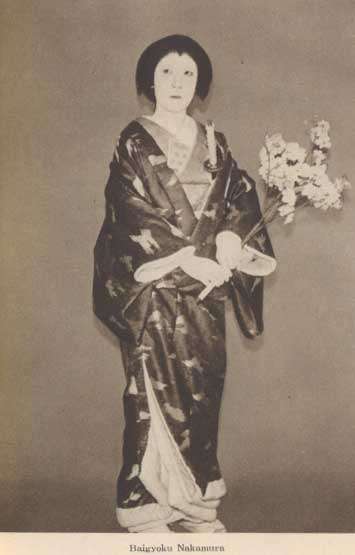
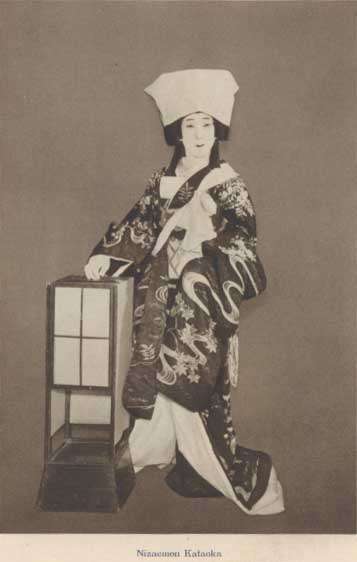
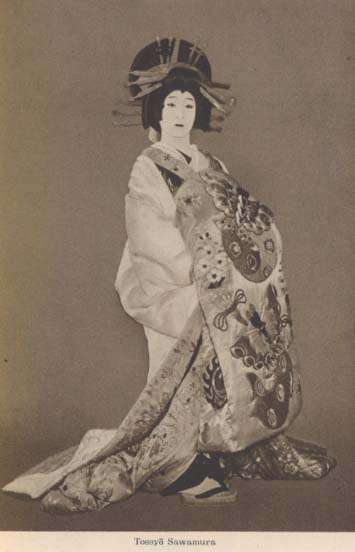
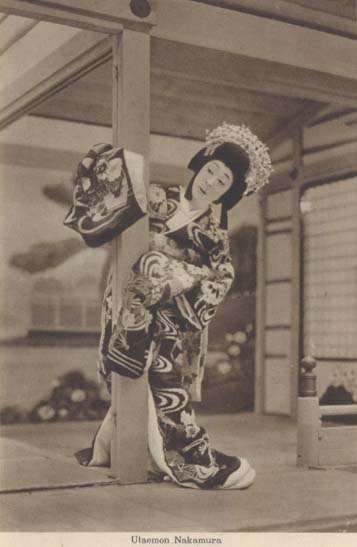
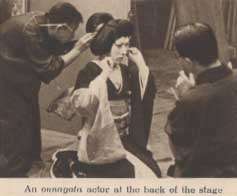
Because of the all-male cast the best-looking actors naturally come to take the roles of female characters. Such actors were called onnagata, or oyama. This art of female impersonation by men has made remarkable progress during the past three centuries. Onnagata are trained for their work from early childhood. Before the Meizi Restoration (1868), onnagata dressed in female costume oft the stage as well as on and every effort was made by them to be like a woman in every-day life. The result was a marked advance in the art of impersonation, making it possible for trained actors to represent women of all sorts and conditions on the stage. This is one of the most conspicuous features of the Kabuki play.
Even today there are no actresses in a Kabuki play and it remains untouched by
modernism. All parts are taken by male players, who are far superior to the actresses of
present-day Japan.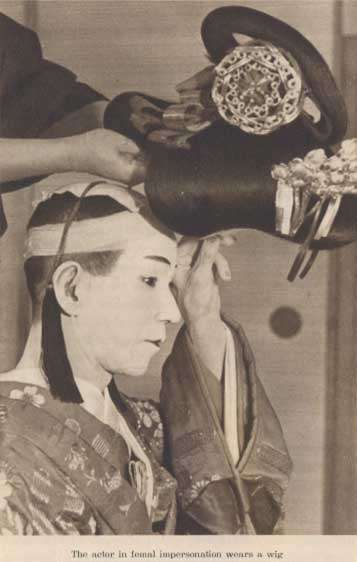
But how can an onnagata, who at first seems unnatural, do better acting than an actress? To begin with, the Kabuki is an unrealistic art; it is an art of bold outlines. The women of Japan, as a rule, are small in stature and lacking in dominating features. They are not, therefore, fitted for the Kabuki, which requires strong personality in its players.
The masculine element in the onnagata fits in with the symbolism of Kabuki. Besides,
having been trained from childhood in the manners of the fair sex, the onnagata knows
woman from A to Z - even better than a woman knows herself. Centuries of application and
tradition have resulted in such perfection in make-up, costume, and stylization that the
onnagata elicits admiration and compels respect. Today there are fewer onnagata of
distinguished skill, most of the more illustrious ones having passed away. Among the
living are Baigyoku Nakamura, of Osaka, who is perhaps entitled to be called a master; and
Nizaemon Kataoka, Syoutyou Itikawa, and Tokizou Nakamura, of Tokyo, all of whom are known
for their ability in impersonating women. There are also Tossyou Sawamura, Hukusuke
Nakamura, and Kikunosuke Onoe, who are rising onnagata of very great promise. These latter
three usually play the parts of young girls or ohimesama (high-born daughter). The ability
of those young actors compares very favourably in skill with the masters of the past in
their immature days.
It may be mentioned in passing that in the Kabuki, an ohimesama, which means a daughter of
a family of high social position, is an active participant in the play. The role is often
quite wonderful. A Kabuki play which features an ohimesama is generally one which comes
under the head of Maruhonmono.
A Maruhonmono means a form of musical drama which is performed not by human beings but
by dolls. The art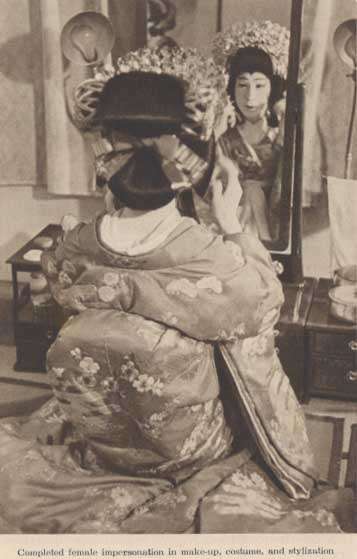 was created in Osaka more than two hundred years ago through the collaboration of
Monzaemon Tikamatu, a playwright of rare genius, and Takemoto Gidayuu, a reciter of
Zyoururi accompaniment. Zyoururi means the telling of the story of the puppet play by a
chanter. The proper name for this sort of play is Ningyou-zyoururi.
was created in Osaka more than two hundred years ago through the collaboration of
Monzaemon Tikamatu, a playwright of rare genius, and Takemoto Gidayuu, a reciter of
Zyoururi accompaniment. Zyoururi means the telling of the story of the puppet play by a
chanter. The proper name for this sort of play is Ningyou-zyoururi.
The Ningyou-zyoururi is of as much artistic merit as the Kabuki play. Though puerile at
first sight, because it is after all but a play involving toy-like puppets,
Ningyou-zyoururi was developed into a musical drama of high excellence because it was
fortunate in having as the composer of its play-books, one of the greatest geniuses the
dramatic world of Japan has ever had - the celebrated Tikamatu, the Shakespeare of Japan.
Almost immediately after the birth of the Ningyou-zyoururi, some of its plays were reproduced in flesh and blood on the Kabuki stage with considerable success. Today we find that the better Kabuki plays are those which have been borrowed from Ningyou-zyoururi rather than those of pure Kabuki origin.
In the Kabuki plays of Ningyou-zyoururi origin, the ohimesama figures conspicuously. She usually is the heroine of a love story and enlivens the stage with colour and romance. The Kabuki's most noted ohimesama, who are featured in Kabuki plays, are: Yaegakihime, who appears in the scene of "Zissyukou" in the "Hontyou Nizyuusikou," Yukihime of "Kinkakuzi" in the "Gion Sairei Sinkouki," and Tokihime in "Kamakura Sandaiki." Another typical example of the ohimesama is Hinadori in the scene of "Yama-no-dan" in "Imoseyama Onna Teikin."
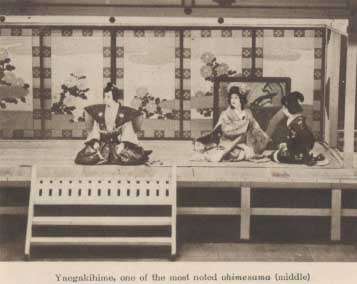
The oiran (courtesan) is another of the chief parts taken by onnagata players. In feudal Japan, an oiran was an inhabitant of the pleasure quarters. People paid respect to her as an object of beauty. In the Kabuki plays of Kabuki origin she is made much of, and, as in the case of the ohimesama, she helps a good deal in creating an atmosphere of romance on the stage.
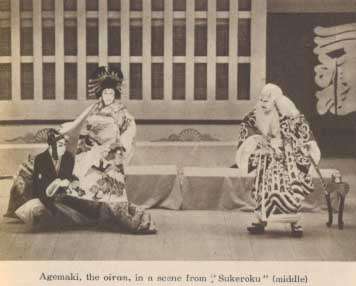 From among the
plays of Kabuki origin, the eighteen which were most successful on the Edo stage have been
selected and are known as "Kabuki Zyuuhatiban." "Sukeroku" is one of
the masterpieces of the group. Agemaki, the oiran, plays opposite Sukeroku in the title
role. The courtesan is the symbol of the esthetic taste and culture of the Edo period. She
is spectacularly attired in sikake, a gown, under which she wears kimonos of gorgeous
splendour. The characteristic features of the onnagata are fully displayed when an
onnagata player is enacting the role of Agemaki. In such a character are embodied feminine
charms, brought out in strong relief and as unreal as the beauties of Utamaro, the
celebrated colour-print artist. The wig the actor wears for acting this female part may
weigh as much as 25 pounds on account of its grand display of decorations. Such a heavy
burden would almost break the neck of a Japanese actress. With a man-woman, however, the
unwieldy wig becomes but an element that goes towards the building up of beauty and
character harmony. In fact, the onnagata has made it possible for the Kabuki play to
present a type of feminine beauty impossible in ordinary conditions.
From among the
plays of Kabuki origin, the eighteen which were most successful on the Edo stage have been
selected and are known as "Kabuki Zyuuhatiban." "Sukeroku" is one of
the masterpieces of the group. Agemaki, the oiran, plays opposite Sukeroku in the title
role. The courtesan is the symbol of the esthetic taste and culture of the Edo period. She
is spectacularly attired in sikake, a gown, under which she wears kimonos of gorgeous
splendour. The characteristic features of the onnagata are fully displayed when an
onnagata player is enacting the role of Agemaki. In such a character are embodied feminine
charms, brought out in strong relief and as unreal as the beauties of Utamaro, the
celebrated colour-print artist. The wig the actor wears for acting this female part may
weigh as much as 25 pounds on account of its grand display of decorations. Such a heavy
burden would almost break the neck of a Japanese actress. With a man-woman, however, the
unwieldy wig becomes but an element that goes towards the building up of beauty and
character harmony. In fact, the onnagata has made it possible for the Kabuki play to
present a type of feminine beauty impossible in ordinary conditions.
The geisya is another favourite role of the onnagata. The geisya represents a gay-quarter beauty more delicate than the oiran. The onnagata has succeeded in representing on the stage a geisya even excelling that of real life in beauty of form and refinement of manners.
From the foregoing it will be seen that the Kabuki play is actually a highly refined product of Edo culture and hence a comparatively modern form of Japanese drama.
III. MACHINERY PECULIAR TO THEKABUKI STAGE
1. Curtains
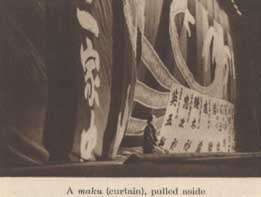
The leading theatres where the Kabuki plays are staged are also used for performances of the modern school. In view of this circumstance, the managements of most of such theatres find it convenient to use the European curtain. But if possible, the European curtain which works up and down is avoided. Instead, a maku (curtain) of simple-patterned cotton is regularly used. This curtain is not of the lift type, but is pulled aside. In Tokyo theatres, when the maku is used, it is usually striped with thick lines of green, red-brown, and black, while in the Kansai, there is more variety and colour in the design of the traditional Kabuki stage curtain. The simple-patterned curtain of the Kabuki stage is termed zyouhiki-maku ("proper curtain"), and it is considered by competent critics to be in perfect keeping with the spirit of the Kabuki.
2. "Hanamiti"
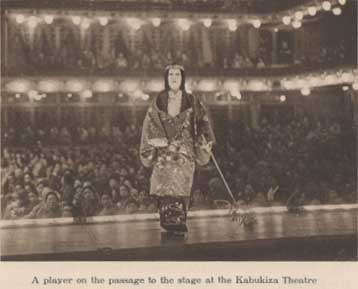
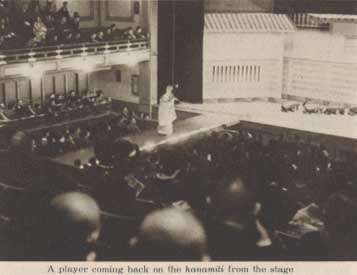 Hanamiti, or
"flower way," is a passage leading to the stage through the left section of the
theatre. There is diverse opinion as to the history of the hanamiti, and no detailed
account of it can be given here. Suffice it to say that the hanamiti has been in use for
about two centuries. The passage of the actors on to the stage over the hanamiti is called
de (advance) and the passage back from the stage to the exit screened with a small curtain
termed agamaku, is called hikkomi (withdrawal). The use of the hanamiti is considered very
important and productive of histrionic effect. Foreigners are unanimous in their praise of
this particular feature of the Kabuki stage. It is said that a Russian dramatist,
Meierchold, who deeply appreciated the Kabuki, was so much pleased with the hanamiti that
he adapted it in a modified form in a Russian theatre with which he was connected. The
hanamiti is sometimes doubled to enhance the spectacular effect and maintain closer
contact with the audience. The auxiliary passage, kari-hanamiti ("provisional flower
way"), runs parallel on the opposite side of the main passage, and it is narrower
than the hanamiti by about one-third. These two passages are sometimes used by actors to
great advantage in such scenes as the one called "Numazu-no-ba" in the Kabuki
version of "Igagoe Doutyuusugoroku," a puppet play. The hanamiti, a theatrical
device peculiar to Japan, is no doubt a valuable adjunct to the Kabuki.
Hanamiti, or
"flower way," is a passage leading to the stage through the left section of the
theatre. There is diverse opinion as to the history of the hanamiti, and no detailed
account of it can be given here. Suffice it to say that the hanamiti has been in use for
about two centuries. The passage of the actors on to the stage over the hanamiti is called
de (advance) and the passage back from the stage to the exit screened with a small curtain
termed agamaku, is called hikkomi (withdrawal). The use of the hanamiti is considered very
important and productive of histrionic effect. Foreigners are unanimous in their praise of
this particular feature of the Kabuki stage. It is said that a Russian dramatist,
Meierchold, who deeply appreciated the Kabuki, was so much pleased with the hanamiti that
he adapted it in a modified form in a Russian theatre with which he was connected. The
hanamiti is sometimes doubled to enhance the spectacular effect and maintain closer
contact with the audience. The auxiliary passage, kari-hanamiti ("provisional flower
way"), runs parallel on the opposite side of the main passage, and it is narrower
than the hanamiti by about one-third. These two passages are sometimes used by actors to
great advantage in such scenes as the one called "Numazu-no-ba" in the Kabuki
version of "Igagoe Doutyuusugoroku," a puppet play. The hanamiti, a theatrical
device peculiar to Japan, is no doubt a valuable adjunct to the Kabuki.
3. The Revolving Stage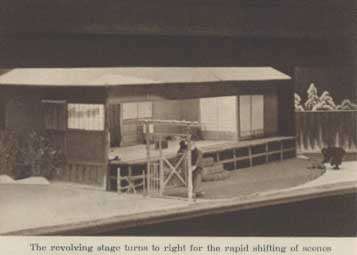
This is a device for the rapid shifting of scenes, bringing to view, by means of a mechanism similar to the turntable, the scene which is ready behind the stage. This device is called mawari-butai, or revolving stage. Its invention is ascribed to Syouzou Namiki, a playwright of Osaka, who lived some two hundred years ago. The mawari-butai makes for much economy in time, by shortening the intervals between acts, and is deservedly well commented on by Western play-lovers.
Another device, which like the mawari-butai, is a time saver, is the seriage, or platform on which a character is raised to the stage from underneath. There is also a device which reverses the process, so that an actor may disappear from the stage into the ground. It is called the serisage. Such inventions, products of the fertile brain of Syozou Namiki, add to the uniqueness of the Kabuki play.
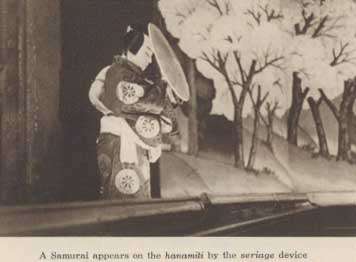
Another device, which like the mawari-butai, is a time saver, is the seriage, or platform on which a character is raised to the stage from underneath. There is also a device which reverses the process, so that an actor may disappear from the stage into the ground. It is called the serisage. Such inventions, products of the fertile brain of Syozou Namiki, add to the uniqueness of the Kabuki play.
 4.
"Ki"
4.
"Ki"
In the Kabuki, ki or wooden clappers invariably accompany the pulling on and off of the curtain. Ki or hyosigi are a pair of square-shaped sticks made of hard kasi wood. The clapper is about three inches thick and about a foot long. The hyousigi are clapped by a kyougenkata, who is a sort of assistant to the stage manager. The bell or the gong of the Western plays, are used to punctuate the beginning, close, or intervals of a play. Simple as it may seem, considerable skill is really required for the proper operation of the hyousigi.
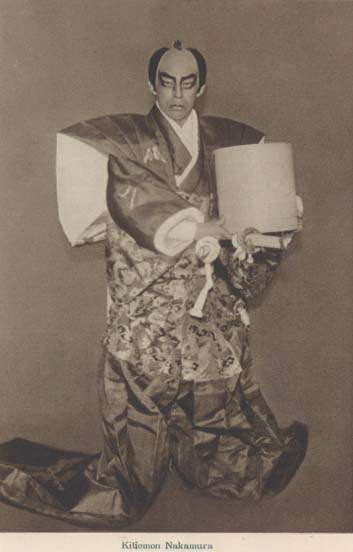
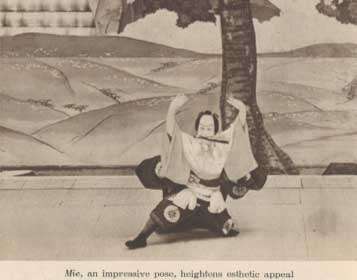
In the Kabuki, the climax of a piece of is accentuated by an impressive pose in which the actor becomes statue-like with his eyes wide open. This posing is called mie. It effectively heightens esthetic appeal. A good Kabuki actor must be skilful in this posing. Mie is seen at its best when performed by Kitiemon Nakamura, a well-known modern Kabuki actor.
A mie is emphasized by the striking of the wooden clappers against a thick board by the assistant stage-manager, who sits on one side of the stage. The sound of the wooden clappers is called tuke. Its function is to call attention to the posing of the actor. In fact, the hyousigi is part of the fabric of a Kabuki play, and a neglect of their value keeps the audience from understanding much of the charm and significance of a Kabuki drama.
 5. "Tyobo''
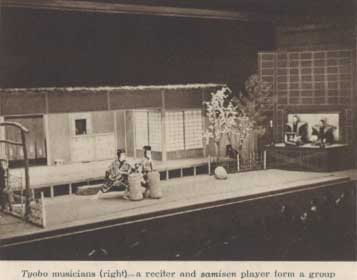
This music is an indispensable adjunct of the Kabuki dramas of puppet-play origin. Tyobo means Gidayuu or Zyoururi, or music which dates back some three hundred years. Gidayuu stands highest in artistic merit among various kinds of music in Japan. The term tyobo is used only when Gidayuu is performed in accompaniment to a Maruhonmono, or a Kabuki drama of puppet-play origin. The words are recited by a tayuu and the musical accompaniment is supplied by a samisen player. A singer and musician form a group and occupy a section of the stage. They are always attired in kamisimo, a costume dating from feudal times. Tyobo is essential to the effective rendering of a Maruhonmono play. The tyobo players, though in the sight of the audience, appear without any other make-up or disguise than the kamisimo already mentioned. The reciter has a play-book before him resting on a kendai, or small decorative desk, from which he reads in a highly dramatic manner. Sometimes the tyobo musicians perform behind a bamboo screen which is situated on one side of the stage.
6. "Geza"
A geza is a kind of music box. It is on the opposite side of the stage from the tybo which is always on the stage. The box is inconspicuously placed, so it passes often unnoticed by the audience. It is manned by a number of musicians, whose work is specialized. The samisen the chief instrument used. The box men signal for the entrance and exit of actors, and are responsible for the effects and various musical incidents which occur in the course of a play. They make sound imitations as in a radio broadcast by simulating with their instruments the noise of water, rain, bells, etc. to add to the reality and impressiveness of the performance on the stage. The musical features other than the tyobo are supplied by the box, and they are of considerable variety.
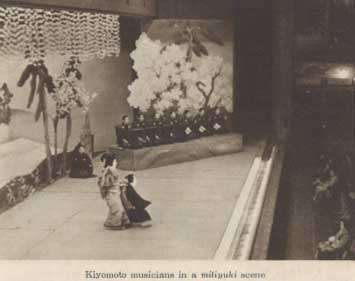
7. "Debayasi"
This is a sort of visible orchestra, and is chiefly used when there is a dance. The members, whose numbervaries according to circumstances, are located in the middle back of the stage or on the right or the left side. The kinds of music they perform are Nagauta, Tokiwazu, and Kiyomoto, all consisting of an emotional recital with samisen accompaniment. For particulars, the reader should refer to "Japanese Drama," which is one of the series of brochures included in the Tourist Library.
 8.
"Kurogo"
8.
"Kurogo"
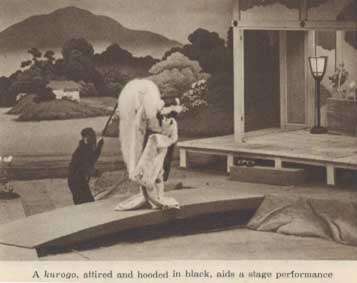
The kurogo corresponds to the prompter of the European stage. A kurogo is attired and hooded in black so as to make himself most unobtrusive; hence the name of kurogo, or kuronbo, which means "negro." The work of a kuronbo is done by one of the assistants of the stage manager. It is his duty to aid the actors at various times during a stage performance. When an actor remembers his words imperfectly in a newly billed play, the kuronbo stands behind him and acts as prompter. He also attends to the placing of the aibiki, a kind of chair often used by an actor in a leading role. Besides the kuronbo there is another stage assistant called kouken. He is more dignified looking, for he shows his face and is in hakama. Assistants of this type may seem to distract the attention of the audience from the play, but in a Kabuki drama their presence sometimes enhances the beauty of the performance by intensifying the glamour of romance.
IV. PRINCIPAL KABUKI PLAYS
I. The Eighteen Best Plays
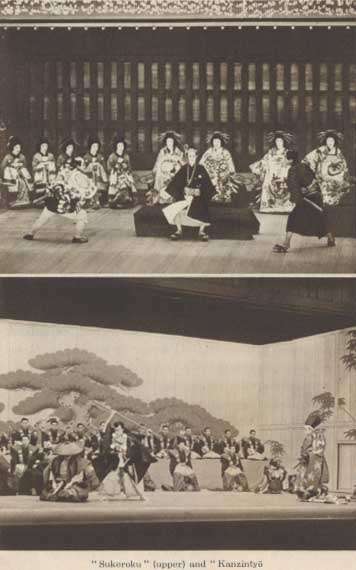
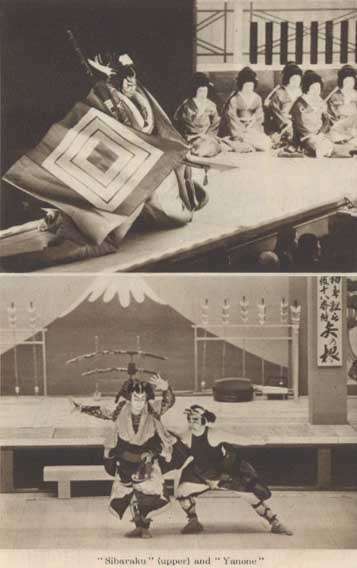
As already mentioned, the eighteen masterpieces selected from the plays of Kabuki origin staged since the birth of the Kabuki about two centuries and a half ago are collectively styled "Kabuki Zyuuhatiban". These eighteen were the repertoire of the nine generations of the illustrious Itikawas from the first Danzyuurou of the Genroku period (1688-1703) to the ninth in the Meizi era. The plays have been the monopoly of the Itikawas, and even now the rights of printing and staging them are in the hands of the present representive of the family. About ten out of the eighteen are now staged, the rest having died a natural death. The following seven are considered by general consent to be of greatest merit: - "Sukeroku," "Kanzintyou," "Sibaraku," "Yanone," "Kenuki," "Narukami," and "Kamahige."
Of these seven, "Sukeroku" and "Kanzintyou" are the most distinguished, being the best of the plays of Kabuki origin. All the plays of the "Kabuki Zyuuhatiban " are characterized by the spirit of hero-worship, and are labelled Aragoto, or plays of masculine character, and are theatrical products peculiar to Edo.
2. Classical Plays
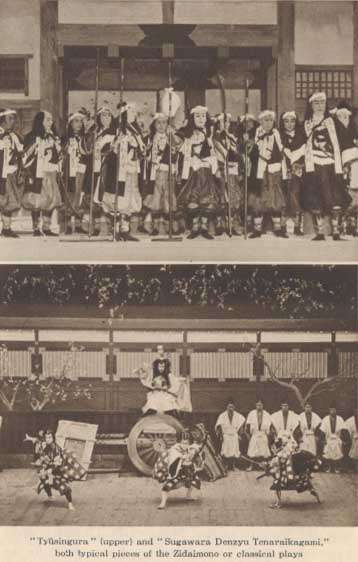
Zidaimono is the general name for Kabuki plays with historical backgrounds. Most of these plays are those of puppet-play origin. A Zidaimono is usually only part of a play - one act taken from a long story in the original. In naming the representative Kabuki plays of the Zidaimono type, "Kanadehon Tyuusingura" by Izumo Takeda comes first in the list. This was originally written for the puppet stage about two hundred years ago. It has been and still is the most oft-staged and most popular of all the Kabuki plays. Plays of Kabuki origin can boast of such masterpieces as "Sukeroku" and "Kanzintyou," but these are only one-act plays, while "Kanadehon Tyuusingura" is an eleven-act play. The story is about the vendetta of the loyal retainers of Akou, and, in spite of the great length of the play, it is very creditably written. It is not an exaggeration to say that this play is the most valuable among those dramas of the Kabuki.
Because of its great length, the play is performed in its abridged form. It was performed in its entirety until recently at the Bunrakuza at Osaka, the only puppet-play theatre extant in Japan, but the exigency of time compelled the management of the theatre to make a curtailment. Now only the first seven acts of the entire eleven are given. On the Kabuki stage, a similar, or an even greater, abridgement is made when the play is staged.
The "Tyuusingura" is a piece really typical of the Zidaimono. It will be remembered that John Masefield has produced an English version of this play under the title of "The Faithful."
Another historical masterpiece of puppet-play origin is "Sugawara Denzyu Tenaraikagami" written by the author of the "Tyuusingura." This is also a play of many acts. Part of the drama - the act called the "Terakoya," - has been made into a play and staged in America under the title of "Busidou." It is proof that among the historical Kakuki plays are to be found dramas of great merit. The reader is reminded that the tyobo, or classical music, plays an important part in the effective presentation of these dramas.
 3.
"Sewamono"
3.
"Sewamono"
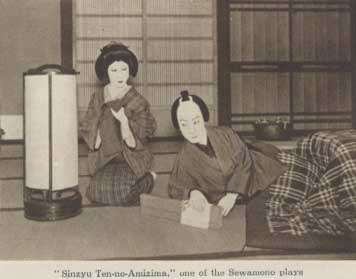
In contrast with the historical plays, there are genre plays dealing with love and other affairs of every-day life, and though they seem classic they are very realistic. These plays may be also regarded as adaptations from puppet plays. As briefly referred to in a preceding passage, the dramatic genius, Monzaemon Tikamatu wrote a number of genre plays of extraordinary merit for the puppet stage, expressing in them scenes from contemporary life. He lived in Osaka in the Genroku period, the last quarter Or the 17th century, when people in that commercial capital were enjoying luxurious living.
There are "Sinzyu Ten-no-Amizima" and "Meido no Hikyaku," to mention only a few. These were made into Kabuki plays with more or less modification. Genre plays were created and developed in Osaka, and even in the present-day Osaka, actors are noted for their special skill in performing them.
 4.
"Kizewamono"
4.
"Kizewamono"
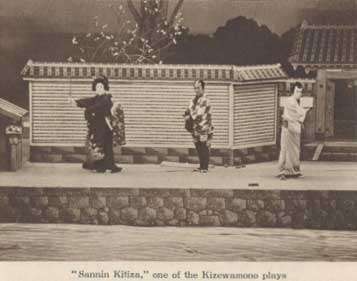
These plays were first produced in Edo about 130 years ago, and so were called Kizewamono in order to distinguish them from Sewamono, most of which were products of Osaka. Kizewamono means later genre plays and they are more realistic than similar Osaka plays. All of the Kizewamono are of Kabuki origin, and belonging as they do to later times, they have no connection with the puppet play. The pioneer writer of this type of play was the fourth Nanboku Turuya, who flourished in the Bunka and Bunsei eras, or, to be more exact, the first quarter of the nineteenth century. Shortly before the Restoration of Meizi, another famous playwright appeared. His name was Mokuami Kawatake, who might be called a pupil of Nanboku. By the time of his death in the middle of the Meizi era, he had given to the world a number of plays, the majority of which were Sewamono. Contemporaneous with him were such great luminaries of the stage as the fourth Kodanzi Itikawa and the fifth Kikugorou Onoe (father of the sixth Kikugorou now living). Mokuami wrote plays with a view to providing these actors with fitting parts. As a writer of plays of Kabuki origin, he was one of the greatest, if not the greatest, dramatist Japan has ever known. All his plays portray contemporary life and culture in Edo and they are made much of even in these days. Edo being their birthplace, these plays are seen at their best when acted by Tokyo actors. Mokuami was very skilful in combining his plays with appropriate music. Especially he is noteworthy for his mastering of stage technique. He is almost without a peer in this respect. His representative plays are "Murai Tyouan Takumi no Yaburegasa," "Sannin Kitiza," "Tuyukosode Mukasihatizyou," and "Kumo ni Magou Ueno no Hatuhana" (popularly known as "Koutiyama to Naozamurai").
V. TECHNIQUE PECULIARTO THE KABUKI
 I .
"Seppuku" (Harakiri)
I .
"Seppuku" (Harakiri)
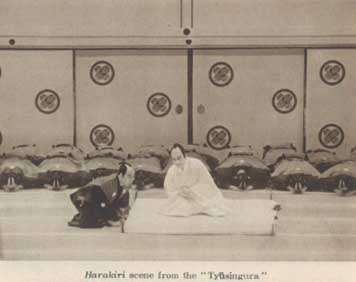
In feudal days the ethical ideal of the Samurai was to give up his life for his lord and his country. When it became necessary for him to die, he resorted, by preference, to a painful method of disembowelling himself by cutting into his stomach with a sword - called by foreigners harakiri, but more commonly known as seppuku among the Japanese. This act of daring was considered as a manifestation of Busidou, the spirit of the Samurai.
Thus up to the dawn of New Japan a multitude of Samurai of great promise took their own lives by committing harakiri for the sake of Busidou and Yamato-damasii.
The Kabuki play makes it a point of actually portraying seppuku when a Samurai is to commit suicide. It may indeed be said that seppuku is a feature peculiar to the Kabuki.
One notable example of harakiri is found in Act IV of the "Tyuusingura," already mentioned. The name of the character is Enya Hangan. The scene, which is an important part of the play, shows a harakiri scene true to life. Enya Hangan is ceremonially dressed in white. And other details of etiquette are closely followed, such as the condition of the mat on which the actor sits. When harakiri is performed, the mat must be reversed.
 2.
"Danmari"
2.
"Danmari"
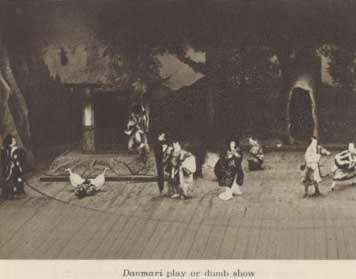
Danmari corresponds to the dumb shows of European drama, the performance being conducted without speech. It was originally conceived as a means of personal appearance for star actors when a new troupe was organized. So a danmari play is necessarily very short, lasting only about ten minutes. The actors, colourfully costumed, give their performance in dance fashion. Sometimes a danmari contains as many as 50 actors organized so as to form a picturesque ensemble. Though nonsensical, a danmari is of great artistic merit. These dumb shows may roughly be grouped in two kinds - Historical and modern. The former aim at being grotesque and colourful; the latter at being realistic and refined. Music accompanies both kinds of danmari. In the presentation of a historical danmari, the stage device of sereiage, or raising of an actor from below the floor, is usually made use of. Another feature worthy of note is roppo. This is a posture made at the foot of the hanamiti by the leading actor of a danmari, who is usually of grotesque appearance. It is highly characteristic of the Kabuki and much appreciated by the connoisseur.
3. "Korosi"
Kabuki plays of the Sewamono variety often contain a murder scene. This act, or korosi in the language of the Kabuki stage, presents a sight less cruel than in reality, as care is taken to make it unreal and more or less artistic. Accompanied by dancing and music, a korosi even impresses the audience as a spectacle different from that of murder. The Kizewamono plays by Mokuami, already mentioned, have many scenes of korosi, which are the outcome of jealousy originating in amorous rivalry. An example of the artistic treatment of a korosi is to be seen in the "Kasi Korosi" scene in "Edo Sodati Omaturi Sasiti" composed by Sinsiti Kawatake, a pupil of Mokuami.
 4.
"Mitiyuki"
4.
"Mitiyuki"
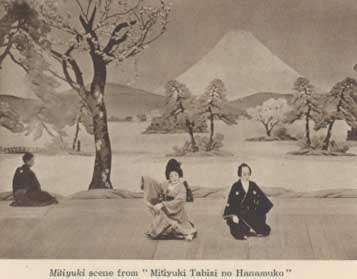
"Mitiyuki" means "travel" or "on the way of travel." This is a favourite feature in a puppet play. It usually introduces the billing and cooing of a pair of lovers and the charms of the form and motion of a dance are woven into such a performance - in fact, it is more in the character of a dance than a part of a play. When a mitiyuki intervenes in a multiple-act play, it gives a feeling of enjoyable relief. Take the "Tyuusingura" for instance. The third act contains a mitiyuki by Okaru and Kanpei, two sweet souls filled with passionate love. In the eighth act there is a rare example of a mitiyuki by a mother and her young daughter. A mitiyuki is usually enlivened by Gidayuu music, and this makes it seem more like an oasis for the audience in their travel through many acts.
 5.
"Tatimawari"
5.
"Tatimawari"
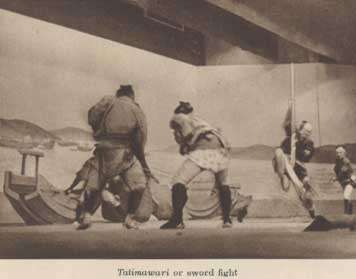
In ideology, the Kabuki play is kindred to Fascism; it is militaristic in character. Always in a Kabuki play one sees the sword, and fights between Samurai themselves or between Samurai and members of the other classes. These sword fights are called tatimawari in the Kabuki. Being more conventional a nd picturesque than realistic, they are in good keeping with the spirit of the drama. When a Samurai cuts an opponent of a low rank, the victim turns a somersault. The performing of this acrobatic feat is called "tonbo wo kiru." The grim seriousness of a fight for life is softened and made humorous by a man leaping down from the roof with the lightness of a leaf driven by a wind. Moreover, a fighting scene is interrupted with much festivity as music is furnished by the geza, or unseen orchestra, already described elsewhere. All these endeavour to make the severity of a struggle as unreal and artistic as possible. Examples of tatimawari are found in "Hiragana Seisuiki" and "Sakaro no Higuti" by Izumo Takeda and in a "Marubasi Tyuuya" by Mokuami.
 6.
"Monogatari"
6.
"Monogatari"
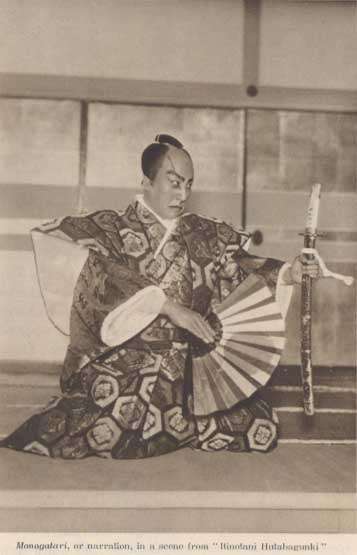
This does not mean "story," but "narration." By means of the monogatari an important matter is narrated to another. Many of the Kabuki plays adapted from puppet plays make use of this device, which marks the climax of a particular art. Gestures like that of a stage dancer and music by tyobo combine to make such a narration congenial to the Kabuki. Monogatari is considered to be a very difficult piece of Kabuki acting, and there are many conventions to which the actor must conform. Here an actor has an opportunity to exhibit his talent and skill. Consequently monogatari is well worth the careful attention of the student of the Kabuki. At the risk of repetition, the reader should be warned that here as elsewhere in a Kabuki play the performance should not be judged by the standard of realism. The eye must see the beauty of harmony produced by form, attitude, manner of utterance, and motion combined, and this in the midst of the appearance of the unnatural and the grotesque. There is a symbolistic beauty in the actions of a human being imitating a puppet. An example of monogatari is to be found in the third act of "Itinotani Hutabagunki" by Sasuke Namiki.
 7.
"Kubizikken"
7.
"Kubizikken"
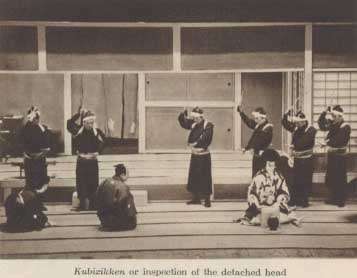
Migawari is a feature of the Kabuki play of puppet-show origin. It means an act of sacrifice in time of danger made for the master by a loyal retainer who bears a resemblance to him in person and age. Kubizikken, or inspection of the detached head, is the way in which sucha fraud is discovered. The head is brought on to the stage in a wooden vessel, and the inspection is conducted by one who can tell whether the head belonged to the right man. In feudal Japan, war was the order of the day and sacrifice in the form above specified was often called for. The institution of kubizikken was born as a countermeasure. The identification of a bloody head placed on a stand and a group of men in breathless attention is not a scene calculated to give artistic pleasure to the audience, but the hand of Kabuki art has succeeded in giving a light touch to it so as to soften and beautify a sight otherwise grotesque. As in the case of monogatari already mentioned, kubizikken invariably accentuates the climax of a play. It is valuable for the student of Japanese culture as it gives a glimpse into the inner life of the Japanese Samurai of yore. Examples of kubizikken are found in the scene of the "Terakoya" in "Sugawara Denzyu Tenaraikagami" and in "Oumi Genzi Senzinyakata" by Hanzi Tikamatu.
8. "Katakiutimono"
The institution of vendetta prevailed in Japan before the Meizi Restoration. When a parent or a relative or a master was killed for some reason or other by another, one related to the victim by blood in the case of a parent or a relative, and one or many of the retainers in the case of a master, tried all possible means to take vengeance upon the victimizer. The revenge by bloodshed is called katakiuti in Japanese. It is a manifestation of Busidou.
Many of the old Kabuki performances featured vendetta stories as it was usually of timely interest when such plays were being staged. In these days far removed from feudal times, vendetta appeals to us only for its historic glamour. Treated in the Kabuki style, these murderous scenes do not offend the beholder; on the contrary, they serve to detach him from the prosaic reality of the present and transport him to the realm of romance in the past. Examples are found in "Igagoe Dotyuusugoroku" by Hanzi Tikamatu and in "Nihonbare Iga no Adauti" by Mokuami. In the first of these plays the vendetta scene is usually omitted when the play is staged.
Vl. SYMBOLISM AND IMPRESSIONISMIN THE KABUKI
As has repeatedly been stated, realism and rationalism must not be sought in a Kabuki play, which is not a play to be heard, but rather a sort of revue to please the eye. In revues, however, reality and truth are not lost sight of by their writers in their work of presenting the beautiful. Though there are some exceptions, the contrary method is used by the Kabuki dramatist. He aims at the beautiful presentation of the unreal and the unnatural. This point is dwelt on at some length in the following paragraphs.
There is a well-known play named "Suzugamori," which belongs to the Kizewamono class. In this play one sees at the opening, when the curtain is drawn off, a black curtain in the background. This kuromaku, as the black curtain is called in the language of the Kabuki stage, symbolizes the darkness of night. The suggestion of a black night is what it is intended to convey, and it is needless for the spectator to inquire whether it is a rice-field or a hill that is hidden. In the same scene there is at the right and left a sort of two-fold screen called yabudatami made of bamboo and bamboo twigs. This represents a bamboo grove. Sometimes a sea is symbolized by a board on which are painted waves - technically called namiita.
It will be seen that, in stage scenery as in other features, the Kabuki play is essentially symbolic in technique. It is important, that the audience should be prepared to adjust their minds to symbolic representation.
Some ten years ago "The Forest," a new Russian play, was staged in Japan by a theatrical company then recently organized. In the production of the play, it is said, the method of Meierchold was adopted. Symbolism was used in the stage scenery to a considerable extent. A tree, for instance, was meant for a large grove. Similarly, a single window served for a group of windows. The Kabuki play works on the same principles of symbolism and impressionism. For the past two centuries or more these principles have characterized the Kabuki play not only in setting, but in the spirit of the actor. To do the Kabuki full justice, therefore, this quintessence of Kabukiism should not be lost sight of.
It is related of the fifth Danzyuurou Itikawa, one of Japan's stage stars who lived in Edo more than one hundred years ago, that when taking a meal on the stage he never used real boiled rice, but instead had some white cotton in the bowl, which he manipulated so skilfully that the audience was deceived. This shows what his idea of art was like. The art of Kabuki consists not in making the real look real, but in making the unreal look real. From this it may be argued that symbolistic representation is the soul of Kabuki.
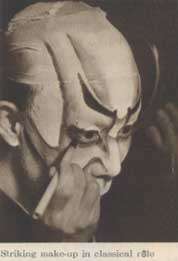
Let us take up the case of the mie already explained. The straining of the eyes and a steady gaze which make up the pose of mie may seem unnatural, but this is the Kabuki way of emphasizing the senses of excitement, sorrow and emotion.
Those who laugh at the Kabuki play as unnatural are themselves at fault, as it is an art which puts unnaturalness out of the question. What it aspires to is something higher - to transport the audience to the world of illusion by presenting a piquant slice of life or a strong expression of human sentiment through the medium of suggestion, impressionism, and symbolism.
In the appreciation of the Kabuki, therefore, one must be richly endowed with imagination; otherwise one will fail to understand the symbolic and impressionistic expression of the Kabuki. One must also be a man of great sensibility, who is capable of perceiving beauty in the apparent grotesqueness and cruelty of a kubizikken or who discovers a dramatic element in harakiri. Only with such imagination and such sensibility, can one penetrate into a feeling intricate but common to all humanity, roughly represented by a mie, a pose reinforced by the sound of wooden clappers.
Vll. THE STORY VALUE OF THE KABUKI
At the outset of this volume, the writer recommended that the Occidental, in approaching the Kabuki play, should assume an attitude similar to that of one who looks at Mt. Huzi looming in the distance. The beginner was warned not to be too critical - that is scientifically - of the contents. Having prepared the reader by what has been said in the foregoing about the essentials of Kabuki, the writer hastens to add that the Kabuki play is not without merit in its contents. This merit, however, is different from that approved of by ideas of modern literature and modern drama.
 In making clear
this point, some of the plays already introduced will be taken for illustration.
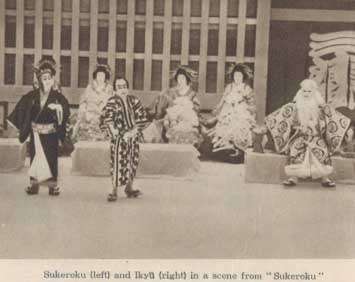
"Sukeroku," or "Sukeroku Yukari no Edozakura," to give its full title,
as already mentioned, is one of the selected eighteen of the Kabuki plays. It is full of
charms peculiar to the Kabuki in form and structure, especially as regards the spectacular
acting of Sukeroku on the hanamiti ("flower way"). In this play, through the
smoke screen of humour and gaiety, flashes a strong popular revolt against oppressive
power which was going on in feudal Japan some two hundred years ago. The hero, Sukeroku,
is in reality the champion of the people's right, and his antagonist, Ikyuu, stands for
the government. Ikyuu, the Samurai, is ridiculed to death by Sukeroku, the commoner, in
Yosiwara, the famous pleasure resort where people of various ranks stood on the same
footing of equality. No doubt it is due to this moral indignation, which proceeds from the
desire for justice, that the play has appealed to the populace and has won for itself the
honour of being the most successful of the Edo plays of Kabuki origin.
In making clear
this point, some of the plays already introduced will be taken for illustration.
"Sukeroku," or "Sukeroku Yukari no Edozakura," to give its full title,
as already mentioned, is one of the selected eighteen of the Kabuki plays. It is full of
charms peculiar to the Kabuki in form and structure, especially as regards the spectacular
acting of Sukeroku on the hanamiti ("flower way"). In this play, through the
smoke screen of humour and gaiety, flashes a strong popular revolt against oppressive
power which was going on in feudal Japan some two hundred years ago. The hero, Sukeroku,
is in reality the champion of the people's right, and his antagonist, Ikyuu, stands for
the government. Ikyuu, the Samurai, is ridiculed to death by Sukeroku, the commoner, in
Yosiwara, the famous pleasure resort where people of various ranks stood on the same
footing of equality. No doubt it is due to this moral indignation, which proceeds from the
desire for justice, that the play has appealed to the populace and has won for itself the
honour of being the most successful of the Edo plays of Kabuki origin.
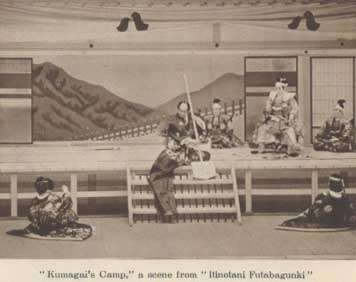 "Kumagai's
Camp," which is the third scene of "Itinotani Hutaba Gunki," is one of the
most distinguished scenes of all the Kabuki dramas. The story of Kumagai is based on a
historic fact - it forms a chapter of the classical war romance, "Genpei
Seisuiki," tracing the fortunes of the two rival clans, Minamoto and Taira. It is
about a warrior, Kumagai Zirou Naozane, who, by way of repaying his indebtedness, saves
the life of a young captain of the enemy, Atumori, in the battle of Suma-no-ura by the
sacrifice of his own son, Kozirou Kumagai. "Kumagai's Camp" begins after the
battle-field episode, and, stripped of the brilliant ornamentation given to most Kabuki
plays, it still has in its plot elements of human interest and universal appeal.
"Kumagai's
Camp," which is the third scene of "Itinotani Hutaba Gunki," is one of the
most distinguished scenes of all the Kabuki dramas. The story of Kumagai is based on a
historic fact - it forms a chapter of the classical war romance, "Genpei
Seisuiki," tracing the fortunes of the two rival clans, Minamoto and Taira. It is
about a warrior, Kumagai Zirou Naozane, who, by way of repaying his indebtedness, saves
the life of a young captain of the enemy, Atumori, in the battle of Suma-no-ura by the
sacrifice of his own son, Kozirou Kumagai. "Kumagai's Camp" begins after the
battle-field episode, and, stripped of the brilliant ornamentation given to most Kabuki
plays, it still has in its plot elements of human interest and universal appeal.
The author describes the mental state of Kumagai at the beginning of his play in these words: "Now that he put to the sword Atumori, in the flower of his youth, he, though a daring soldier, has come to realize the vanity of the world, presumably from seeing the vicissitudes of life." Kumagai was certainly a general of unparalleled prowess; his sole interest in life was war and battle, leaving little or no room in his heart for the play of tender emotions. It so happened that he was compelled to face in a single combat this young Atumori from the enemy, to whom he owed gratitude. His eyes were opened to the frailty ofman. His conscience would not permit him mercilessly to kill his antagonist. He cut the Gordian knot by a pathetic resolution - to victimize his own boy. So Atumori was allowed to go his own way unharmed. He now stood in a critical situation. He had saved the life of Atumori by the sacrifice of his son. The difficulty was that this might be interpreted as an act of betrayal by his friends, and the showing of goodwill to the foe, so he decided to renounce the world and to abandon his military career. He sought refuge in religion, and passed the rest of his life in wandering about as a priest in the service of Buddha. The play depicts the metamorphosis a man undergoes when he experiences a great shock. Though it is not entirely free from grotesque features in its acting, it is of perennial merit because of its literary value.
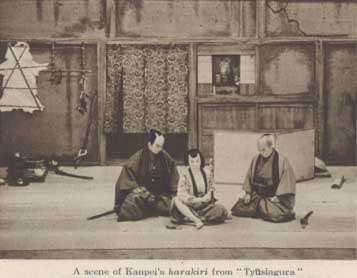 Let us now take
up "Tyuusingura," to which reference was made more than once in the preceding
pages. The scene of Kanpei's harakiri in Act VI is noteworthy for the story it tells.
Kanpei was grieved to learn of the sad end of his master, but he was participating in
amorous relations with a girl named Okaru, with whom he decides to elope into the country.
The news of his friends, planning to revenge the death of their master, comes to Kanpei's
ears, and he decides to join them in their enterprise. But by the irony of fate he is led
into believing that he has killed the father of his sweetheart, Okaru. Despairing
co-operation in the revenge of his master's death and overburdened by the crime of
murdering his sweetheart's father, he puts an end to his hapless life by committing
harakiri. At the moment of his death he regrets his past life which was marked by grave
mistakes - that of falling in love with Okaru, which prevented him from joining the loyal
league, and that of falling a victim to the illusion which made him believe for a time
that he had killed Okaru's father. Thus he ends his life - that of a mere youth not yet
thirty. The tragic element in the story has a compelling interest even for the people of
the present day.
Let us now take
up "Tyuusingura," to which reference was made more than once in the preceding
pages. The scene of Kanpei's harakiri in Act VI is noteworthy for the story it tells.
Kanpei was grieved to learn of the sad end of his master, but he was participating in
amorous relations with a girl named Okaru, with whom he decides to elope into the country.
The news of his friends, planning to revenge the death of their master, comes to Kanpei's
ears, and he decides to join them in their enterprise. But by the irony of fate he is led
into believing that he has killed the father of his sweetheart, Okaru. Despairing
co-operation in the revenge of his master's death and overburdened by the crime of
murdering his sweetheart's father, he puts an end to his hapless life by committing
harakiri. At the moment of his death he regrets his past life which was marked by grave
mistakes - that of falling in love with Okaru, which prevented him from joining the loyal
league, and that of falling a victim to the illusion which made him believe for a time
that he had killed Okaru's father. Thus he ends his life - that of a mere youth not yet
thirty. The tragic element in the story has a compelling interest even for the people of
the present day.
Examples might be multiplied, but space forbids. The illustrations given will be sufficient to show that at least some of the stories told by Kabuki plays, though Kabuki does not place the greatest importance on the story, are of enduring worth for their own sakes.
PRACTICAL GUIDE TO THE PRESENT-DAY KABUKI
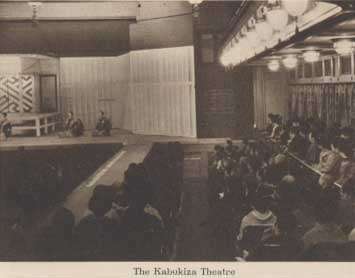
In the Kabukiza Theatre in Kobikityou, Tokyo, which is the finest playhouse in Japan, Kabuki plays are to be seen at their best. It is not devoted exclusively to the Kabuki, the performances being varied with dances and modern plays. The Kabukiza is a sort of theatrical museum, where the old as well as the new in theatrical performances are on view. The theatre has seating accommodation for about 2,200. It is through special arrangement with the Kabuki stars so that prolonged performances, lasting from 3 to 11 p.m., are given three times a year - in January, April and November.
Admission, about 7.00 yen for a first-class ticket.
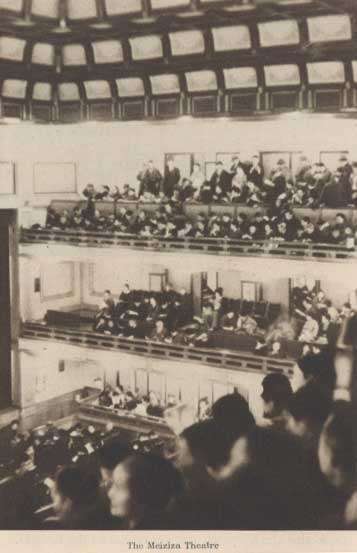
Next in order of merit comes the Meiziza in Hamatyo, Nihonbasi-ku, Tokyo. Its seating capacity is about 1,700. The size, though small compared with that of the Kabuki, is considered more advantageous for the staging of a Kabuki play which is of a high quality and difficult to appreciate. Here also the performances are of various kinds. Kabuki plays, which are given in the theatre three or four times a year, are usually those with a small number of actors. When a good piece of Kabuki drama is chosen, the Meiziza is found to be very satisfactory for the connoisseur playgoer.
Sinzyuku has the Daiiti Gekizyou, which is still smaller, with seating accomodation for 1,400. It may be called a theatre for the training of the young members of the profession. Here Kabuki plays come up on the programme six or seven times a year with the young actors taking the parts. Last on the list is the Tokyo Gekizyou, where, however, Kabuki plays are seldom staged.
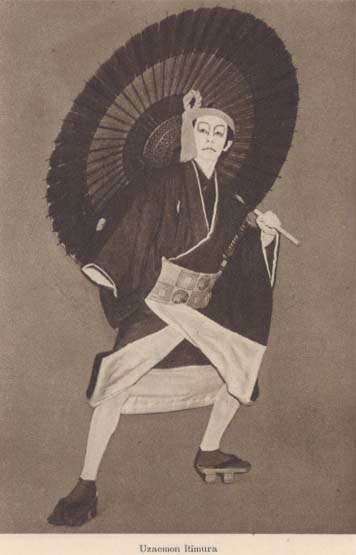
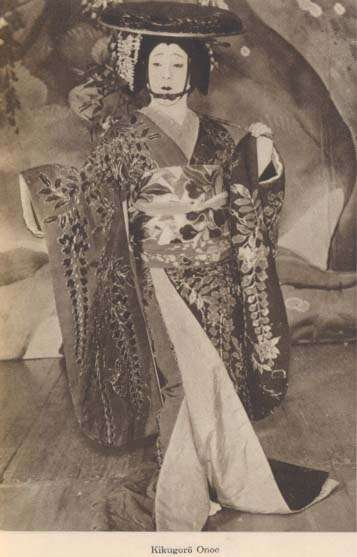
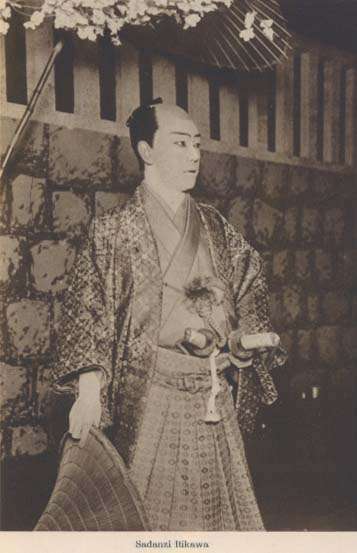
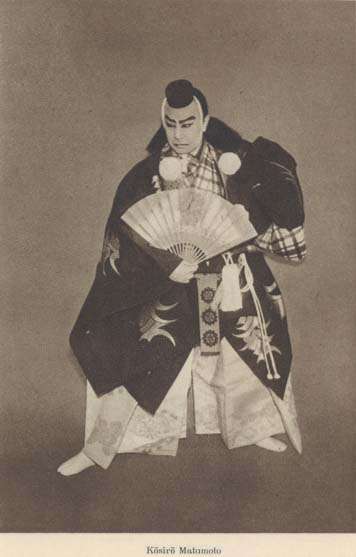
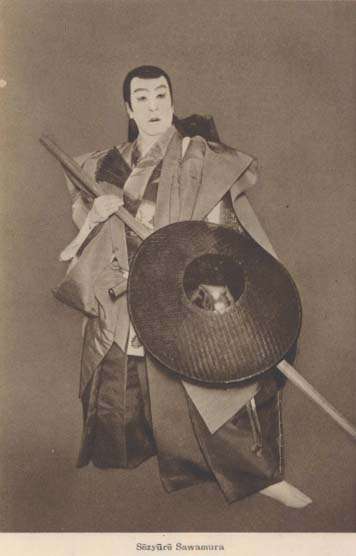
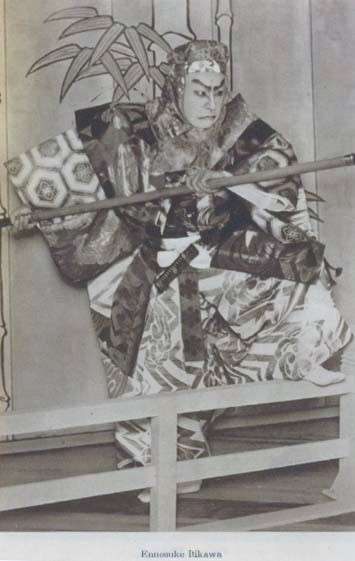
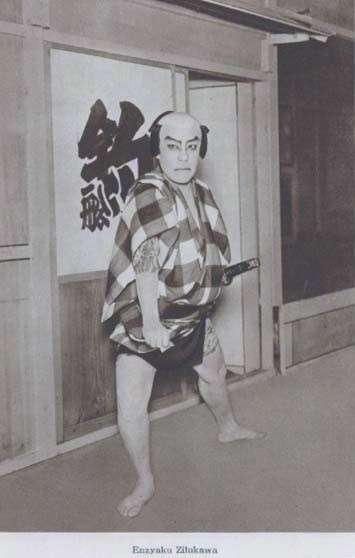
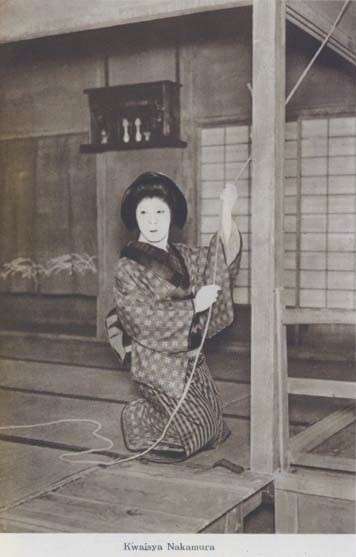
As for onnagata, or actors playing female parts, a brief account have already been given, and here, in concluding this introduction to Kabuki, some of the names of male-part actors famous in the Kabuki world are enumerated with accompanying notes: Uzaemon Itimura, who usually plays the parts of handsome men; Kikugorou Onoe, who has a great talent for portraying characters in Kizewamono plays and for dancing; Kitiemon Nakamura, who is expert in rendering parts in historical plays of puppet-show origin; Sadanzi Itikawa, whose speciality is Aragoto; Kosirou Matumoto, whose forte is the same as Sadanzi's; Souzyuurou Sawamura, whose favourite parts are those of handsome persons; and last but not least, Utaemon Nakamura, who is the doyen of the Kabuki players. Among the younger Kabuki actors are Ennosuke Itikawa and Sumizo Itikawa, who stand high in public estimation. Conspicuous among Kabuki actors in Osaka are Enzyaku Zitukawa, Baigyoku Nakamura, Kaisya Nakamura, and Zyusaburou Bandou.
The following illustrations are portrayals of famous actors playing male or female parts.