

Fine Japanese Calligraphy

The Art of Master Japanese Calligrapher Eri Takase

斬捨て御免 kirisute gomen Kirisute Gomen

斬捨て御免 (kirisute gomen): a samurai's privilege under the shogunate to cut down a townsman or farmer for insolence and go unpunished.
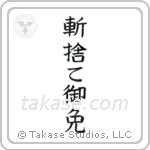
Kirisute Gomen (斬捨て御免) in Block style Japanese calligraphy by Eri Takase
Kirisute Gomen 斬捨て御免 kirisute gomen Vertical Block VB4C
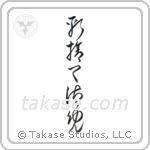
Kirisute Gomen (斬捨て御免) in Cursive style Japanese calligraphy by Eri Takase
Kirisute Gomen 斬捨て御免 kirisute gomen Vertical Cursive VC4B
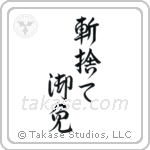
Kirisute Gomen (斬捨て御免) in Design style Japanese calligraphy by Eri Takase
Kirisute Gomen 斬捨て御免 kirisute gomen Vertical Design VD4B
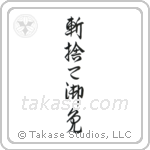
Kirisute Gomen (斬捨て御免) in Design style Japanese calligraphy by Eri Takase
Kirisute Gomen 斬捨て御免 kirisute gomen Vertical Design VD5B
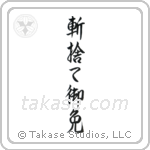
Kirisute Gomen (斬捨て御免) in Semi-Cursive style Japanese calligraphy by Eri Takase
Kirisute Gomen 斬捨て御免 kirisute gomen Vertical Semi-Cursive VS4C
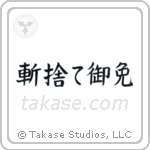
Kirisute Gomen (斬捨て御免) in Block style Japanese calligraphy by Eri Takase
Kirisute Gomen 斬捨て御免 kirisute gomen Horizontal Block HB3A
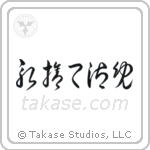
Kirisute Gomen (斬捨て御免) in Cursive style Japanese calligraphy by Eri Takase
Kirisute Gomen 斬捨て御免 kirisute gomen Horizontal Cursive HC3A
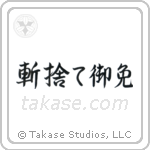
Kirisute Gomen (斬捨て御免) in Semi-Cursive style Japanese calligraphy by Eri Takase
Kirisute Gomen 斬捨て御免 kirisute gomen Horizontal Semi-Cursive HS3A
More about 斬捨て御免

Word for word, 斬捨て is to cut a person down and leave him, and 御免, in the デジタル大辞泉's first sense, is a formal license, said in honor of the one who grants it. The privilege had limits: a samurai who killed wantonly, or could not show proof of the insolence, was punished. Hurst, writing in 1998, says historians have identified no more than a handful of cases. The oldest print of the name found in the books searched for our history is Fukuzawa Yukichi's, in 1873, when the rule had already ended: under laws such as kirisute gomen, he wrote, a commoner's life was no different from a thing on loan. A book of 1876 said officials thought cutting one of the people down was like cutting tofu or a daikon, and one of 1881 that a commoner's life had been light as a hair. The oldest English book found that carries the word is of 1916, and later glosses include permission to cut down and leave (Norman, 1940) and exemption to cut down and discard (Hurst, 1998). Which side of the word you take, the samurai's or his critics', is yours.

An Edo-period rule carried in the shogunate's criminal code, dated to 1742; the name 切捨御免 is first found, in the printed books searched for this study, in Fukuzawa Yukichi's pamphlet of 1873.

We want you to be as happy with the meaning as you are with Master Takase's art. To learn more, visit Philology of 斬捨て御免.

About the Designs

Each design is Master Japanese Calligrapher Eri Takase's hand-brushed calligraphy of the word or phrase on this page, delivered as a PDF you can print. Every PDF includes the line art, so a tattoo artist or a craftsperson can work from the outline as well as the brushed image.

Licensing

Your purchase includes a personal-use license: use the design as a tattoo reference, frame it, engrave it, print it for yourself, or make it into a gift. For more information see Licensing, which also covers commercial-use options that may be purchased separately.

Delivery

Your PDF is available for download the moment your order completes, and a copy is attached to your emailed receipt.

If you need your design again later, ask us for it and we will send it.